

Key Takeaways
Option A
Open Shelving
The airy, display-forward choice for curated living spaces.
Best for: Homeowners who enjoy styling décor, keep collections organized, and want a room to feel more spacious and personalized.
Option B
Closed Cabinetry
The practical, clutter-concealing solution for tidy, polished rooms.
Best for: Households that accumulate mixed belongings, prefer low-maintenance tidiness, and want a streamlined, cohesive look.
If you love displaying books, plants, and curated objects
Open Shelving
Open shelves turn everyday items into intentional décor, making your personality part of the room's design without additional art investment.
If your household accumulates mixed, mismatched items
Closed Cabinetry
Doors conceal variety instantly, so the room always looks composed without requiring regular restyling.
If you're decorating a small or low-light living room
Open Shelving
Open shelves reduce visual weight, helping compact spaces feel less boxed-in — especially when paired with lighter shelf materials.
If dust, allergens, or pet hair are concerns in your home
Closed Cabinetry
Enclosed storage protects items from dust accumulation and simplifies cleaning considerably over time.
If you want maximum design flexibility over time
Open Shelving
Open shelves can be restyled seasonally without any structural change, making it easy to refresh a room's look as your taste evolves.
The Core Trade-Off: Visibility vs. Concealment
Every storage decision in a living space ultimately comes down to one question: do you want what you own to be seen or hidden? Open shelving puts your belongings on display — books, baskets, plants, and objects become part of the room's visual story. Closed cabinetry takes the opposite stance, drawing a visual boundary between the room you inhabit and the stuff required to live in it.
Neither approach is inherently superior. The right choice depends on what you store, how disciplined you are about tidying, and what atmosphere you want the room to project. If you're already thinking about how furniture placement affects perceived space, it's worth reading how room layout influences spatial perception — storage style is part of that same equation.
| Criterion | Open Shelving | Closed Cabinetry |
|---|---|---|
| Visual effect | Airy, layered, spacious | Streamlined, solid, composed |
| Maintenance effort | High — regular dusting and restyling | Low — doors conceal irregularity |
| Best storage type | Curated books, plants, décor objects | Mixed, utilitarian, irregular items |
| Room size impact | Reduces visual weight in small rooms | Can feel heavy in narrow spaces |
| Style flexibility | Easily restyled without renovation | Style locked in by door profile and finish |
| Dust and allergen exposure | Items exposed, dust accumulates | Items protected behind closed doors |
| Design expression | Contents become part of the décor | Hardware and finish carry design weight |
Open Shelving: Strengths and Honest Limitations
Open shelving excels at making a room feel layered and lived-in without feeling heavy. Floating shelves in particular reduce visual mass compared to floor-to-ceiling cabinetry, which can be especially valuable in rooms with lower ceilings or limited natural light. If your living space is on the compact side, the small-space decorating strategies that apply to furniture often extend directly to storage choices.
The limitation is equally honest: open shelves require ongoing curation. Dust settles on every visible surface, meaning more frequent cleaning. Items that lack visual coherence — mismatched containers, utilitarian clutter, stacked paperwork — will read as disorganized rather than styled. For households where belongings naturally resist neat categorization, open shelving can quickly become a source of visual stress rather than pride.
68%
Homeowners citing clutter as a stress source
A Houzz survey found that a majority of homeowners undertaking renovation projects cited better organization and reduced clutter as primary motivators.
2–3×
More frequent cleaning needed for open shelves
Interior designers generally estimate that open shelving requires cleaning and restyling two to three times more often than equivalent closed storage.
Closed Cabinetry: Where It Truly Earns Its Place
Closed cabinetry offers something open shelving simply cannot: reliable, effortless tidiness. Close the doors, and the room is composed — regardless of what's behind them. This makes closed storage the practical choice for media equipment, board games, office supplies, children's toys, and any category of item that tends to accumulate in mixed, irregular forms.
From a design standpoint, closed cabinetry can define a room's style through its door profile, hardware, and finish. Shaker-style doors read as classic; flat-front panels feel contemporary; glass-insert doors offer a middle ground, partially displaying contents while maintaining some boundary. The trade-off is weight: tall, wide closed units can make a wall feel solid and imposing, especially in narrower rooms. Thoughtful placement — leaving breathing room between units, alternating with open wall space — helps counteract this. This conversation about visual density connects naturally to broader decorating philosophies; see minimalism vs. maximalism in interior design for context on how storage philosophy fits into a wider design worldview.
Glass-Front Doors: A Useful Middle Ground
If you want the tidiness of closed cabinetry without the full visual weight of solid doors, glass-insert panels offer a practical compromise. They partially reveal contents, which creates incentive to keep items organized while still protecting them from dust. Clear glass suits contemporary and transitional styles; reeded or fluted glass obscures detail while still softening the visual mass of a closed unit.
Mixing Both: A Practical Strategy for Most Homes
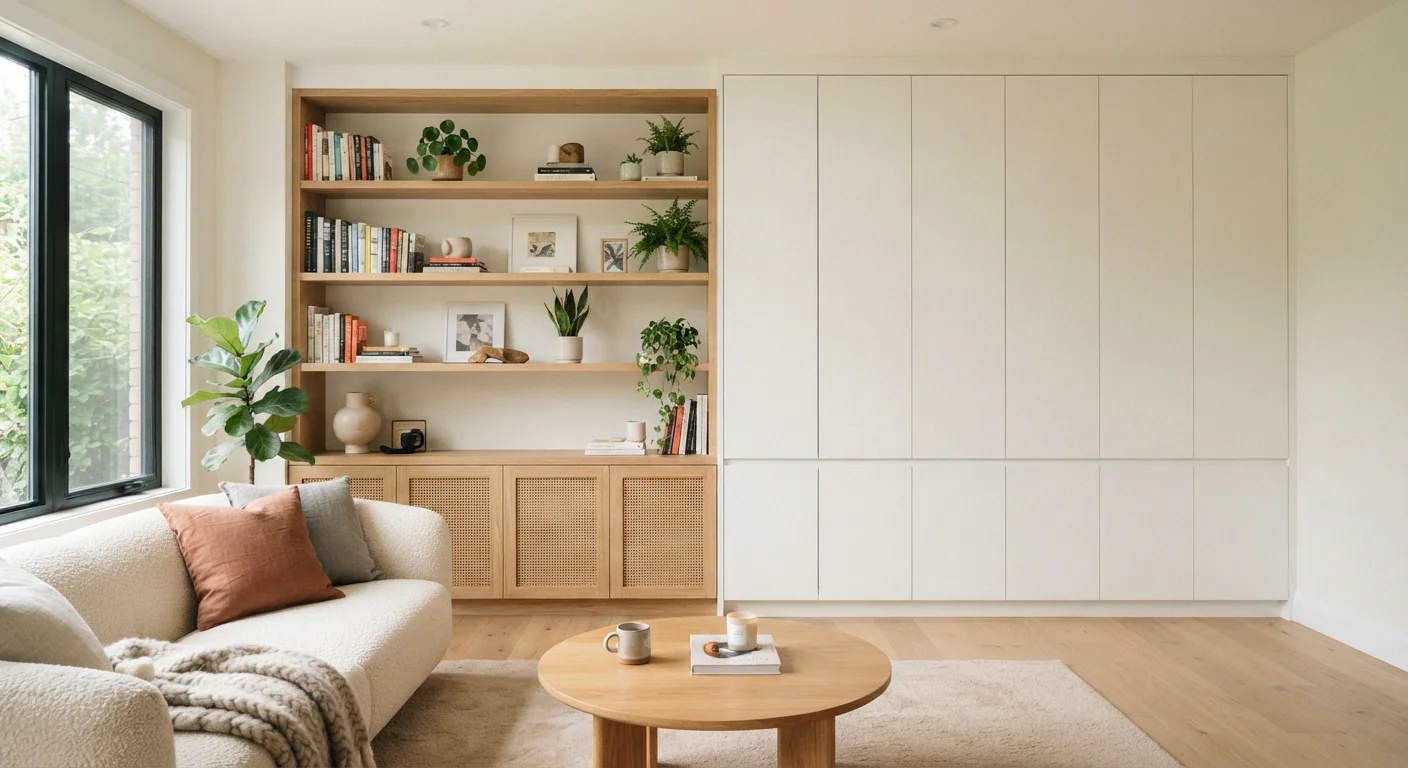
In practice, the majority of well-designed living spaces use both approaches in deliberate proportion. A common formula: closed cabinetry handles the lower two-thirds of a wall unit (where utilitarian storage lives), while open shelves occupy the upper third for display. This keeps the most visually cluttered items hidden at eye level and below, while allowing curated objects — framed artwork, plants, interesting spines — to read clearly above.
Another effective hybrid is alternating closed and open bays within the same built-in system. This creates rhythm and visual interest while giving you storage flexibility. If you're using open sections for art or sculptural objects, principles of art curation and scale apply directly to shelf styling as well.
Before committing to a built-in solution of either type, consider whether your room's walls can support structural changes — particularly if you're thinking about structural modifications like wall removal that could affect where storage can be placed.