

Key Takeaways
Option A
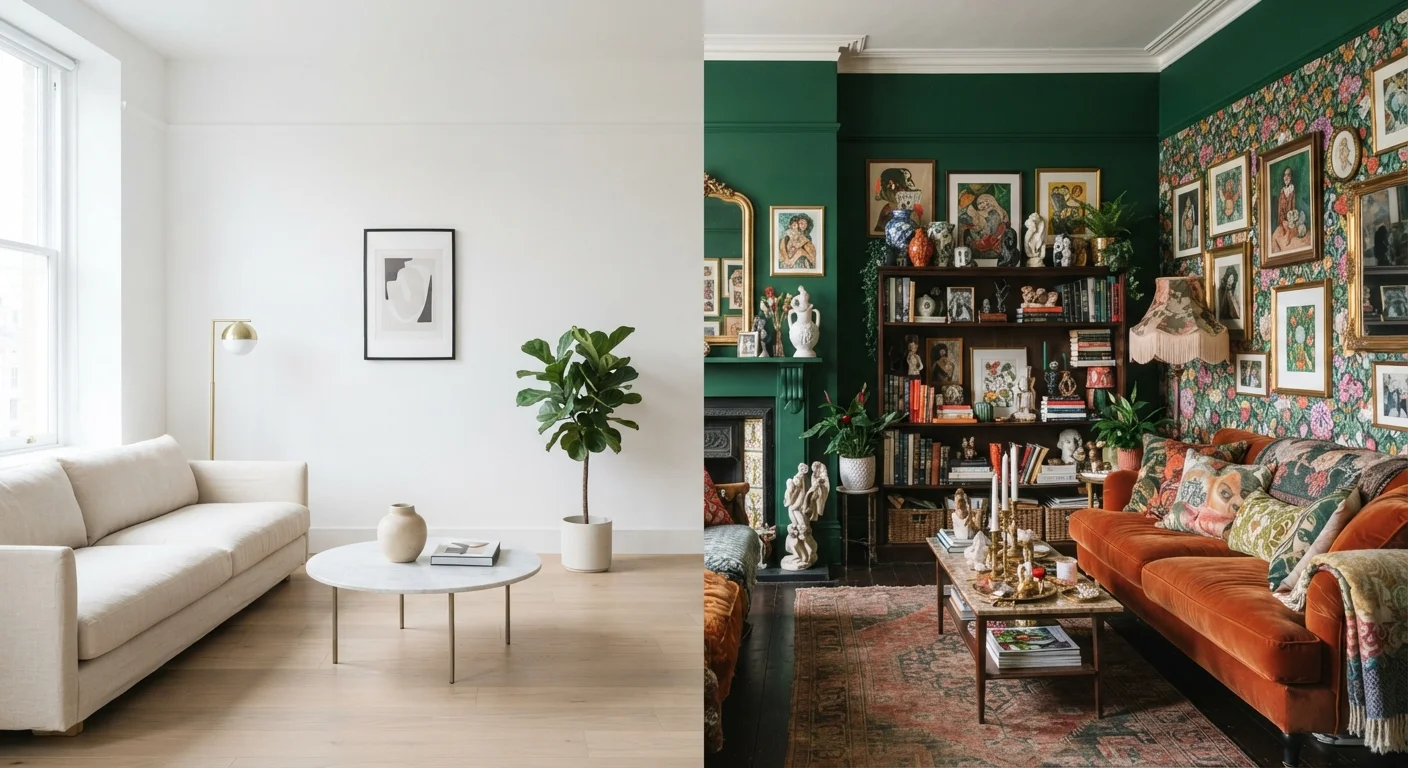
Minimalism
The art of intentional restraint and purposeful simplicity.
Best for: People who find calm in open space and prefer every object to earn its place.
Option B
Maximalism
The celebration of abundance, personality, and layered visual richness.
Best for: People who feel most at home surrounded by collected objects, bold color, and expressive pattern.
If you crave calm and find clutter genuinely stressful
Minimalism
Fewer objects and open surfaces reduce visual noise, making it easier to decompress in your home environment.
If your collections, art, and keepsakes feel like part of your identity
Maximalism
Maximalism gives meaningful objects a home and lets personal history become part of your decor rather than something to hide.
If you live with children or pets in a high-traffic home
Minimalism
Fewer surfaces and objects generally means easier cleaning and less risk of breakage in busy households.
If you enjoy frequently refreshing and rearranging your decor
Maximalism
A layered space offers more flexibility for rearranging groupings, swapping accent pieces, and introducing seasonal elements.
If you're decorating a small apartment and want it to feel larger
Minimalism
Restraint in furnishings and a neutral palette can make a compact space feel more open and breathable.
What Each Philosophy Actually Stands For
Interior minimalism traces its roots to modernist architecture and Japanese design traditions, both of which treat empty space as a design element in its own right. The guiding principle is that removing the unnecessary reveals what is truly essential. In practice, this means neutral palettes, clean-lined furniture, concealed storage, and a deliberate limit on decorative objects. Every item present is meant to serve either a functional or a clearly intentional aesthetic purpose.
Maximalism is not simply the absence of editing — it is a philosophy of abundance governed by personal meaning and visual boldness. Layered textiles, gallery walls, collected objects, mixed patterns, and saturated color are hallmarks of the style. The goal is a space that feels richly inhabited rather than staged. As art placement and curation play a central role in maximalist rooms, understanding how groupings interact with surrounding elements matters as much here as in any other style.
A useful frame: minimalism asks what can I remove? Maximalism asks what can I add that belongs? Neither question is trivial to answer well.
| Criterion | Minimalism | Maximalism |
|---|---|---|
| Core value | Restraint and intentionality | Abundance and self-expression |
| Color palette | Neutral, monochromatic, muted | Bold, layered, mixed |
| Furniture approach | Few pieces, clean lines | Mixed styles, varied scale |
| Decorative objects | Minimal; each one deliberate | Many; curated for cohesion |
| Storage style | Concealed; clear surfaces | Often open; displays collections |
| Maintenance demand | Ongoing editing and tidying | Ongoing curation and dusting |
| Pattern use | Rare or absent | Frequent, often layered |
| Mood created | Calm, open, uncluttered | Warm, rich, personal |
The Real Demands of Each Approach
Minimalism has a reputation for being low-effort, but maintaining it requires consistent discipline. Open surfaces gather dust and clutter quickly, so the style only works when residents have reliable systems for storing and returning items. It also asks a genuine psychological willingness to part with things — a harder task than it sounds. Common decorating myths often frame minimalism as universally calming, but for people who find sparse rooms cold or impersonal, the style can feel alienating rather than restful.
Maximalism carries its own discipline: the difference between a richly layered room and a chaotic one is curation. Objects should share some connective thread — a recurring color, a time period, a material — that creates cohesion across apparent variety. Understanding balance and proportion in interior design is particularly critical here; maximalist rooms can easily tip into visual overwhelm without careful attention to scale and visual weight.
~72%
Homeowners prioritizing "calm" in decor
According to a Houzz survey on home design trends, the majority of homeowners cite creating a calm, relaxing atmosphere as a primary decorating goal.
3–5 years
Typical home decor refresh cycle
Interior design professionals generally observe that most homeowners meaningfully update their decor style every three to five years as tastes and life circumstances evolve.
Storage is another practical dividing line. Minimalist interiors depend on ample concealed storage to keep surfaces clear. Maximalist spaces often use open shelving to display collections — a trade-off explored in depth in our guide to open shelving vs. closed cabinetry.
Finding Your Place on the Spectrum
Most people don't live comfortably at either extreme. A useful exercise is to walk through your current home and note where your eye rests comfortably and where it feels tired. Spaces that feel calming despite having several objects suggest you may lean maximalist; a single piece of clutter that bothers you disproportionately suggests minimalist leanings.
Lifestyle habits matter just as much as aesthetic preference. A household that entertains frequently and values personality-driven spaces will find maximalism easier to sustain. A household that prizes quiet and easy maintenance may find minimalism genuinely livable rather than aspirational. If you're starting from a blank room and trying to decide where to begin, our guide to decorating a room from scratch walks through the foundational decisions that apply regardless of which direction you lean.
The 'Decluttered Maximalism' Middle Ground
Some designers use the term 'curated maximalism' or 'warm minimalism' to describe spaces that blend both sensibilities — generous in personality but disciplined in what stays. This hybrid approach works well for people who love collected objects but also value visual breathing room. The key is choosing a single organizing principle — color, material, or era — to unify the mix.
There is no design authority that requires commitment to either extreme. Many well-designed homes use minimalist architecture as a backdrop for maximalist collections, or anchor maximalist color choices in restrained, functional furniture. Understanding what each philosophy values — and what it demands — is the starting point for making deliberate choices that reflect how you actually live.