

Key Takeaways
Balance & Proportion in Design
Balance refers to the visual weight distributed across a room — how furniture, colour, and objects are arranged so the space feels stable and harmonious. Proportion describes the size relationship between objects and the room itself, ensuring nothing feels too large, too small, or out of place. Together, these two principles form the foundation of rooms that feel instinctively comfortable and cohesive.
In design theory, proportion is often informed by classical ratios — such as the golden ratio (approximately 1:1.618) — though in everyday decorating, trained intuition and visual testing are equally valid approaches.
Why These Principles Matter More Than Style
Interior design trends come and go, but balance and proportion are principles that hold across every era and aesthetic. A mid-century modern room and a traditional farmhouse interior can both succeed or fail for exactly the same reason — the way visual weight is managed and how objects relate to each other in scale.
These aren't abstract concepts reserved for professional designers. They're the reason a room feels immediately right when you walk in, or subtly uncomfortable without you knowing why. If you're starting a room from scratch, understanding balance and proportion before you buy a single piece of furniture can save you from costly mistakes.
Start With the Largest Piece First
When furnishing a room, anchor your layout around the largest piece — usually the sofa or bed — before introducing anything else. This gives you an accurate sense of how much visual weight is already in the room and how much space remains for balance. Everything else should feel like it belongs in relationship to that anchor.
The Three Types of Balance
Balance in a room falls into three main categories, each producing a different atmosphere:
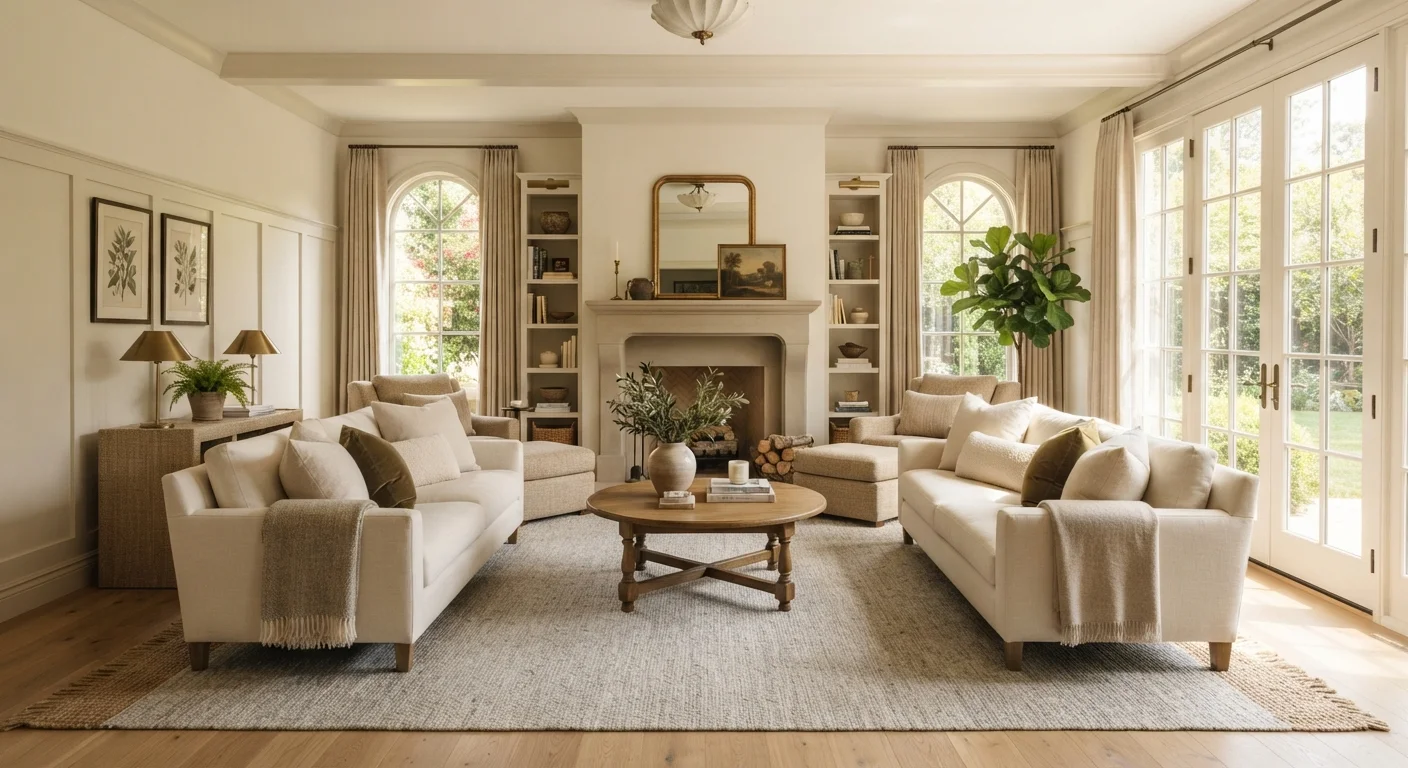
- Symmetrical balance mirrors elements on either side of a central axis — matching nightstands flanking a bed, for example. It reads as formal and restful, but can feel static if overused.
- Asymmetrical balance uses objects of different sizes, colours, or types that carry equal visual weight overall. A tall floor lamp on one side of a sofa balanced by a low side table with stacked books on the other. This approach feels more dynamic and contemporary.
- Radial balance arranges elements around a central point — dining chairs circling a round table, or a pendant light anchoring a seating cluster. It creates a natural focal point and a sense of flow.
Most rooms use a combination of all three. The goal isn't to pick one formula and apply it rigidly, but to understand which approach suits each zone in your home. For a deeper look at how these terms are used by designers, the Decorator's Glossary is a useful reference.
1:1.618
The golden ratio used in classical proportion
This ratio, observed in classical architecture and art, describes proportional relationships that tend to read as naturally pleasing to the human eye.
2/3 Rule
Rug size relative to seating area
Design professionals commonly recommend that a living room rug occupy approximately two-thirds of the seating area to maintain visual proportion and avoid floating furniture.
Understanding Proportion and Scale
Proportion refers to the size relationship between individual objects, while scale describes how those objects relate to the room as a whole. A large sectional sofa may be well-proportioned internally — cushions, arms, and depth in harmony — but wrong in scale if it overwhelms a compact living room.
A common proportion principle in decorating is the rule of thirds: when arranging a shelf or grouping objects, compositions tend to feel more natural when divided into thirds rather than halves. Similarly, varying object heights in a grouping — tall, medium, short — creates visual rhythm without chaos.
Art placement is one of the clearest tests of proportion. Hanging a small frame above a large sofa creates an imbalance that most people notice immediately. Our guide to decorating with art covers how to select and place artwork so it reads correctly within a room's overall scale.
Proportion Differs From Room to Room
What reads as well-proportioned in a large open-plan space may feel oversized in a compact bedroom. Always consider the specific room's ceiling height, floor area, and natural light when evaluating whether a piece is the right scale. Rules of thumb are helpful starting points, but your room's actual dimensions are the final measure.
Practical Ways to Apply These Principles at Home
You don't need to redecorate an entire room to improve its balance and proportion. Small adjustments often produce noticeable results:
- Audit visual weight by zone. Stand at the room's entrance and assess whether one side or corner feels heavier. Redistribute objects, or introduce a plant, mirror, or artwork to the lighter side.
- Use rugs to anchor and define scale. An undersized rug is one of the most common proportion mistakes. As a general guide, in a seating area, at least the front legs of all major furniture pieces should sit on the rug.
- Vary heights deliberately. Rooms where every piece of furniture sits at the same height feel monotonous. Introduce floor lamps, tall plants, and low coffee tables to create a more engaging visual landscape.
- Test before committing. Use painter's tape on the floor to map furniture footprints before moving heavy pieces. This simple step reveals proportion issues early.
These approaches align well with broader home improvement thinking — home improvement principles consistently emphasise planning before execution. It's also worth examining common decorating myths that often lead people to prioritise matching over genuinely balanced design.