

Key Takeaways
Our Verdict
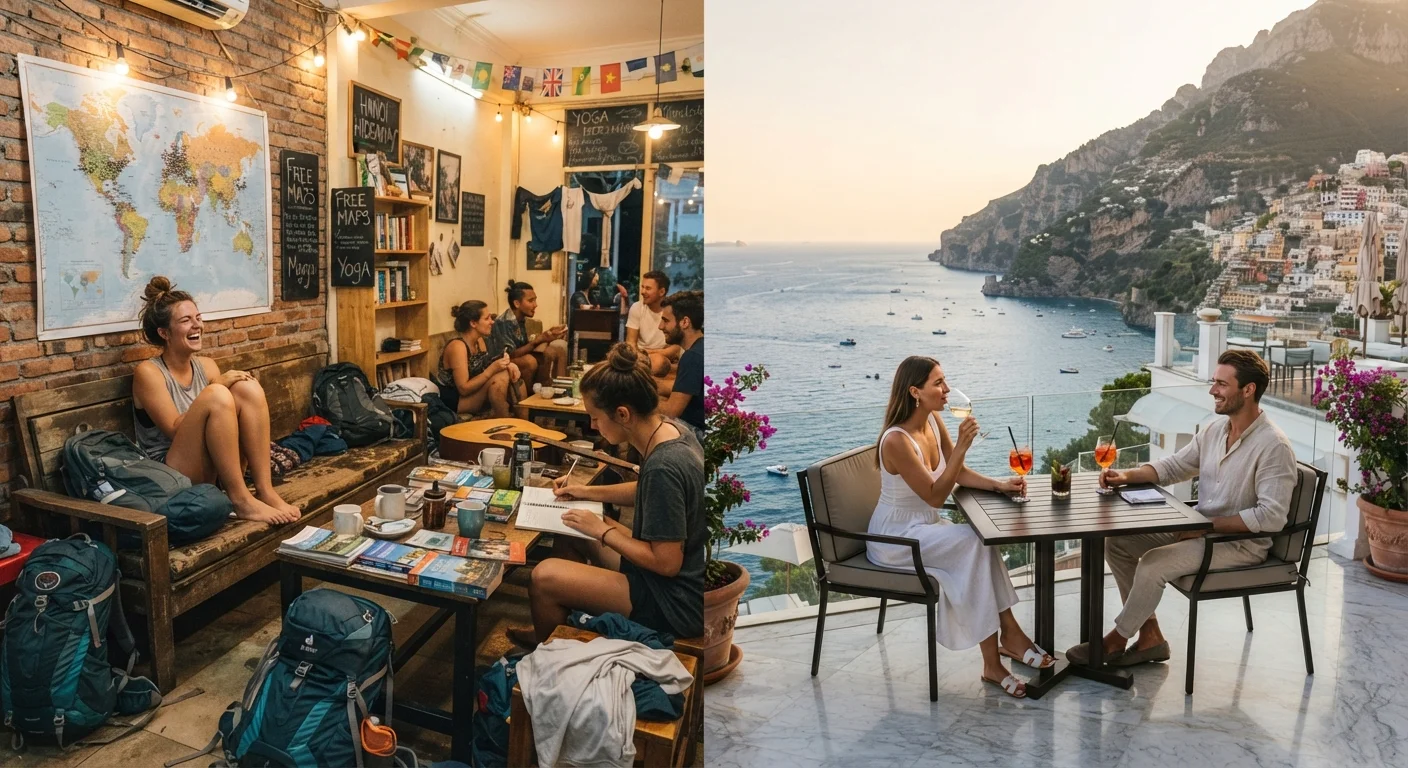
Budget travel and splurge travel are not opposites on a quality scale — they're different tools for different traveler goals. Budget-focused trips reward flexibility and resourcefulness; premium travel purchases time, ease, and reliability. For most travelers, the most rewarding approach lies in identifying which specific moments genuinely benefit from extra spending and protecting the rest of the budget for more experiences.
| Best for | Recommended |
|---|---|
| Travelers prioritizing trip length and number of destinations | Budget travel |
| Travelers with limited vacation days who value seamless logistics | Splurge travel |
| First-time international travelers who want structure and reduced friction | Splurge travel |
| Experienced travelers who are comfortable with uncertainty and improvisation | Budget travel |
What Each Approach Actually Buys You
Budget travel and splurge travel are often framed as a money question, but they're really a values question. What are you willing to trade — comfort for duration, convenience for spontaneity, or reliability for adventure?
At its core, budget travel converts saved money into more: more destinations, more nights away, more meals at local spots rather than tourist-facing restaurants. The trade-off is friction. Cheaper flights often mean inconvenient layovers — something worth examining closely, as transit time is one of the most commonly misjudged costs in any trip. Budget accommodations may require shared bathrooms or earplugs.
Splurge travel, meanwhile, purchases reliability and ease. A direct flight, a hotel room that's guaranteed clean and quiet, a pre-booked airport transfer — these reduce decision fatigue and the likelihood of something going sideways. That matters enormously if your vacation window is narrow. See our guide on planning depth by trip duration for how these priorities shift depending on how long you're actually away.
| Budget Travel | Splurge Travel | |
|---|---|---|
| Trip length potential | Longer — savings stretch further | Shorter — higher daily spend |
| Planning effort required | High — more research and flexibility needed | Lower — reliability often pre-purchased |
| Sleep and comfort consistency | Variable — quality ranges widely | Predictable — standards more reliable |
| Local immersion | Often deeper by necessity | Can feel more insulated from local life |
| Flexibility to change plans | High — fewer locked-in bookings | Lower — non-refundable commitments common |
| Ideal for short vacation windows | Less ideal — friction costs time | Well-suited — logistics run smoothly |
Where Spending More Genuinely Changes the Experience
Not all splurges are equal. Some premium upgrades deliver a measurable difference in how a trip feels; others are largely symbolic.
High-impact splurges
- Sleep quality: A quiet, comfortable room shapes how you experience every waking hour. Budget accommodations vary wildly here, and a bad night compounds across a multi-day trip.
- Long-haul flight comfort: On flights under three hours, seat class rarely changes much. On overnight or 10-hour routes, the difference between economy and business can determine whether you arrive functional or exhausted.
- Guided access to restricted or nuanced sites: Some destinations — archaeological sites, wildlife reserves, culturally sensitive areas — are meaningfully richer with a knowledgeable guide than self-navigated.
Lower-impact splurges
- Hotel brand prestige: A well-located mid-range property often outperforms a luxury hotel in a less convenient area.
- Premium airport lounges on short trips: The comfort benefit diminishes when you're only transiting for 45 minutes.
- Upgraded rental vehicles: Unless you're driving remote terrain, the baseline category usually suffices.
Splurge on the Moments That Compound
Think about which parts of your trip set the tone for everything that follows. A well-rested arrival night, a reliable airport transfer on day one, or a single standout guided experience often shape how the entire trip feels in memory. These are the moments worth protecting in your budget — not the minibar or the hotel branding.
Where Budget Travel Surprises on the Upside
Budget travel has a reputation problem. Travelers who've only experienced the friction often miss the genuine advantages that come with a leaner approach.
Deeper local immersion is perhaps the clearest one. Staying in neighborhoods rather than tourist hotel districts, eating where locals eat, and using public transit rather than private transfers all happen almost automatically when you're watching costs. The constraints of budget travel push you toward authenticity in ways that premium travel sometimes bypasses entirely.
Flexibility is another underrated asset. Without a stack of non-refundable bookings, budget travelers can extend a stay somewhere unexpected, pivot around bad weather, or follow a local recommendation without financial penalty. Traveling off-season amplifies this — lower prices and fewer crowds often make the overall experience richer, not just cheaper.
Budget travel also sharpens practical skills. Navigating unfamiliar transit systems, handling currency exchanges wisely (a real skill — many travelers overpay without realizing it), and improvising solutions builds confidence that carries into every subsequent trip.
54%
Travelers who mix budget and premium elements
According to MMGY Global's Portrait of American Travelers research, a majority of U.S. travelers describe their travel style as a deliberate blend of economy and splurge choices rather than one extreme.
3–5×
Cost difference: budget vs. premium accommodation
Industry hospitality data consistently shows nightly rates for comparable destinations can vary three to five times between budget and luxury tiers, with mid-range properties closing much of the comfort gap at a fraction of the price.
Building a Smarter Hybrid Strategy
The most effective travel budgets aren't uniformly cheap or uniformly premium — they're deliberate. The framework is simple: identify your personal friction points and spend there; hold back everywhere else.
If disrupted sleep derails you, prioritize accommodation. If you lose a full travel day to a long layover, the time cost of the cheap flight may outweigh the savings — check what patterns actually show about flight fare timing before assuming last-minute or ultra-early bookings always pay off. If you're traveling with others, group dynamics shift the calculus entirely, especially when aligning everyone's comfort thresholds.
Good trip planning starts with honest self-assessment: What has genuinely diminished a past trip? What went unnoticed? Spending intentionally based on those answers — rather than defaulting to either extreme — tends to produce the most satisfying results. For building the underlying financial framework that makes any travel style sustainable, budgeting basics offers a practical starting point.
There's no universal answer to budget vs. splurge. But there is a right answer for your trip, your timeline, and your priorities — and finding it is the most valuable travel skill of all.