

Key Takeaways
The Hidden Cost Buried in Every Exchange
Currency exchange is one of travel's most misunderstood expenses. On the surface, swapping dollars for euros or yen looks straightforward. In practice, every exchange point — from the airport kiosk to the hotel front desk — builds a margin into the rate they offer you. That margin is the difference between the mid-market rate (the real exchange rate you see on a financial data site) and the rate you actually receive. The gap can range from 2% to more than 10%, depending on where you exchange.
Because the cost is embedded in the rate rather than charged as a visible fee, many travelers don't realize they're paying it at all. Understanding this mechanism is the first step toward keeping more of your travel budget working for you. For a broader look at where travel money genuinely goes, see our guide to budget vs. splurge travel trade-offs.
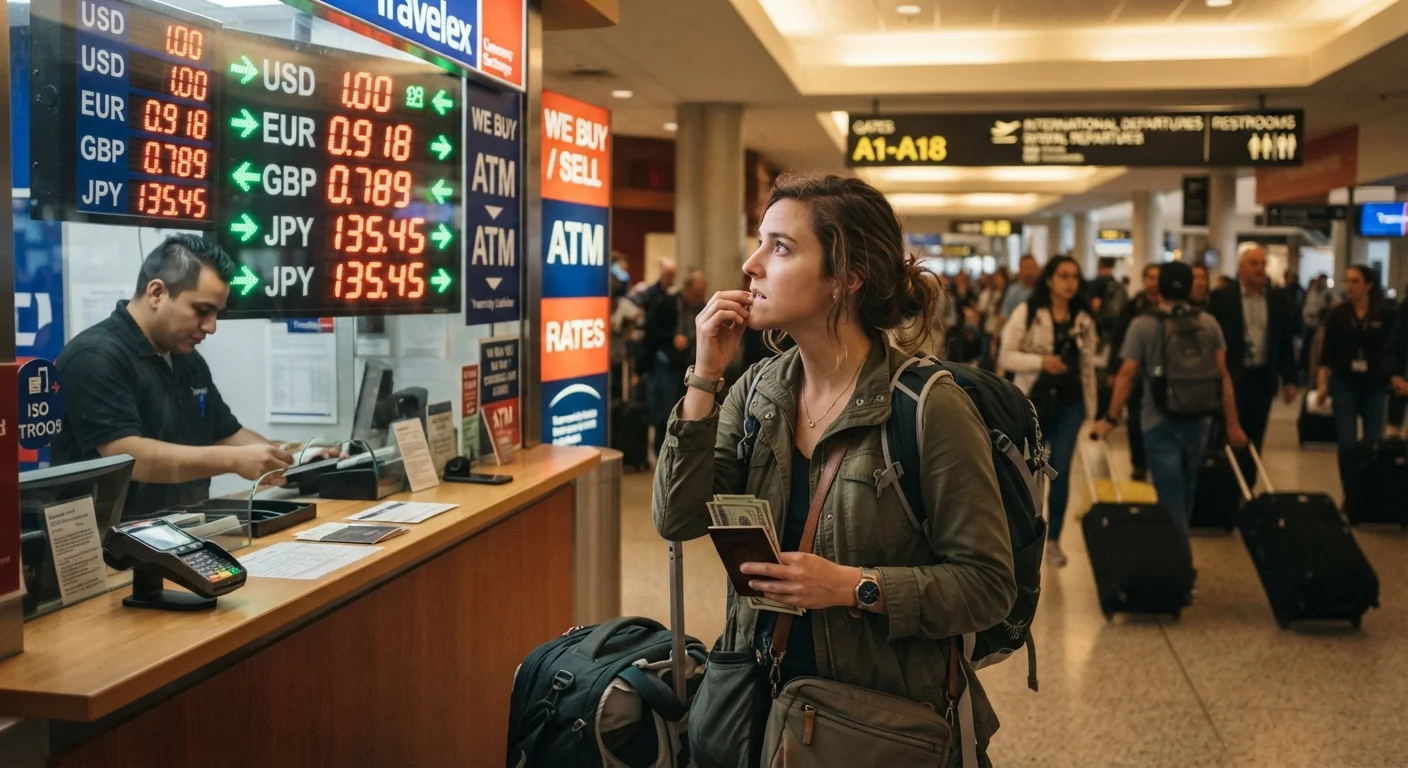
Exchanging currency at the airport kiosk on arrival.
Why it happens: Travelers are tired, in an unfamiliar place, and want local cash immediately — the kiosk is the most visible option right after customs.
Accepting Dynamic Currency Conversion (DCC) at card terminals or ATMs.
Why it happens: When a foreign merchant or ATM offers to charge you in your home currency, it sounds reassuring — you can see the dollar amount right away. Most travelers don't realize the merchant's bank sets that conversion rate, not yours, and it is almost always less favorable.
Using hotel front desks or resort exchange services.
Why it happens: It feels convenient and secure to exchange money where you're staying, so travelers assume it must be a reasonable deal.
Never checking the mid-market rate before exchanging.
Why it happens: Most people trust that the rate offered is fair because they have no reference point for comparison.
Exchanging large lump sums at unfavorable locations out of convenience.
Why it happens: Travelers often think exchanging everything at once saves time and reduces the hassle of finding multiple ATMs.
Smarter Habits That Generally Yield Better Rates
No exchange method is guaranteed to offer the best rate on any given day — rates fluctuate constantly. That said, certain approaches consistently perform better than others for most travelers.
2%–10%
Typical markup range at exchange kiosks
Currency exchange booths, especially at airports, commonly embed markups of 2% to over 10% above the mid-market rate, varying by location and operator.
1%–3%
Typical foreign transaction fee on credit cards
Many standard credit and debit cards charge a foreign transaction fee of 1%–3% per purchase abroad, though some travel-oriented cards waive this fee entirely.
Use in-network ATMs at your destination. Withdrawing local currency from an ATM abroad typically delivers a rate much closer to the mid-market rate than any exchange kiosk. Choose ATMs operated by established local banks over standalone machines in tourist zones, which may add their own surcharges. Always select the option to be charged in local currency, not your home currency — this sidesteps Dynamic Currency Conversion (DCC), a separate trap described in the mistakes section above.
Check your bank's international policies before you leave. Some checking accounts reimburse foreign ATM fees or waive them entirely. Others charge a flat fee per withdrawal plus a percentage markup. Knowing this in advance lets you plan how many withdrawals to make rather than being surprised by charges on your statement.
Order a modest amount of foreign currency before departure. Banks and some credit unions can often order foreign currency for pickup at a branch. Rates won't be perfect, but having a small amount of local cash on arrival removes the pressure to accept the first exchange point you see — usually the airport kiosk with the steepest margin. Planning ahead is a habit that pays off in other areas too; our article on underestimating transit time shows how last-minute decisions across the board tend to cost more.
Watch Out for 'No Commission' Signs
Exchange booths advertising "zero commission" or "no fees" often simply build a larger spread into the exchange rate itself. A poor rate with no commission is still a poor deal. Always compare the offered rate to the current mid-market rate rather than focusing on fee labels. Commission-free does not mean cost-free.
Traveling with a group adds another layer — pooling one larger ATM withdrawal and splitting cash among travelers can reduce per-person transaction fees. Our group vs. solo travel planning guide covers more strategies for coordinating group finances on the road.
This article is for general informational purposes only and does not constitute financial or investment advice. Currency exchange rates fluctuate and no method guarantees the best rate at all times. Verify current policies with your bank or card issuer before travelling.