

Key Takeaways
Option A
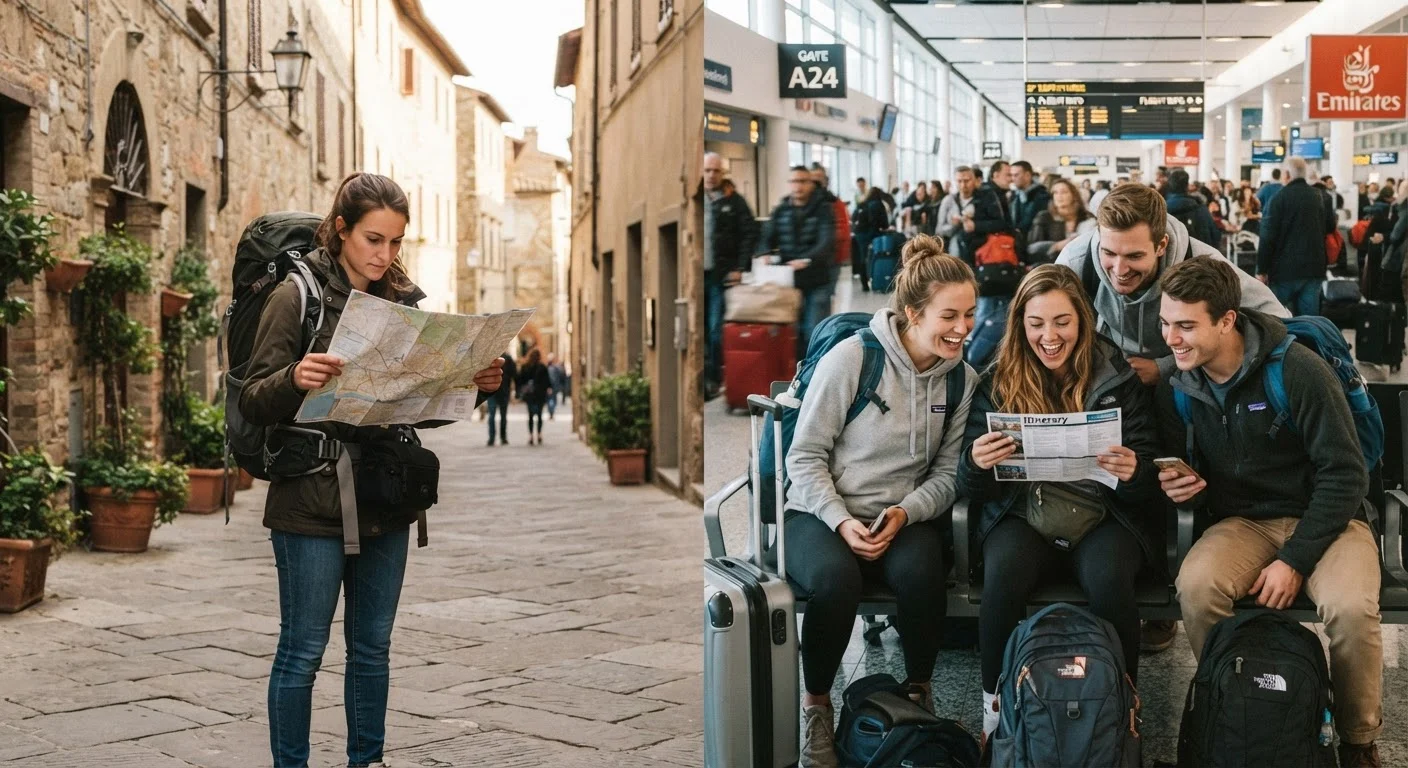
Group Travel
The shared-experience, coordination-heavy approach.
Best for: Travelers who enjoy company, want to split costs, and are comfortable building consensus around a shared itinerary.
Option B
Solo Travel
The fully autonomous, move-at-your-own-pace approach.
Best for: Travelers who prize flexibility, self-directed decisions, and the personal growth that comes from navigating the world independently.
If you want complete control over your schedule and pace
Solo Travel
Solo travel lets you pivot on a whim — sleep in, skip an attraction, or extend a stay without negotiating with anyone else.
If splitting accommodation and transport costs is a priority
Group Travel
Shared rooms, rental vehicles, and group bookings can meaningfully reduce per-person costs when managed with a clear budget system.
If you're a first-time international traveler seeking built-in support
Group Travel
Travelling with others provides a safety net of shared problem-solving when navigating unfamiliar destinations, visas, or transit systems.
If deep personal immersion and spontaneity define your ideal trip
Solo Travel
Without group dynamics to manage, solo travelers can follow local rhythms and unexpected opportunities as they arise.
If celebrating a milestone with friends or family is the goal
Group Travel
Shared experiences create lasting memories; group trips designed around a shared purpose tend to deliver strong satisfaction when logistics are handled early.
How Planning Scope Changes with Group Size
The moment a second person joins your trip, the planning scope multiplies. A solo traveler makes one set of decisions: departure dates, accommodation type, daily pace, and budget ceiling. Add three or four companions and every one of those decisions becomes a negotiation.
Group travel requires early alignment on the big questions — destination, travel dates, budget range, and must-see priorities — before any bookings are made. Without this foundation, you risk itinerary conflicts mid-trip. Setting a shared planning document or group chat with clear decision deadlines helps prevent these friction points. For a deeper look at structuring that process, see the key phases of trip planning.
Solo travelers, by contrast, carry the full planning load themselves — but that load is leaner. Every decision is immediate and reversible, and there's no need to accommodate competing preferences. The trade-off is that there's no safety net of shared knowledge: if you miss a ferry, forget a booking, or hit a language barrier, you're the sole problem-solver in the room.
| Criterion | Group Travel | Solo Travel |
|---|---|---|
| Planning complexity | High — requires group consensus | Low — single decision-maker |
| Accommodation cost per person | Often lower when split | Single-occupancy premium common |
| Itinerary flexibility | Limited by group dynamics | Fully flexible, real-time changes |
| Budget tracking | Requires shared system | Simple, fully personal |
| Safety and support | Built-in peer support | Self-reliant; needs solid prep |
| Decision speed | Slower — group input needed | Instant — no consultation required |
| Social experience | Shared memories with companions | Open to chance local connections |
Budget Logic: Shared Costs vs. Full Ownership
Money is where the two approaches diverge most concretely. Group travel can reduce per-person costs for accommodation (splitting a villa or multi-room rental), ground transport (shared car rental or ride-shares), and occasionally food when cooking communally. However, these savings only materialise with deliberate cost-sharing systems — informal arrangements frequently lead to confusion or resentment.
Setting up a shared tracking tool before departure helps. Our guide to splitting costs with travel companions covers approaches that keep shared finances transparent and fair.
~1 in 4
US travelers who have taken a solo trip
Survey data from the Adventure Travel Trade Association has consistently found solo travel growing as a distinct trip category, particularly among travelers aged 25–45.
15–30%
Typical single-supplement cost increase
Single-occupancy hotel rooms and cruise cabins frequently carry a surcharge compared to per-person double-occupancy rates, a well-documented pricing pattern in the travel industry.
Solo travelers own every expense outright — no shared meals, no split Airbnb. Single-occupancy rooms typically carry a price premium over double rooms, which can offset potential savings elsewhere. On the upside, a solo budget is precise: you know exactly what you're spending and can adjust in real time without group consensus. For a broader framework on where travel spending actually pays off, budget vs. splurge travel trade-offs is worth a read.
Flexibility, Itinerary Pace, and the Accommodation Factor
Flexibility is the defining advantage of solo travel. A solo traveler can book a last-minute hostel in a new city, linger an extra day because a hike was spectacular, or skip a planned museum without consequence. For guidance on how that kind of adaptability interacts with booking strategy, see flexible vs. fixed booking trade-offs.
Group itineraries demand more structure — not because groups can't be spontaneous, but because the logistics of moving multiple people require anchor points. Confirmed accommodation bookings are essentially non-negotiable when coordinating several travelers across different cities. Building deliberate buffer time into each day — at least 60 to 90 minutes of unscheduled space — helps groups absorb the inevitable slower mornings, longer meals, and energy-level differences that arise. See how to build that kind of realistic structure in an itinerary that actually works.
Solo travelers thinking about their first independent adventure will find a practical starting framework in solo travel from zero, which covers destination selection through day-of logistics.
Entry Requirements Apply Regardless of Group Size
Whether traveling solo or with a group, each individual is responsible for their own visa, passport validity, and any health documentation required at the destination. Group travel does not confer any collective exemption from entry requirements. Always verify current rules directly with official government sources and the destination country's embassy or consulate well before departure, as requirements can change.