

Key Takeaways
Why Lisbon Rewards a Quarter-by-Quarter Approach
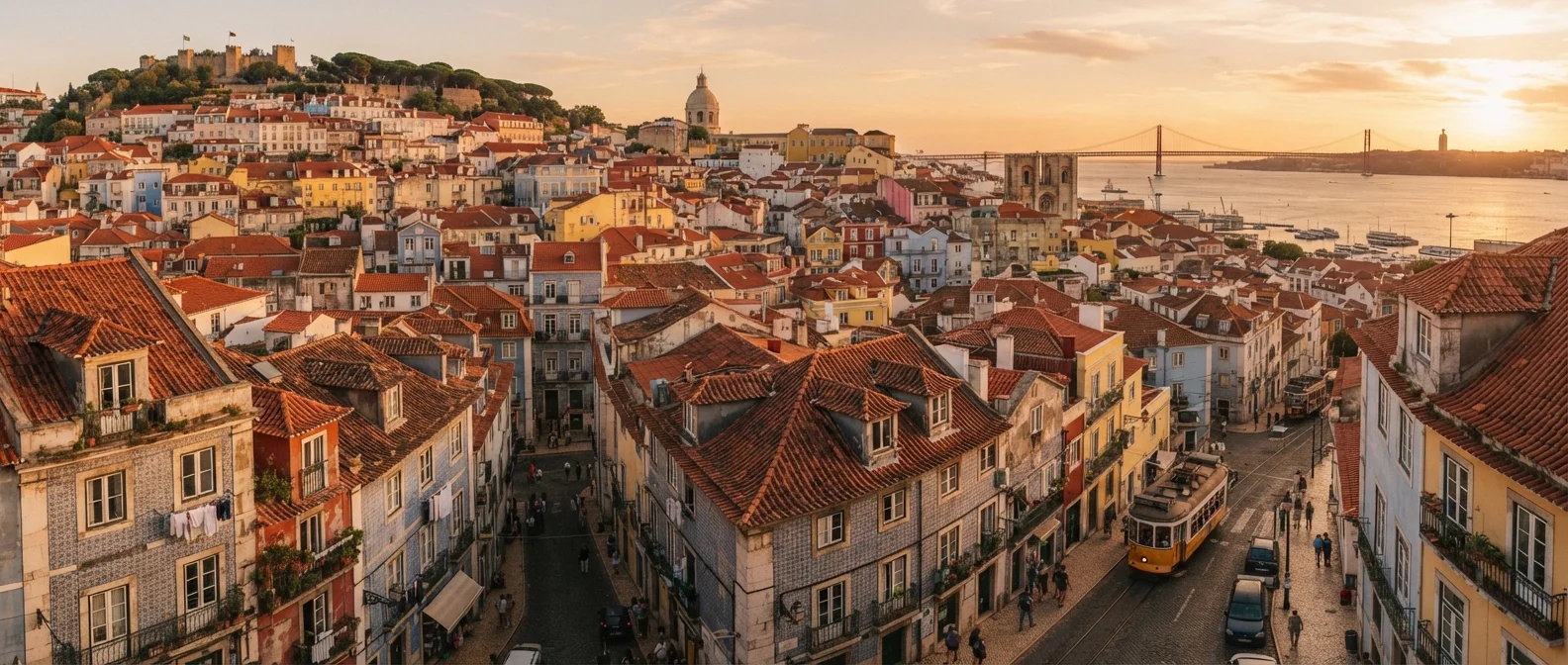
Lisbon doesn't reveal itself uniformly. The city climbs seven hills above the Tagus River, and each neighborhood that clings to those hillsides has developed its own identity over centuries — shaped by conquest, earthquake, empire, and reinvention. Arriving without a sense of these distinct characters means missing most of what makes Lisbon genuinely compelling.
Think of it less like visiting one city and more like moving through a sequence of villages, each with its own soundtrack, pace, and visual logic. Whether you're planning a weekend or settling in for a week, structuring your days by neighborhood lets the city's texture emerge naturally rather than through a rushed checklist. The quarters below aren't ranked — they're introduced as they deserve to be: on their own terms.
Use the Trams and Elevadores Strategically
Lisbon's historic tram lines and funicular elevators (called elevadores) aren't just charming — they solve a real practical problem. The city's hills can be steep enough to make walking every route genuinely tiring. Tram 28E passes through Alfama, Graça, and Estrela in a single journey, offering one of the most scenic urban transits in Europe. Verify current routes and operating hours before traveling, as services and schedules are subject to change.
Lisbon's Most Distinctive Neighborhoods
Alfama — The City's Emotional Anchor
Alfama is the neighborhood that survived Lisbon's catastrophic 1755 earthquake largely intact, and that survival is written into its bones. The Moorish street plan — tight, winding, logic-defying — remains essentially unchanged, and the neighborhood has resisted wholesale modernization in a way that few city centers anywhere in Europe have managed.
This is fado country. The melancholic Portuguese musical tradition, recognized by UNESCO as an intangible cultural heritage, didn't emerge from concert halls — it grew from the taverns, courtyards, and narrow stairwells of Alfama itself. Visitors can hear it performed at small, intimate venues called casas de fado, where the music retains its neighborhood roots rather than becoming purely theatrical.
The hilltop viewpoint at Portas do Sol offers one of the city's most iconic panoramas, looking down over terracotta rooftops toward the Tagus. The São Jorge Castle, perched above, is worth the climb for the views alone.
Alfama's Moorish street plan survived the 1755 earthquake — and its soul survived modernization too.
Bairro Alto — Late Nights and Creative Energy
By day, Bairro Alto is quiet in an almost deceptive way — bookshops, small galleries, and independent fashion studios tucked into a 16th-century grid of streets. By evening, the neighborhood transforms into one of Europe's liveliest nightlife corridors, with hundreds of small bars opening their doors onto the cobblestones.
What makes Bairro Alto interesting beyond the nightlife is its long history as a neighborhood of ideas. It was home to printing presses, political dissidents, and bohemian culture across different eras. That creative inheritance is still visible in the density of independent creative businesses that operate here alongside the bars and restaurants.
The nearby Chiado district — essentially Bairro Alto's more refined, cafe-centered neighbor — is where intellectuals and artists have gathered for generations. The famous Brasileira café on Rua Garrett has been a literary meeting point since the early 20th century.
Bairro Alto carries centuries of bohemian and intellectual heritage beneath its reputation for nightlife.
Belém — Where the Age of Discovery Left Its Mark
Belém sits a few kilometers west of the city center along the riverfront, and its character is defined almost entirely by its maritime history. This is where Vasco da Gama departed for India in 1497, launching a period of Portuguese global exploration that reshaped trade routes and world maps.
The monuments here — the Jerónimos Monastery and the Tower of Belém — are among the finest examples of the Manueline architectural style, which blends late Gothic structure with seafaring motifs: ropes, armillary spheres, coral, and navigational instruments carved into stone. Walking through the monastery cloister is one of the genuinely transporting architectural experiences Portugal offers.
Belém also houses the MAAT (Museum of Art, Architecture and Technology) on the riverbank, giving the district a contemporary cultural layer alongside its historic weight. The area is best visited on a weekday to avoid the most concentrated crowd pressure.
Belém's carved stone monuments make the Age of Discovery tangible in a way no museum exhibit quite replicates.
Príncipe Real — Elegant, Leafy, and Unhurried
If Alfama is Lisbon's soul and Bairro Alto its energy, Príncipe Real is the city's considered exhale. Centered on a shaded garden square where locals linger over weekend markets, this neighborhood is characterized by 19th-century palaces converted into boutique hotels, design shops, antique dealers, and some of the city's most thoughtfully curated restaurants.
The neighborhood sits on a hilltop with its own miradouro offering river views, and the pace here is noticeably slower than the more tourist-dense corridors. The Saturday organic market draws local families alongside visitors. Independent bookshops, concept stores, and specialty food producers give the streets a browseable quality that rewards an unscheduled afternoon.
Príncipe Real is also home to the Natural History Museum and the Geological Museum, both housed in a former royal palace — understated institutions that are easy to visit without crowds.
Príncipe Real is the neighborhood Lisbon residents themselves tend to recommend when asked where to spend a quiet afternoon.
LX Factory and Alcântara — Industrial Reinvention
On the riverside in Alcântara, a repurposed 19th-century textile factory complex called LX Factory has become one of the city's most interesting cultural spaces. What began as a creative industries hub — studios, print shops, independent publishers, concept restaurants — has evolved into a weekend market destination and arts venue that attracts both residents and visitors without feeling manufactured for tourism.
The surrounding Alcântara neighborhood retains its industrial and working-class character beyond the factory walls, providing genuine contrast to the polished surfaces of Chiado or the monument-heavy atmosphere of Belém. The 25 de Abril Bridge, Lisbon's dramatic suspension crossing over the Tagus, dominates the skyline here in a way that gives the whole district a slightly cinematic quality.
This is a neighborhood for those who find Lisbon's historic core a touch overwhelming — the pace is looser, the aesthetic more raw, and the sense of genuine local life more present.
LX Factory channels Lisbon's creative momentum without abandoning the honest industrial character of its surroundings.
Mouraria — Multicultural Roots and Living Traditions
Adjacent to Alfama and sharing some of its topography, Mouraria carries a history that is arguably even more layered. It was the neighborhood designated for Lisbon's Moorish population following the Christian reconquest of the city in the 12th century, and it has remained a neighborhood of immigration, diversity, and cultural mixing ever since.
Today, Mouraria is home to communities from South Asia, West Africa, China, and across the Portuguese-speaking world, giving the area a vibrancy and culinary breadth that is unlike any other part of Lisbon. The neighborhood's Intendente square has been thoughtfully renovated in recent years and now functions as a genuine community gathering point.
Mouraria is also closely tied to fado's origins — some historians argue the music has as much to do with the cultural crossroads of this neighborhood as with Alfama proper. Street art, tiled staircases, and small religious shrines mark the route up toward the castle, creating one of the city's most visually layered walking experiences.
Mouraria's multicultural identity isn't a recent trend — it has been the neighborhood's defining characteristic for nearly nine centuries.
Neighborhood Character Evolves Continuously
Like many European capitals, Lisbon's neighborhoods are in ongoing transition. Gentrification pressures, short-term rental concentration, and tourism growth have shifted the character of some areas — particularly Alfama and Chiado — over the past decade. What visitors experience today reflects both deep historical roots and contemporary economic change. Engaging with locally owned businesses and being attentive to community dynamics makes for a more authentic and respectful visit.
For those traveling with minimal luggage and maximum curiosity, packing light for a city like Lisbon pays off quickly — cobbled hills and staircase alleyways are not friendly to oversized bags. And as with any unfamiliar urban environment, navigating with awareness and confidence makes all the difference between feeling lost and feeling at home. Lisbon, for what it's worth, is a remarkably walkable and generally welcoming city — but its topography demands comfortable shoes and a willingness to get pleasantly disoriented.
If Lisbon sparks a broader curiosity about Portugal, the country's interior and southern coast reward the same neighborhood-level attention. And travelers drawn to old-world atmosphere woven into city districts may find a compelling contrast in Morocco's imperial cities just across the strait.