

Key Takeaways
Our Verdict
Each imperial city rewards visitors with a genuinely distinct experience — no two feel alike. Choosing between them depends on whether you prioritize medieval authenticity, sensory energy, off-the-beaten-path exploration, or a blend of history and contemporary culture.
| Best for | Recommended |
|---|---|
| Travelers seeking medieval Islamic architecture and deep historical immersion | Fez |
| First-time visitors wanting an iconic, energy-filled Moroccan experience | Marrakech |
| Those who prefer monument-rich sights without the tourist crowds | Meknes |
| Visitors interested in mixing historic sites with a functioning modern capital | Rabat |
What Makes a City 'Imperial'?
In Moroccan history, the term imperial city designates a settlement that served as the political capital — a seat of royal power — at some point under one of the country's major dynasties. Each of the four cities earned this status under different rulers across different centuries, which is precisely why they feel so architecturally and culturally distinct from one another today.
Together, Fez, Marrakech, Meknes, and Rabat tell the full arc of Moroccan civilization — from medieval Islamic scholarship through Saadian grandeur, Alaouite ambition, and French Protectorate-era urban planning. Visiting even two of them side by side reveals how dramatically a single country's identity can shift across regions and eras. For another compelling example of how history layers itself across a city's neighborhoods, the quarter-by-quarter character of Lisbon offers a useful parallel in the European Atlantic world.
Fez: The Scholar's City
Founded in the 9th century, Fez rose to prominence under the Idrisid dynasty and later flourished under the Marinids, who made it one of the medieval Islamic world's great intellectual centers. The University of al-Qarawiyyin, established in 859 CE, is widely recognized as the oldest continuously operating degree-granting institution in the world.
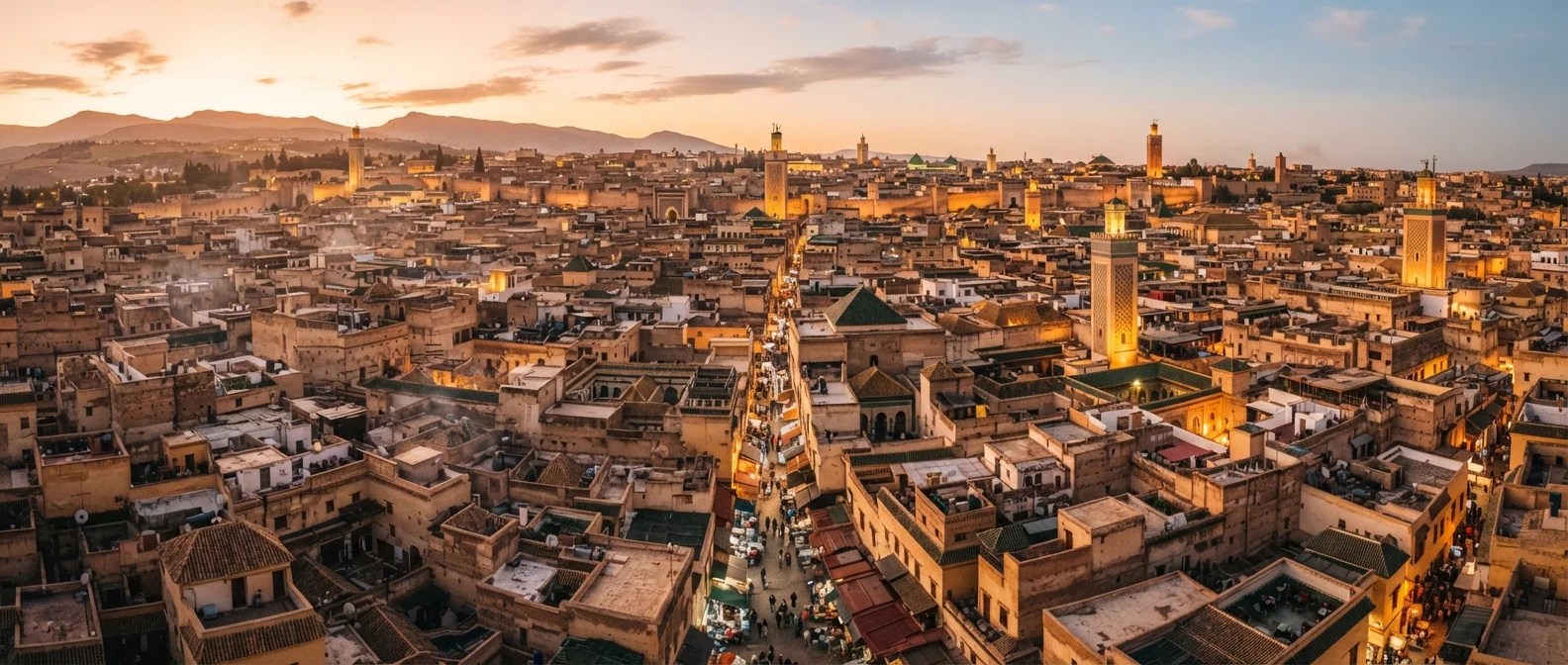
Fez el-Bali — the old medina — is a UNESCO World Heritage Site and arguably the most complete medieval city fabric surviving anywhere on earth. Its roughly 9,000 lanes are largely car-free; navigation by foot is the only real option, which creates an extraordinarily immersive experience. Tanneries, brass workshops, and Quranic schools occupy spaces they have filled for hundreds of years.
Navigating Fez el-Bali
Fez rewards slow travel. Plan at least two full days inside the medina, and consider hiring a licensed local guide for the first morning — the street layout confounds even experienced navigators. Offline maps can help but are no substitute for local knowledge in the oldest quarters.
Fez rewards slow travel. Plan at least two full days inside the medina, and consider hiring a licensed local guide for the first morning — the street layout confounds even experienced navigators.
Marrakech: The Rose-Red City
Marrakech was founded by the Almoravid dynasty in the 11th century and became the empire's southern power base, a role it reprised under the Almohads and again during the Saadian dynasty in the 16th and 17th centuries. The Saadians left behind some of Morocco's most refined architecture: the Bahia Palace, the Saadian Tombs, and the sprawling Ben Youssef Madrasa all date to this extraordinary period.
Today, Marrakech is Morocco's most internationally recognized city. Djemaa el-Fna square — a UNESCO Intangible Cultural Heritage space — transforms from a market by day into a vast open-air performance venue by evening, with storytellers, musicians, and food stalls creating an atmosphere found nowhere else. The city's modern creative district, the Guéliz, adds galleries, design studios, and contemporary restaurants to its historic appeal.
| Fez | Marrakech | Meknes | Rabat | |
|---|---|---|---|---|
| Founding dynasty | Idrisid (9th century) | Almoravid (11th century) | Alaouite (17th century) | Almohad (12th century) |
| UNESCO recognition | Medina — World Heritage Site | Medina — World Heritage Site | Medina — World Heritage Site | City — World Heritage Site |
| Crowd level | High (medina) | Very high | Low to moderate | Moderate |
| Signature monument | al-Qarawiyyin University | Djemaa el-Fna square | Bab Mansour gate | Hassan Tower |
| Best for | Medieval immersion | First-time visitors | Off-the-beaten-path | History + modern capital |
| Nearby day-trip | Ifrane & cedar forests | Ourika Valley | Volubilis Roman ruins | Chellah necropolis |
Meknes: The Underrated Giant
Meknes is the least visited of the four imperial cities, which, for many travelers, is its greatest asset. Sultan Moulay Ismail designated it his capital in the late 17th century and poured extraordinary resources into building walls, granaries, stables, and ceremonial gates that rivaled Versailles in ambition. The monumental Bab Mansour gate — completed in 1732 — remains one of the most impressive pieces of decorative architecture in North Africa.
The city sits close to Volubilis, a remarkably well-preserved Roman archaeological site that speaks to the deep pre-Islamic layers of Moroccan history. Combining a half-day at Volubilis with an afternoon in Meknes makes for one of the most historically rewarding day-trips in the country.
Verify Volubilis Opening Hours Ahead of Time
Volubilis is a working archaeological site and access conditions can vary by season or for conservation work. Check current opening hours and any entry requirements with official Moroccan heritage authorities before making the trip from Meknes — it is roughly 30 kilometers and worth confirming in advance.
Rabat: Capital, Coast, and Continuity
Rabat has been Morocco's administrative capital since 1912, when the French Protectorate established it as such partly to preserve Fez's medina from heavy colonial development. The result is a city that carries both old and new with unusual grace. Its medina and kasbah are UNESCO-listed, yet the city also operates as a fully functional modern capital with wide boulevards and government institutions.
The Kasbah of the Udayas, perched above the Atlantic at the mouth of the Bou Regreg river, offers some of the most atmospheric urban walking in Morocco. The incomplete Hassan Tower — begun in 1195 under the Almohad sultan Yacoub al-Mansour and left unfinished after his death — stands as one of the country's most evocative monuments, a testament to the scale of ambition that has characterized Morocco's imperial cities across every era.
This article provides general travel information for educational purposes. Entry requirements, local conditions, and site access can change; always verify current details with official government and tourism sources before traveling.