

Key Takeaways
Pet Food Label
A pet food label is the regulated information printed on pet food packaging, including the product name, ingredient list, guaranteed analysis, feeding directions, and a nutritional adequacy statement. In the United States, these labels are governed by the Association of American Feed Control Officials (AAFCO) and state feed control agencies. Reading them accurately helps pet owners evaluate whether a food is nutritionally appropriate for their animal.
AAFCO establishes model regulations and nutrient profiles that most U.S. states adopt into law; the FDA also has authority over pet food safety and labeling under the Federal Food, Drug, and Cosmetic Act.
The Ingredient List: What Order Really Means
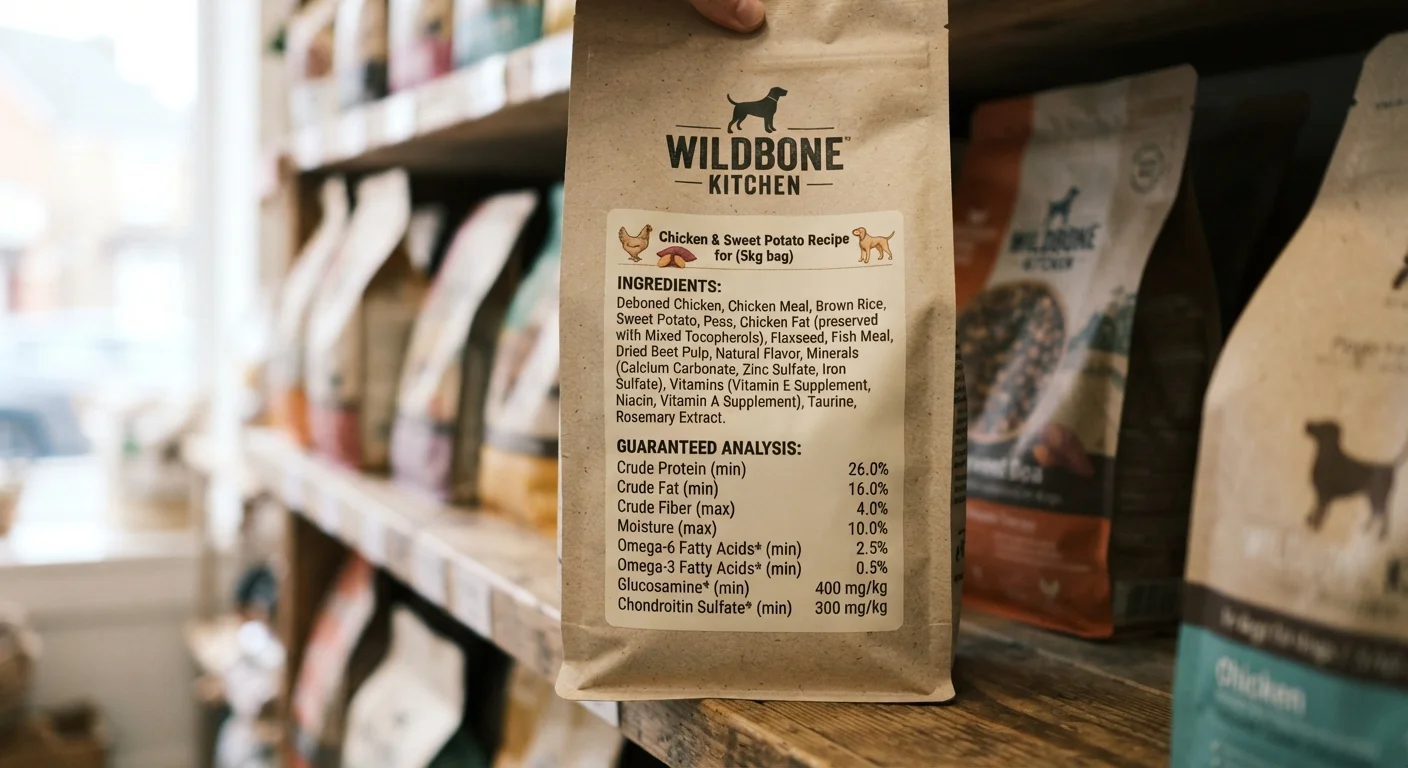
Pet food ingredients are listed in descending order by pre-processing weight. That means a fresh ingredient like chicken, which is roughly 70% water, may appear first on the list but contribute less protein to the finished product than a lower-listed ingredient like chicken meal, which has already had most of its moisture removed and is more nutrient-dense pound for pound.
This does not automatically make the food inferior — it simply means raw ingredient weight is not the same as final nutrient contribution. A more useful signal is whether a named protein source (e.g., "salmon," "turkey meal") appears before multiple carbohydrate fillers.
Watch for ingredient splitting, a practice where a single ingredient is listed under several names to push it further down the list. For example, "ground corn," "corn gluten meal," and "corn bran" are all corn derivatives; combined, they might outweigh the protein source despite each appearing lower individually.
Look for Named Protein Sources First
When scanning an ingredient list, check whether the first few ingredients include a named animal protein — such as 'deboned chicken,' 'turkey meal,' or 'salmon' — rather than a generic term like 'meat by-products.' Named sources indicate the manufacturer can trace and verify the protein origin. This is one of the more reliable quick checks you can apply without a nutritional background.
The Guaranteed Analysis: Numbers With Context
The guaranteed analysis panel lists minimum or maximum percentages for four core nutrients: crude protein, crude fat, crude fiber, and moisture. These figures are not precise averages — they are regulatory floors and ceilings that protect consumers from gross misrepresentation.
One important complication is moisture variation. Wet foods may contain 75–80% moisture, while dry kibble sits around 10%. Comparing protein percentages between them directly is misleading. To make fair comparisons, convert both to a dry matter basis by removing moisture from the calculation: divide the nutrient percentage by (100 minus the moisture percentage), then multiply by 100.
95%
Minimum named ingredient for single-name pet foods
Under AAFCO naming rules, a pet food simply named after one ingredient (e.g., 'Tuna Cat Food') must contain at least 95% of that ingredient, excluding added water.
3%
Minimum for 'with [ingredient]' label claims
AAFCO's '3% rule' means a product marketed as 'with chicken' only needs to contain 3% chicken by weight, a threshold far lower than most consumers assume.
If you want precise nutrient data — actual averages rather than guaranteed minimums — you can contact the manufacturer to request a typical or average analysis. Reputable companies generally provide this information.
The AAFCO Statement: The Most Important Line on the Package
The AAFCO nutritional adequacy statement is arguably the single most useful piece of information on a pet food label. It tells you two things: whether the food is nutritionally complete and balanced, and for which life stage it is intended.
There are two ways a manufacturer can earn this statement. The first is by formulating to AAFCO's established nutrient profiles — a calculation-based method. The second is through feeding trials, where real animals eat the food over a defined period and are monitored for health outcomes. Feeding trials are generally considered the higher bar, and some labels will specify which method was used.
Life stage designations matter: a food labeled for "all life stages" must meet the more demanding nutrient requirements for growth and reproduction, making it appropriate for puppies and kittens. A food labeled for "adult maintenance" only may be inadequate for growing or pregnant animals.
If a label carries no AAFCO statement, the food is likely intended as a treat, supplement, or topper — not a complete diet. Using it as a sole food source could lead to nutritional deficiencies over time. For a deeper look at how diet formats compare, see our comparison of fresh food, kibble, and raw diets.
AAFCO Does Not Approve Individual Products
AAFCO sets the standards and model regulations, but it does not test, certify, or approve individual pet foods before they reach shelves. Compliance is primarily enforced at the state level. When a label says 'formulated to meet AAFCO nutrient profiles,' it means the manufacturer calculated that the recipe meets those standards — not that an independent body has verified it.
Marketing Language vs. Regulated Terms
Pet food packaging is full of words designed to appeal to owners, not to describe nutritional reality. Understanding which terms carry legal weight — and which do not — cuts through the noise.
- "Natural" — AAFCO defines this as derived from plant, animal, or mined sources without chemically synthetic processing, with limited exceptions. It does not mean organic, unprocessed, or nutritionally superior.
- "Holistic," "premium," "gourmet" — No regulated definitions exist. These are marketing terms only.
- "With chicken" vs. "Chicken dinner" — AAFCO has naming rules: a product called "Chicken Cat Food" must be at least 95% chicken (excluding water). A "Chicken Dinner" or "Chicken Entrée" only needs 25%. A food "With Chicken" needs just 3%.
These naming conventions apply before moisture is considered, but they still reveal meaningful differences in ingredient emphasis. For context on how food processing labels work more broadly, the concepts in understanding the food processing spectrum offer a useful parallel.
Once you can read a label clearly, the next step is applying that knowledge to portion decisions. Portion size plays a critical role in your pet's long-term health — feeding the right food in the wrong amount still carries real risks.
This article is for general educational purposes only and is not a substitute for personalized veterinary advice. Always consult a licensed veterinarian before making significant changes to your pet's diet.