

Key Takeaways
Our Verdict
Each diet format has genuine strengths and real limitations. Dry kibble remains a practical, well-studied option for many households, while fresh and raw diets may offer advantages in palatability and moisture — but require more planning and oversight. The right choice depends on your pet's individual needs, your lifestyle, and guidance from a veterinary professional.
| Best for | Recommended |
|---|---|
| Busy households needing convenience and long shelf life | Dry Kibble |
| Pets needing extra hydration or those with dental sensitivities | Wet / Canned Food |
| Owners who prioritize minimally processed ingredients and have time to plan meals | Fresh-Cooked Diet |
| Experienced owners who can manage food safety protocols carefully | Raw Diet (with veterinary guidance) |
Understanding the Four Main Diet Types
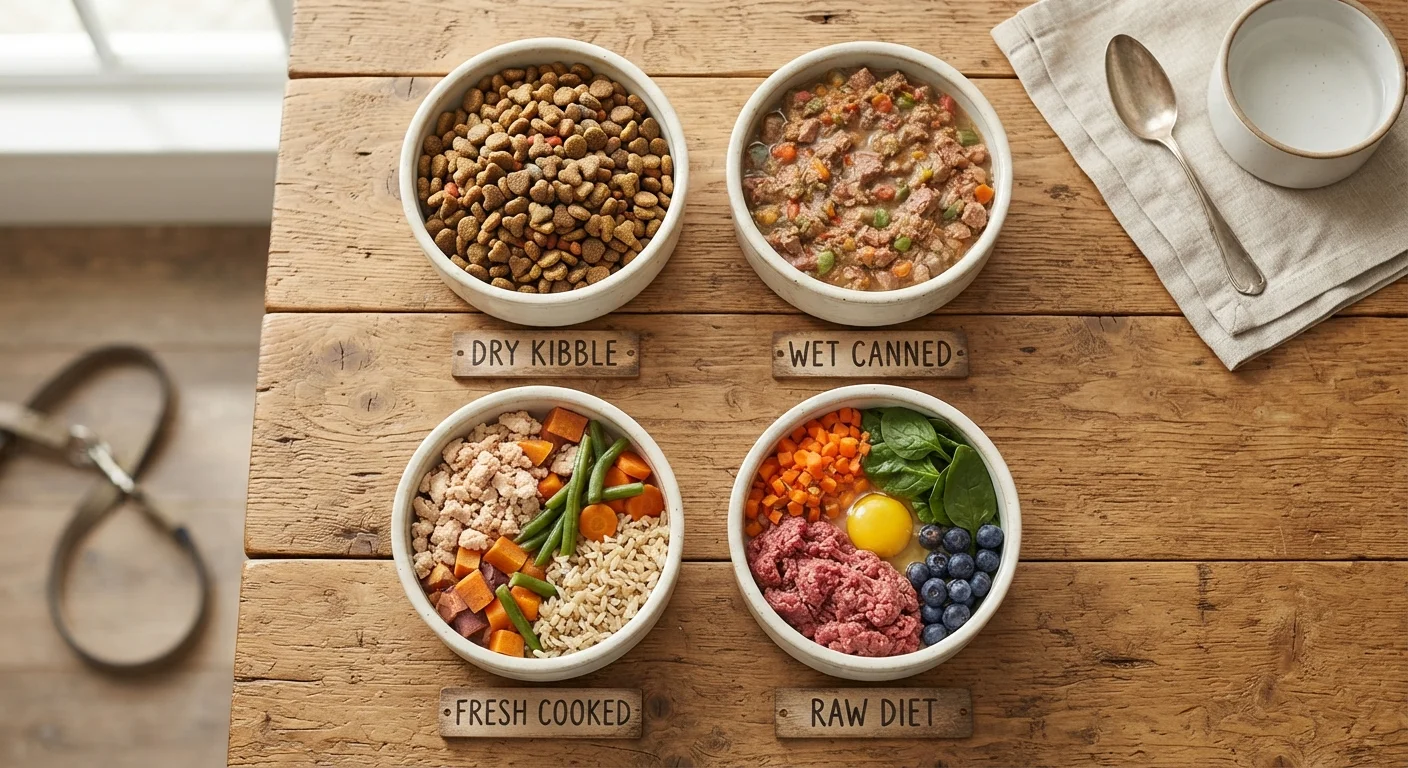
When it comes to feeding a dog or cat, the options on the market fall into four broad categories: dry kibble, wet or canned food, fresh-cooked meals, and raw diets. Each represents a fundamentally different approach to processing, moisture content, and ingredient form. Understanding what separates them is the starting point for any informed feeding decision.
Dry kibble is the most widely used format in the United States. It is extruded at high heat, which extends shelf life and eliminates many pathogens, but also alters some heat-sensitive nutrients. Wet food is cooked and sealed in cans or pouches, providing significantly higher moisture content — a meaningful benefit for cats, who are prone to low water intake. Fresh-cooked diets use whole or minimally processed ingredients prepared at lower temperatures and are typically refrigerated or frozen. Raw diets — sometimes called BARF (Biologically Appropriate Raw Food) — consist of uncooked meat, organs, and bones, sometimes combined with vegetables and supplements.
For a deeper look at how to interpret what's actually inside any of these products, see what pet food labels actually tell you.
| Dry Kibble | Wet / Canned Food | Fresh-Cooked | Raw Diet | |
|---|---|---|---|---|
| Typical moisture content | ~10% | ~75–80% | ~60–70% | ~60–70% |
| Shelf life (opened) | Weeks (sealed) | 3–5 days refrigerated | 3–5 days refrigerated | 1–3 days refrigerated |
| AAFCO-compliant options available | Widely available | Widely available | Some commercial options | Limited; verify carefully |
| Food safety risk | Low | Low | Low–moderate | Higher (pathogen risk) |
| Relative cost per serving | Generally lower | Moderate | Moderate–high | High |
| Preparation effort | Minimal | Minimal | Moderate | Moderate–high |
| Palatability for picky eaters | Variable | Often good | Often high | Often high |
Nutritional Completeness and Safety Considerations
Regardless of format, the most critical standard any pet diet should meet is nutritional completeness for the animal's life stage. In the U.S., the Association of American Feed Control Officials (AAFCO) sets nutrient profiles that pet foods can be formulated or tested against. Most commercial kibbles and canned foods carry an AAFCO statement; many raw and fresh-cooked options — particularly homemade versions — do not.
This gap matters. Homemade diets, even well-intentioned ones, have been found in multiple peer-reviewed studies to contain nutrient imbalances, particularly deficiencies in calcium, zinc, and certain vitamins. If a fresh or raw diet is not formulated by a board-certified veterinary nutritionist, there is real risk of long-term nutritional deficiency.
Homemade Diets Carry Nutritional Risk
Preparing pet meals at home without professional formulation frequently results in nutritional imbalances. Studies have found that many homemade recipes available online fail to meet established minimum nutrient requirements. If you want to feed a homemade diet, work with a board-certified veterinary nutritionist to develop a properly balanced recipe for your specific pet.
Food safety is the other major concern with raw diets. Raw meat can carry Salmonella, Listeria, and E. coli — pathogens that pose risks not only to pets but to the humans handling the food, particularly children, elderly individuals, and anyone who is immunocompromised. The U.S. Food and Drug Administration (FDA) has documented these risks and recommends that owners weigh them carefully.
Nutritional needs also shift across a pet's life. How nutritional needs shift from puppy to senior is a useful reference for understanding those changes over time.
Practical Trade-Offs: Cost, Time, and Palatability
Beyond nutrition and safety, day-to-day practicality shapes what most owners can realistically sustain. Dry kibble generally has the lowest cost per serving, the longest shelf life after opening, and the simplest storage requirements. Wet food costs more per calorie but requires no preparation and is often more appealing to finicky eaters.
Fresh-cooked and raw diets carry higher costs — both in ingredients and, for commercial versions, in refrigerated or frozen shipping. They also require more planning: fresh food typically has a short refrigerator life of three to five days, while frozen portions need to be thawed safely. Cross-contamination risks with raw food mean dedicated prep surfaces and thorough handwashing are non-negotiable.
Transitioning Diets Gradually
Switching a pet's food abruptly can cause digestive upset, including vomiting and diarrhea. A gradual transition over seven to ten days — mixing increasing proportions of the new food with the old — gives the gut microbiome time to adjust. This applies to any diet change, including switching between formats.
Palatability — how much a pet actually enjoys eating the food — is one area where fresh and raw diets often have an edge. The aroma and texture of less-processed food tends to be more appealing to many animals, which can be a meaningful factor for picky eaters or pets recovering from illness. That said, palatability alone is not sufficient justification for a diet that does not meet nutritional standards.
Portion accuracy matters regardless of format. See why portion size matters more than the feeding schedule for guidance on calibrating amounts to your pet's actual needs.
For owners curious about how processing levels affect nutritional value more broadly, understanding the processing spectrum offers useful context.
This article is for general informational and educational purposes only and does not constitute veterinary or nutritional advice. Always consult a licensed veterinarian before making significant changes to your pet's diet.