

Key Takeaways
Option A
Whole Foods
Foods in or close to their natural, unaltered state.
Best for: Maximizing nutrient density and fiber intake with minimal additives across all eating patterns.
Option B
Processed Foods
Foods altered from their original form through any physical or chemical method.
Best for: Convenience, affordability, and shelf stability — with nutritional value varying widely by processing level.
If you want to maximize fiber and micronutrient intake
Whole Foods
Fruits, vegetables, legumes, and whole grains deliver the broadest range of nutrients with minimal interference from additives or reformulation.
If convenience and budget are primary concerns
Processed Foods
Minimally or moderately processed options — like canned beans, frozen vegetables, or plain yogurt — can be nutritious, affordable, and practical for busy households.
If you're building a sustainable long-term eating pattern
Whole Foods
A diet anchored in whole foods with selective use of minimally processed items tends to support balanced nutrition without requiring constant label scrutiny.
If you're managing eating on a tight schedule
Processed Foods
Strategically chosen processed foods — such as fortified cereals or pre-cut frozen produce — can fill nutritional gaps when time for meal preparation is limited.
What Do 'Whole' and 'Processed' Actually Mean?
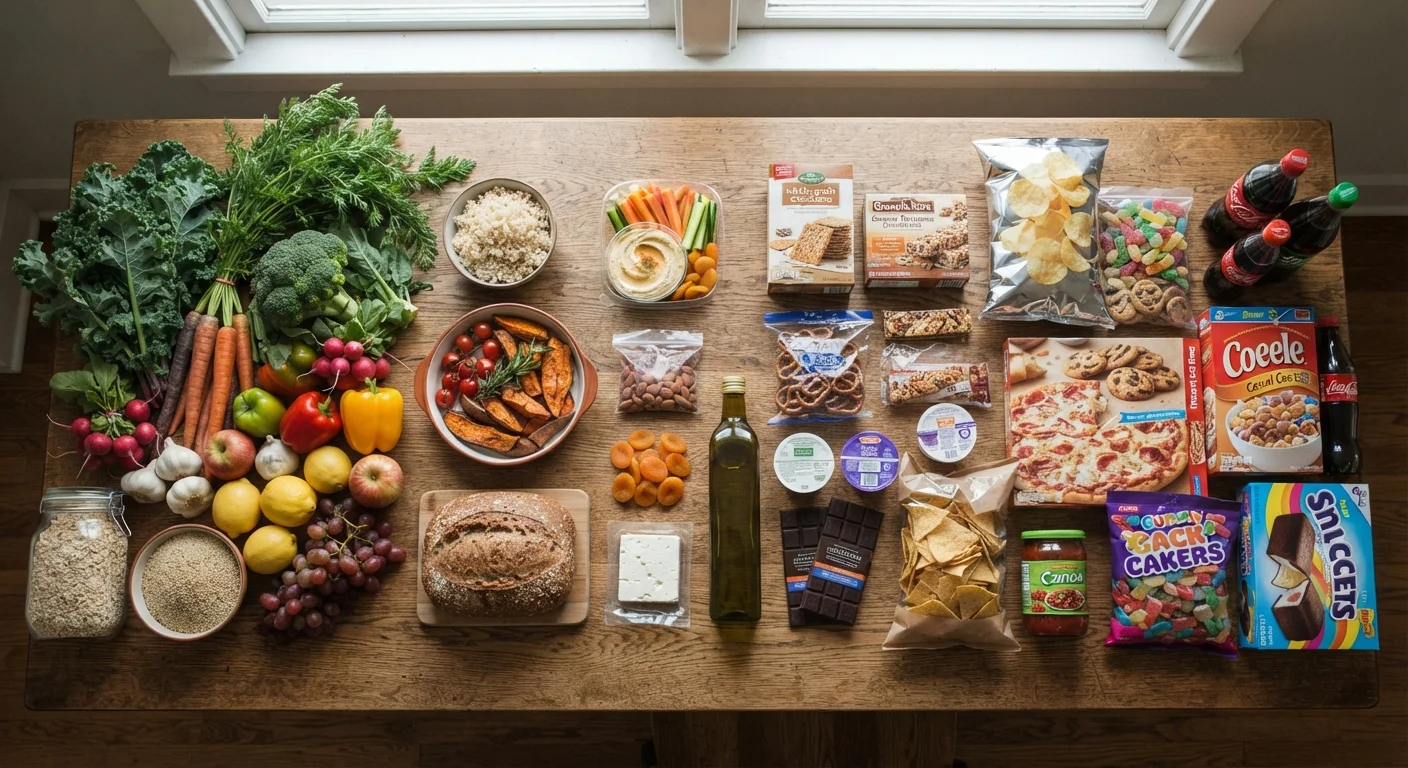
The terms whole foods and processed foods are used constantly in nutrition conversations, but they're rarely defined precisely. A whole food is one that remains close to its natural state — an apple, a handful of walnuts, a cup of dry lentils. A processed food is any food that has been altered from its original form through mechanical, chemical, or biological means.
By that definition, even frozen peas are technically processed — they're blanched and blast-frozen before packaging. So is yogurt, which is cultured milk. The word "processed" on its own tells you very little about whether a food is nutritious or not. What matters far more is how much it has been processed, and what has been added or removed in the process.
Nutrition researchers commonly use tiered classification systems — such as the NOVA framework — to organize foods by their degree of processing. These systems distinguish between minimally processed foods (like plain frozen vegetables), processed culinary ingredients (like olive oil or flour), processed foods (like canned fish or cheese), and ultra-processed foods (like packaged snack cakes or flavored chips). Understanding where a food falls on this spectrum is far more useful than a simple whole-versus-processed binary.
The Spectrum: From Minimal to Ultra-Processed
Thinking about food processing as a spectrum rather than a yes/no label clarifies most of the confusion around this topic.
| Criterion | Whole Foods | Processed Foods |
|---|---|---|
| Definition | Unaltered or minimally altered from natural state | Any food changed from its original form |
| Examples | Apples, lentils, oats, walnuts | Canned soup, cheese, packaged snacks |
| Fiber content | Generally high | Varies widely; often lower in ultra-processed |
| Added sugars/sodium | Naturally absent or minimal | Can be high, especially in ultra-processed |
| Shelf life | Often short (fresh produce) | Typically longer due to preservation |
| Cost and convenience | Can be higher cost; prep time required | Often affordable and ready to use |
| Nutrient density | Generally high relative to calories | Highly variable by processing level |
Minimally processed foods — such as roasted nuts, plain canned tomatoes, or washed salad greens — undergo changes that make them safer, more convenient, or more shelf-stable without significantly altering their nutritional profile. Moderately processed foods like whole-grain bread or canned beans involve more steps but still deliver meaningful nutrients. At the far end of the spectrum, ultra-processed foods are typically manufactured with industrial ingredients — hydrogenated oils, high-fructose corn syrup, artificial flavors, emulsifiers — that rarely appear in home cooking.
Multiple large observational studies, including research published in peer-reviewed journals such as The BMJ, have associated higher consumption of ultra-processed foods with increased risks of cardiovascular disease, weight gain, and other health markers. It's worth noting that these are associations in population-level data, not proof of direct causation for any individual. Nevertheless, the pattern is consistent enough to inform general dietary guidance.
For a deeper look at how to interpret nutritional data on any product, see our guide to reading nutrition labels.
Where Whole Foods Hold an Advantage
Whole foods tend to deliver nutrients in their most complete form. An orange, for instance, provides vitamin C alongside fiber and phytonutrients that interact in ways a supplement or juice may not fully replicate. Legumes offer protein and fiber together, slowing digestion and supporting satiety. Whole grains retain their bran and germ, which house B vitamins, iron, and fiber that are partially stripped away in refined grain products.
~17g
Average daily fiber intake for US adults
The Dietary Guidelines for Americans identify fiber as a nutrient of public health concern, with recommended intakes generally ranging from 22–38g per day depending on age and sex.
57%
Share of US calories from ultra-processed foods
A study published in BMJ Open estimated that ultra-processed foods accounted for roughly 57% of energy intake in the average American diet.
3–5x
More antioxidants in whole vs refined grains
Research comparing whole and refined grain products consistently finds that the bran and germ layers — removed during refining — contain the majority of antioxidants and micronutrients.
Fiber is one of the most practically significant advantages of whole foods. Most US adults consume well below the generally recommended daily intake — a gap that whole plant foods directly address. Fiber supports digestive health, helps regulate blood sugar response, and contributes to feelings of fullness.
That said, whole foods aren't always accessible or affordable for everyone. Fresh produce spoils quickly and can be expensive. This is where minimally processed options — frozen vegetables, canned legumes, dried whole grains — serve as nutritionally sound and cost-effective alternatives. Our article on eating well on a budget explores this in practical detail.
Making Practical Sense of Both
A realistic, sustainable eating pattern doesn't require eliminating all processed foods. What the evidence consistently supports is shifting the proportion — making whole and minimally processed foods the foundation of your diet, and treating ultra-processed items as occasional rather than routine choices.
Processing Can Sometimes Add Nutritional Value
Fortification — adding vitamins or minerals to processed foods — has meaningfully reduced nutrient deficiencies in many populations. Iodized salt and vitamin D–fortified dairy are well-established public health examples. Fermentation, another form of processing, produces beneficial compounds in foods like yogurt and kimchi. Processing, by itself, is not the determining factor in a food's nutritional value.
When evaluating a processed food, a few practical questions help: How long is the ingredients list, and are most items recognizable? Is sodium, added sugar, or saturated fat listed near the top? Does the product offer meaningful amounts of fiber or protein alongside its calories? These aren't rigid rules, but they guide more informed choices. Our food groups and dietary guidelines reference can help you build that foundational knowledge.
It's also worth acknowledging that if you have food intolerances or allergies, the ingredient lists on processed foods become even more significant. For context on how those conditions intersect with dietary choices, see our overview of food intolerances vs allergies.
This article is for general informational and educational purposes only and is not a substitute for professional medical or dietary advice. Consult a qualified healthcare provider or registered dietitian for guidance specific to your health needs.