

| Number of main food groups (USDA MyPlate) | 5 (Fruits, Vegetables, Grains, Protein Foods, Dairy) (USDA MyPlate, current edition) |
| Primary macronutrients | Carbohydrates, protein, and fat |
| U.S. Dietary Guidelines update cycle | Every 5 years (USDA/HHS Dietary Guidelines for Americans) |
| Recommended proportion of grains that are whole grain | At least half (Dietary Guidelines for Americans) |
| Vitamins absorbed only with dietary fat | A, D, E, and K (fat-soluble) |
| Primary dietary source of vitamin B12 | Animal-based foods (meat, fish, eggs, dairy) |
What Are the Major Food Groups?
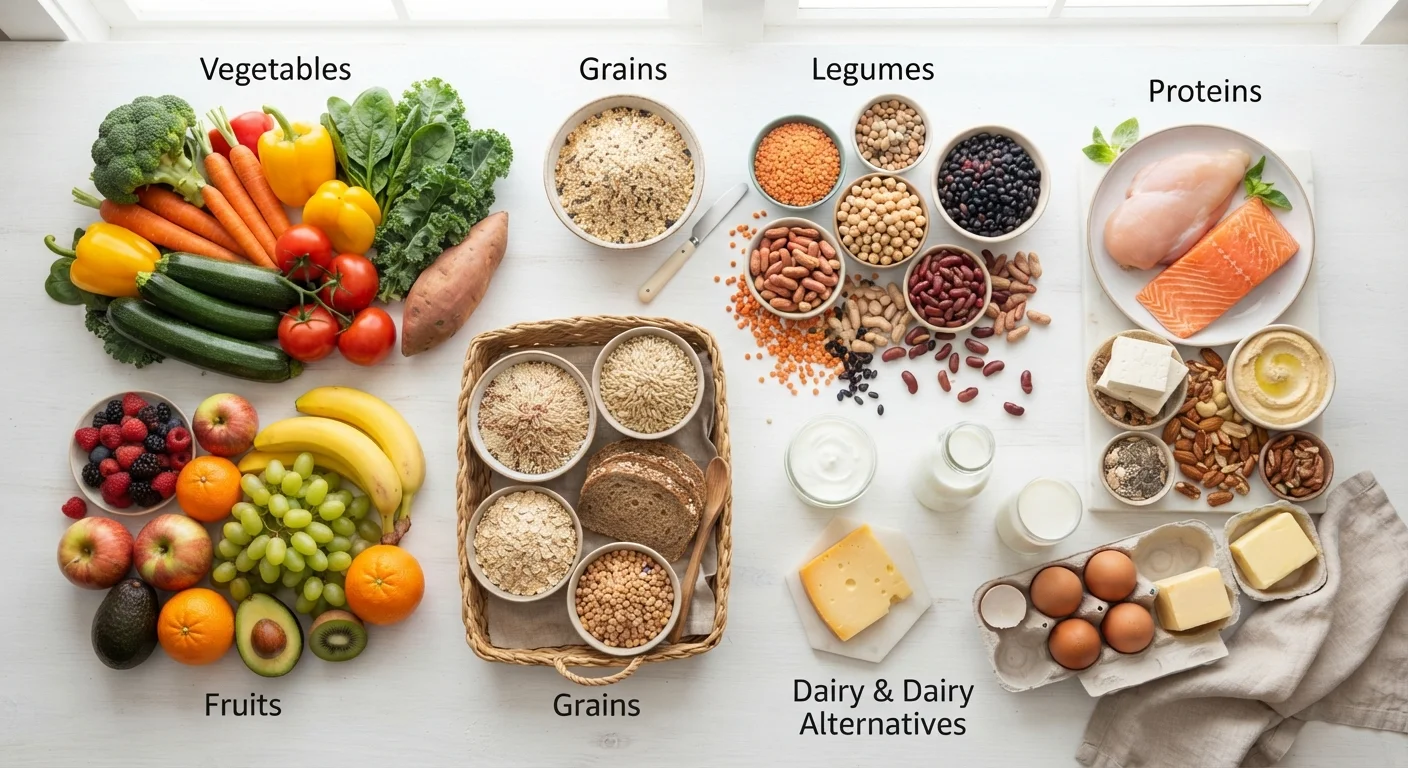
Dietary guidance frameworks — including the U.S. Department of Agriculture's MyPlate model — organize foods into groups based on shared nutritional profiles. Understanding these groups helps clarify why variety matters: no single group supplies everything the body needs.
| Number of main food groups (USDA MyPlate) | 5 (Fruits, Vegetables, Grains, Protein Foods, Dairy) (USDA MyPlate, current edition) |
| Primary macronutrients | Carbohydrates, protein, and fat |
| U.S. Dietary Guidelines update cycle | Every 5 years (USDA/HHS Dietary Guidelines for Americans) |
| Recommended proportion of grains that are whole grain | At least half (Dietary Guidelines for Americans) |
| Vitamins absorbed only with dietary fat | A, D, E, and K (fat-soluble) |
| Primary dietary source of vitamin B12 | Animal-based foods (meat, fish, eggs, dairy) |
- Grains
- Include bread, rice, oats, pasta, and cereals. Whole grains retain the bran and germ, providing fiber, B vitamins (thiamin, riboflavin, niacin, folate), and iron. Refined grains are processed to remove these layers, leaving a starchier product often enriched to restore some lost nutrients.
- Vegetables
- Broadly grouped into subgroups: dark-green (spinach, broccoli), red and orange (carrots, sweet potatoes), beans and peas (lentils, chickpeas), starchy (corn, potatoes), and others. Rich in fiber, potassium, folate, and vitamins A, C, and K.
- Fruits
- Whole fruits — fresh, frozen, canned in water or juice, or dried — provide natural sugars alongside fiber, potassium, and vitamin C. 100% fruit juice counts but lacks the fiber of whole fruit.
- Protein Foods
- Encompass meat, poultry, seafood, eggs, nuts, seeds, and legumes. Key nutrients include protein, iron, zinc, B vitamins, and omega-3 fatty acids (especially from fatty fish and walnuts).
- Dairy
- Milk, yogurt, cheese, and fortified soy beverages supply calcium, vitamin D (when fortified), potassium, and protein. Plant-based alternatives vary widely in nutrient content — check labels carefully.
- Oils and Fats
- Not a food group in the traditional sense, but dietary guidelines acknowledge oils as a source of essential fatty acids and fat-soluble vitamins (A, D, E, K). Unsaturated fats from olive oil, avocados, and nuts are generally favored over saturated or trans fats.
For a deeper look at how processing affects these foods, see whole foods vs. processed foods.
Key Nutrients and What They Do
Nutrients fall into two broad categories: macronutrients (needed in larger amounts) and micronutrients (needed in smaller amounts but equally essential).
Macronutrient
A nutrient required in relatively large quantities for energy and growth. The three primary macronutrients are carbohydrates, protein, and fat; fiber is often included as a fourth.
Micronutrient
Vitamins and minerals needed in smaller amounts but essential for proper physiological function. Deficiencies can have significant health consequences even at low levels.
Nutrient Density
A measure of how much nutritional value a food provides relative to its calorie content. Nutrient-dense foods deliver vitamins, minerals, fiber, and other beneficial components without excessive added sugars or saturated fats.
Whole Grain
A grain that retains all three parts of the kernel: the bran, germ, and endosperm. Whole grains provide more fiber and nutrients than refined grains, which have had the bran and germ removed.
Unsaturated Fat
A type of fat found in plant oils, nuts, seeds, and fatty fish. Unlike saturated fat, unsaturated fats remain liquid at room temperature and are associated with cardiovascular benefit in established dietary research.
Dietary Fiber
A form of carbohydrate that the human body cannot fully digest. Fiber supports gut health, slows digestion, contributes to satiety, and helps regulate blood sugar levels.
Fortified Food
A food that has had nutrients added to it that were not originally present, or were present in lower amounts. Examples include vitamin D–fortified milk and iodine-fortified salt.
Added Sugars
Sugars and syrups incorporated into food or beverages during processing or preparation, distinct from naturally occurring sugars in fruit or milk. Dietary guidelines recommend limiting added sugar intake.
Macronutrients
- Carbohydrates — the body's primary energy source. Found in grains, fruits, vegetables, and legumes. Complex carbohydrates (whole grains, legumes) digest slowly; simple carbohydrates (added sugars, refined starches) digest quickly. See also: the glycaemic index explained.
- Protein — supports muscle repair, enzyme production, immune function, and hormone synthesis. Quality protein sources include seafood, eggs, legumes, tofu, and lean meats.
- Fat — essential for cell membrane integrity, brain function, and absorbing fat-soluble vitamins. Unsaturated fats are associated with cardiovascular benefit in well-established dietary research; trans fats are widely discouraged.
- Fiber — technically a carbohydrate but not digested for energy. Supports digestive health, blood sugar regulation, and satiety. Found in whole grains, vegetables, fruits, and legumes.
Micronutrients
Vitamins and minerals drive hundreds of biochemical processes. Highlights include:
- Vitamin D and calcium — critical for bone density; vitamin D also supports immune function.
- Iron — oxygen transport in red blood cells; requirements are higher for menstruating individuals.
- Potassium — supports healthy blood pressure and nerve signaling; under-consumed in many US diets.
- Folate (B9) — essential for cell division; especially important during pregnancy.
- Vitamin B12 — found almost exclusively in animal foods; supplementation is generally recommended for those following strictly plant-based diets.
For a full breakdown, our micronutrients reference guide covers each vitamin and mineral in plain language.
90%
Americans under-consuming vegetables
According to the Dietary Guidelines for Americans, roughly 9 in 10 Americans do not meet recommended vegetable intake targets.
~55%
Daily calories from ultra-processed foods (US average)
Research published in BMJ Open estimated that ultra-processed foods account for more than half of energy intake in the average US diet.
17+ teaspoons
Average daily added sugar intake (US adults)
The American Heart Association reports average US adult added sugar consumption well above its recommended limit of 6–9 teaspoons per day.
How Dietary Guidelines Work — and Their Limits
The U.S. Dietary Guidelines for Americans are updated every five years by the USDA and Department of Health and Human Services. They establish evidence-based patterns for healthy eating across life stages, informing school meals, food assistance programs, and nutrition labeling.
Core principles that have remained consistent across recent editions include:
- Emphasize nutrient-dense foods and beverages across all food groups.
- Limit added sugars, saturated fats, sodium, and alcoholic beverages.
- Shift toward more plant-forward eating patterns without mandating a single diet.
- Maintain a calorie balance appropriate to individual needs over time.
Guidelines Are for Generally Healthy Adults
The U.S. Dietary Guidelines for Americans are designed as population-level guidance for healthy individuals aged two and over. They are not tailored to specific medical conditions, food sensitivities, life stages such as pregnancy, or cultural food traditions. If you have a health condition or specific dietary concern, a registered dietitian or physician is the appropriate resource for personalized guidance.
These guidelines apply to generally healthy individuals aged two and over. People managing chronic conditions, food allergies or intolerances, eating disorders, or other health concerns should work with a registered dietitian or qualified healthcare professional to tailor guidance to their situation. See food intolerances vs. allergies for more on how specific dietary needs may differ.
Dietary guidelines describe patterns, not prescriptions. They represent population-level evidence and carry inherent limitations — research methods, food access inequities, and cultural eating diversity are all active areas of ongoing discussion among nutrition scientists.
When navigating food labels within these frameworks, our guide to reading nutrition labels can help you apply this knowledge at the grocery store. And if cost is a concern, eating well on a budget offers practical strategies for meeting nutritional goals affordably.
This article is for general informational and educational purposes only and is not a substitute for personalized medical or nutrition advice. Consult a qualified healthcare professional or registered dietitian for guidance specific to your health needs.