

Key Takeaways
Right of Way
Right of way is the legal entitlement of a driver, pedestrian, or cyclist to proceed through a given point on a road before another road user. It determines who must yield and who may continue moving at intersections, crosswalks, and merges. Importantly, right of way is always given — it cannot be taken.
Under US traffic law, no driver is permitted to demand or claim right of way; the law only specifies who must yield. Even when you have the right of way, you may be held liable if you fail to take reasonable steps to avoid a collision.
Why Right-of-Way Rules Matter
Right-of-way rules form the backbone of orderly, predictable traffic flow in the United States. Without them, intersections — where the vast majority of vehicle collisions occur — would be governed only by whoever was most aggressive behind the wheel. These rules are established by each state's vehicle code, but the core principles are consistent nationwide.
Violating right-of-way is a leading contributing factor in angle and turning crashes, which account for a significant share of serious injury collisions at intersections each year, according to the National Highway Traffic Safety Administration (NHTSA). Understanding these rules isn't just about avoiding a ticket — it's about protecting yourself, your passengers, and everyone else sharing the road.
For context on how right-of-way interacts with other traffic laws, see our guides on pedestrian and cyclist rights on US roads and US speed limit rules.
~40%
Of all US traffic crashes occur at intersections
According to the Federal Highway Administration (FHWA), intersection-related crashes represent a substantial share of fatal and injury crashes annually.
3 in 4
Intersection crashes involve driver decision errors
NHTSA research indicates that the majority of intersection collisions stem from failures to yield, obey signals, or properly scan for hazards.
Intersections: Signals, Stop Signs, and Uncontrolled Crossings
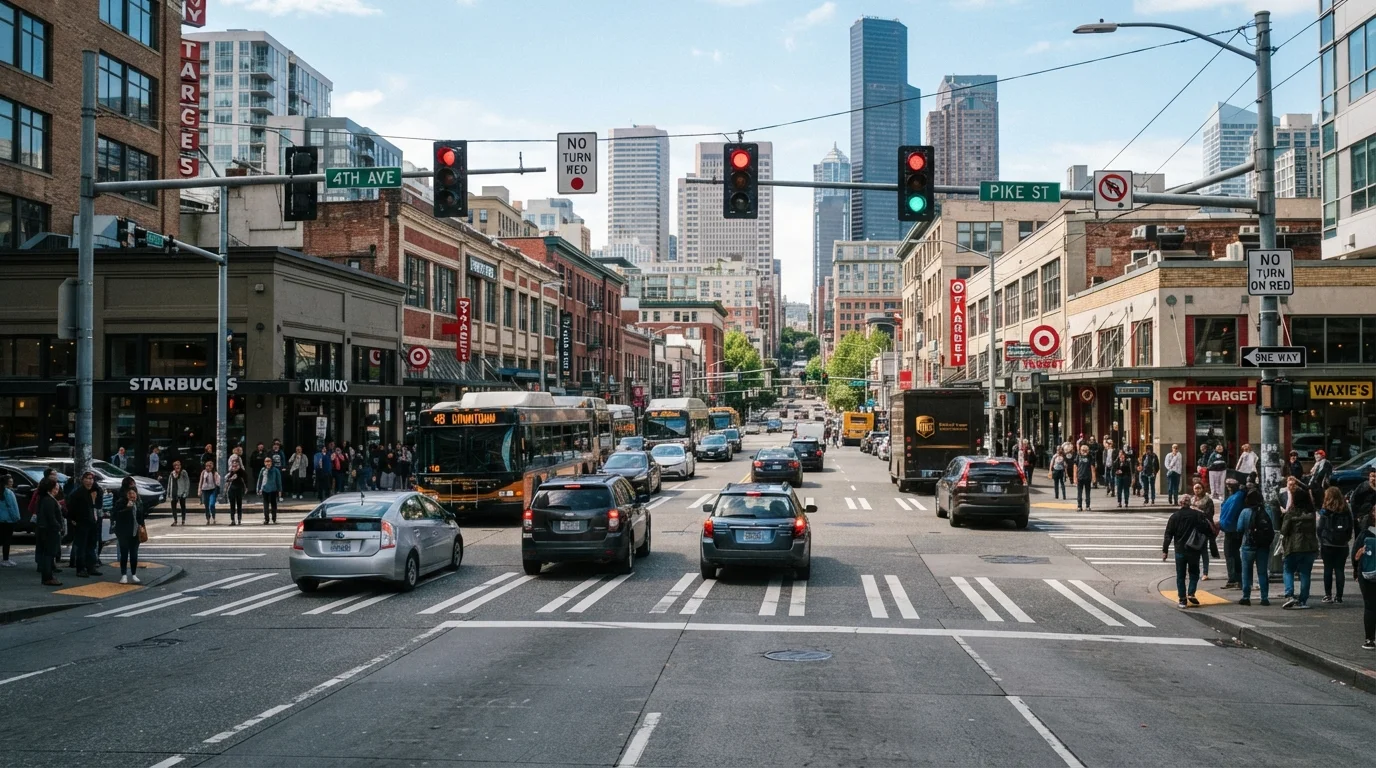
Signalized intersections are the most straightforward: follow the light. A green signal grants passage; a red requires a full stop. However, even with a green light, drivers must yield to pedestrians in the crosswalk and cannot enter an intersection if they cannot clear it before the light changes (a practice known as blocking the box, which is illegal in many jurisdictions).
At four-way stops, the rules follow a clear hierarchy:
- The first vehicle to arrive and stop proceeds first.
- When two vehicles stop simultaneously side by side, the driver on the left yields to the driver on the right.
- When two vehicles stop simultaneously facing each other, right-turning drivers yield to left-turning drivers, and left-turning drivers must yield to oncoming through traffic.
At uncontrolled intersections — those without any signs or signals — drivers must treat the crossing with caution and yield to any vehicle already in the intersection. The same right-of-left principle applies when arrival times are unclear.
Never assume right of way is guaranteed
Even when traffic law entitles you to proceed, a defensive driving mindset means verifying that other road users are actually yielding before you move. A split-second check can prevent a collision even when you're legally in the right. Being legally correct after a crash is far less valuable than avoiding the crash entirely.
Roundabouts, Merges, and Special Situations
Roundabouts follow a simple rule: vehicles already circulating inside the roundabout have the right of way. Entering drivers must yield to all traffic in the circle before proceeding. This design reduces conflict points compared to traditional intersections and generally improves safety when navigated correctly.
Highway merges require entering drivers to yield to existing highway traffic. On-ramp drivers should use the acceleration lane to match speed and find a gap — not force their way into traffic. In most US states, highway drivers are not legally required to move over for merging vehicles, though doing so when safe is considered courteous and practical.
Emergency vehicles always supersede standard right-of-way rules. When an authorized emergency vehicle is using audible or visual signals (sirens and lights), drivers in every state are required by law to pull to the right edge of the road and stop until the vehicle has passed. Failure to do so is a traffic violation and can result in substantial fines.
Conditions like rain, fog, or ice can affect how right-of-way situations unfold safely. Our article on driving in adverse weather explains the legal and practical adjustments drivers must make.
Pedestrians, Crosswalks, and Vulnerable Road Users
In the vast majority of US states, drivers must yield to pedestrians in both marked crosswalks and unmarked crosswalks (the implied crossing at any intersection where sidewalks meet). A pedestrian who has entered the crosswalk with the intent to cross generally has the right of way, and drivers approaching must slow or stop to allow safe passage.
This obligation does not evaporate simply because a pedestrian is crossing mid-block or at an unexpected location. Most state vehicle codes require drivers to exercise due care to avoid colliding with pedestrians regardless of legal right of way. Contributory negligence on the part of a pedestrian may affect legal liability, but it does not excuse a driver from reasonable caution.
Cyclists operating in the roadway as vehicles follow the same right-of-way rules as motor vehicles at intersections. When a cyclist uses a crosswalk, they may be treated as a pedestrian under some state laws — a nuance worth understanding. For a deeper look, see pedestrian and cyclist rights on US roads.
Related responsibilities, such as behavior in school zones and work zones, add further layers to how drivers must interact with vulnerable road users.
Right-of-Way Rules Vary by State
While core principles are consistent across the US, specific provisions — such as rules for cyclists in crosswalks, T-intersections, or private driveways — can differ by state. Always consult your state's current driver handbook or vehicle code for jurisdiction-specific guidance. The FHWA and your state DMV are reliable official sources.