

| Typical school zone speed limit | 15–25 mph (Varies by state and local ordinance) |
| Fine multiplier in school zones | 2x–3x standard fine (Varies by state; e.g., New York, California) |
| Work zone fine doubling | Required in all 50 states (Federal Highway Administration guidance) |
| Move Over Law adoption | All 50 states (American Automobile Association (AAA)) |
| Advance warning sign distance | 500–1,000 feet before zone (Manual on Uniform Traffic Control Devices (MUTCD)) |
| Flagger legal authority | Equivalent to posted signs (Most state traffic codes) |
Why These Zones Carry Extra Legal Weight
School zones and work zones are among the most strictly regulated stretches of road in the United States. Unlike ordinary posted speed limits, the rules governing these areas are designed to protect some of the most vulnerable people on or near roadways — children walking to school and construction workers standing feet from moving traffic.
Violations in these zones typically carry higher fines, additional penalty points, and in some states, mandatory court appearances. Ignorance of a zone's boundaries or hours is rarely a valid legal defense. Understanding what the law requires — not just what seems reasonable — is the starting point for every driver passing through.
For a broader look at how speed limit categories work across US roads, see our guide to US speed limit signs.
| Typical school zone speed limit | 15–25 mph (Varies by state and local ordinance) |
| Fine multiplier in school zones | 2x–3x standard fine (Varies by state; e.g., New York, California) |
| Work zone fine doubling | Required in all 50 states (Federal Highway Administration guidance) |
| Move Over Law adoption | All 50 states (American Automobile Association (AAA)) |
| Advance warning sign distance | 500–1,000 feet before zone (Manual on Uniform Traffic Control Devices (MUTCD)) |
| Flagger legal authority | Equivalent to posted signs (Most state traffic codes) |
School Zone Laws: Core Requirements
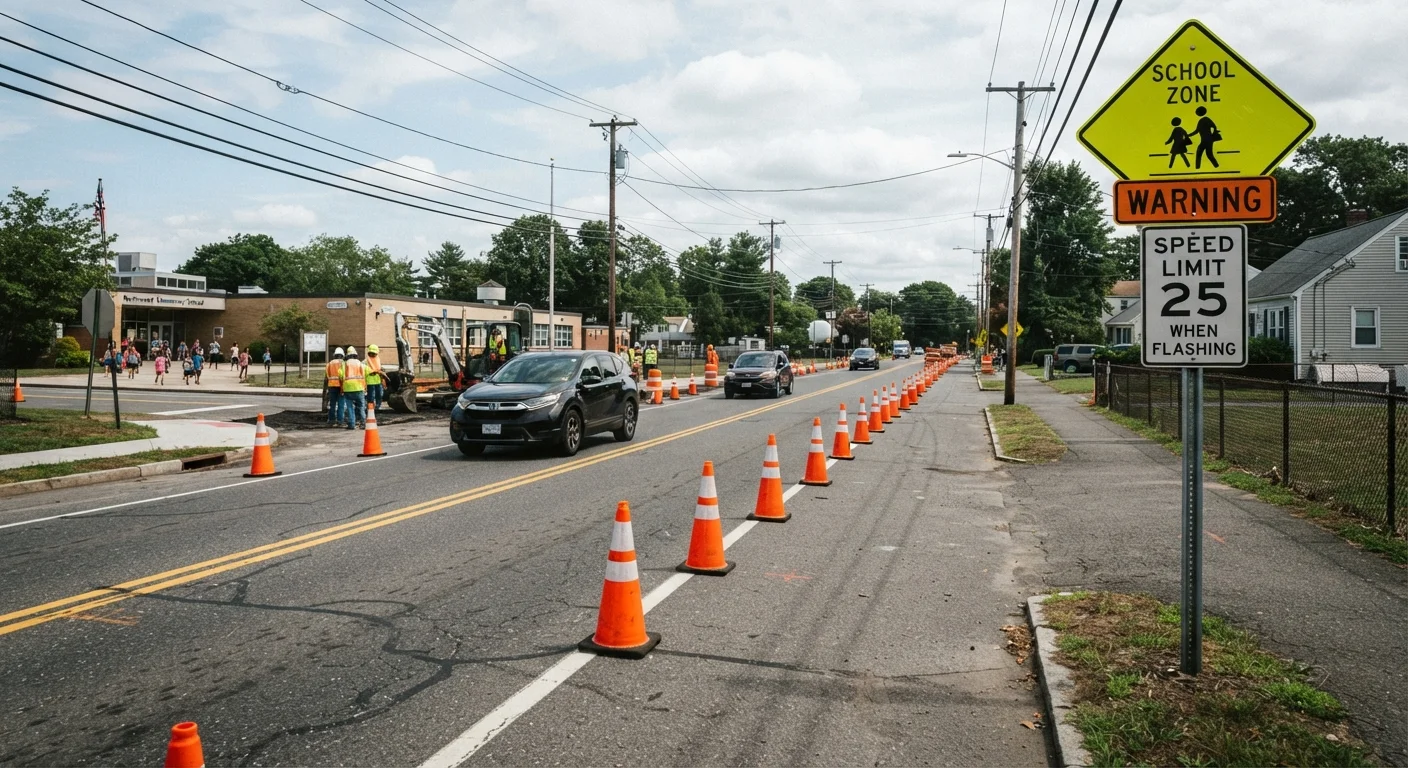
School zone speed limits in the US typically range from 15 to 25 mph, though exact limits vary by state and municipality. In most jurisdictions, these reduced limits apply during specific hours — commonly when children are arriving or departing — and are often displayed on the zone signs themselves. Some states apply the reduced limit whenever a school zone sign is posted, regardless of time or school calendar.
Key obligations for drivers in school zones
- Reduce speed to the posted school zone limit when the zone is active.
- Stop for school buses displaying flashing red lights and an extended stop arm — in most states this applies to both directions of travel on undivided roads.
- Yield to pedestrians at crosswalks, including those controlled by crossing guards.
- Avoid using a handheld mobile device — many states impose stricter distracted-driving penalties inside school zones.
- Do not pass other vehicles in or near a school zone unless explicitly permitted by signage.
Fines for school zone speeding are routinely doubled or tripled compared to standard violations. Some states, such as New York and California, automatically double the base fine when the offense occurs in a school zone. Court surcharges and license points often apply on top of the monetary penalty.
Drivers should also be aware that pedestrians hold specific legal protections that are especially enforced near schools and crosswalks.
School zone
A designated stretch of road near a school where reduced speed limits and additional traffic rules apply during specified hours to protect students. The active hours are typically posted on the zone signs.
Work zone
A section of road where construction, maintenance, or utility work is taking place, marked by signage, cones, and sometimes flaggers. Reduced speed limits and special rules apply whenever workers or equipment are present.
Flagger
A trained worker stationed in or near a work zone who directs traffic using handheld signs or paddles. In most states, flagger instructions carry the same legal authority as posted traffic signs.
Move Over Law
A law requiring drivers to slow down and, where safe, change lanes when passing stationary emergency, law enforcement, or highway maintenance vehicles displaying flashing lights. Adopted in all 50 states.
Stop arm (school bus)
The extendable red arm deployed from the left side of a school bus when loading or unloading students. Drivers on most road types are legally required to stop when it is extended and red lights are flashing.
Work Zone Laws: What Drivers Must Do
Work zones — also called construction zones — are active whenever workers, equipment, or lane alterations are present on a roadway. Federal law and all 50 states require reduced speeds in these areas. The Move Over Law, adopted in every state, also requires drivers to slow down or change lanes when passing stationary emergency or maintenance vehicles with flashing lights.
Standard work zone requirements
- Obey posted work zone speed limits, which commonly drop 10–15 mph below the normal limit for that road.
- Merge early and yield when lane closures are indicated by signage, cones, or flaggers — late aggressive merging is both dangerous and, in many jurisdictions, a citable offense.
- Follow flagger instructions — flaggers have the same legal authority as posted signs in most states. Disregarding them can result in traffic citations.
- Maintain safe following distance; sudden stops are common where heavy equipment crosses travel lanes.
- Do not use a handheld device — many states impose elevated fines for distracted driving in work zones.
857
Work zone fatalities in a single recent year
According to the Federal Highway Administration, work zone crashes kill hundreds of workers and motorists annually in the United States.
2x–4x
Fine multiplier for speeding with workers present
Several states, including Illinois and Virginia, impose significantly higher fines when construction workers are actively present in the zone.
All 50
States with work zone fine-doubling laws
Every US state has enacted legislation requiring enhanced penalties for traffic violations committed within active work zones.
Work zone fines are frequently doubled in active construction areas when workers are present. Some states, including Illinois and Virginia, impose mandatory minimum fines or add surcharges that can push total penalties into hundreds of dollars for a single offense. Repeat work zone violations may result in license suspension in certain states.
Understanding lane behavior around work zones is also relevant — improper lane changes near cones and closures are a common source of citations and collisions.
Enforcement, Penalties, and Practical Reminders
Both school zones and work zones increasingly use automated enforcement — speed cameras and red-light cameras — in addition to police patrols. Camera-based citations are generally upheld by courts and do not require a law enforcement officer to be present at the time of the violation.
A practical checklist for any driver approaching these zones:
- Look for advance warning signs, which typically appear 500–1,000 feet before the zone begins.
- Check posted hours on school zone signs before assuming the reduced limit is or isn't active.
- Scan for workers, flaggers, and equipment — their presence often triggers higher fine thresholds.
- Eliminate distractions before entering, not after you've already crossed the zone boundary.
- Plan extra travel time when a known work zone is on your route.
For related road safety obligations, including rules that apply in adverse conditions common near construction sites, see driving in adverse weather: rules and legal obligations.
This article provides general legal and safety information for US drivers. Traffic laws vary by state and municipality. Consult your state's Department of Motor Vehicles or a licensed attorney for guidance specific to your jurisdiction.