

Key Takeaways
Option A
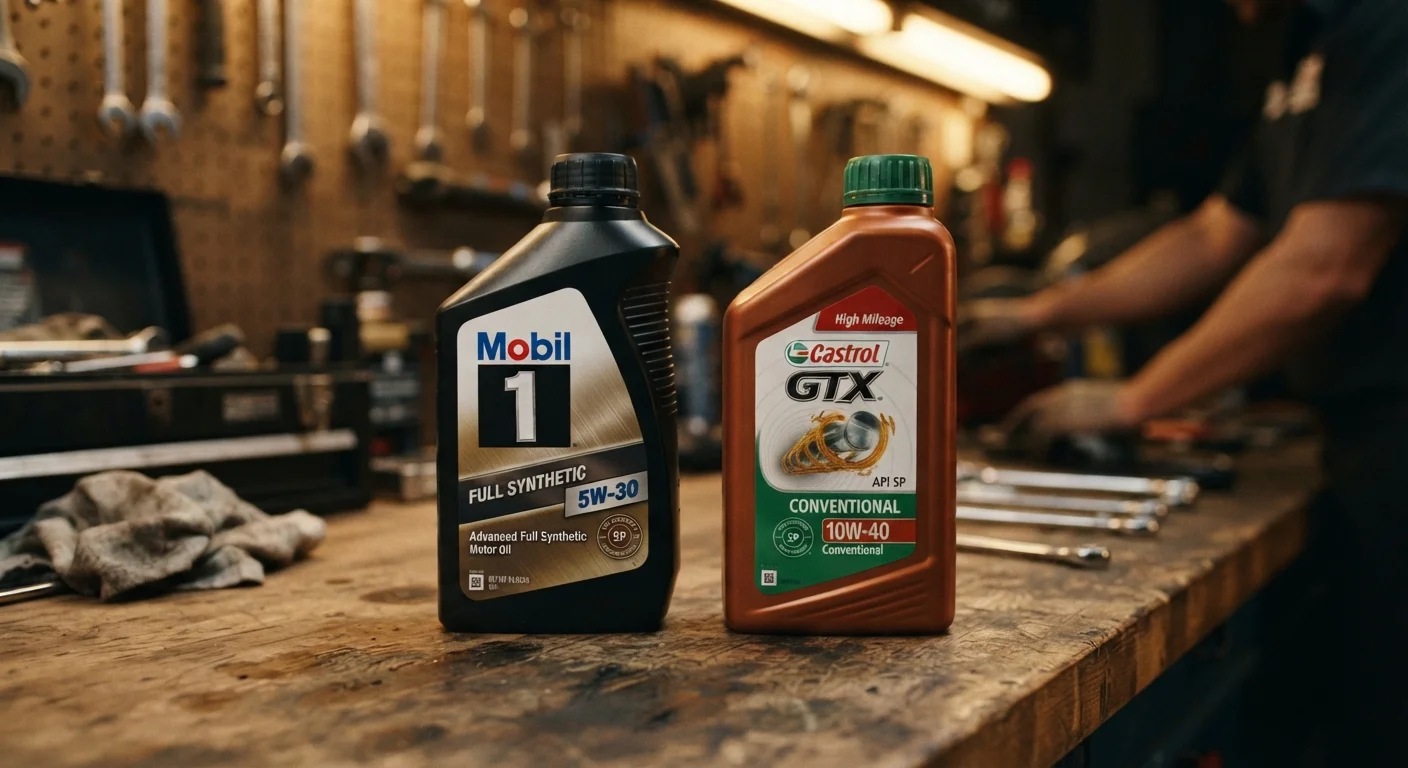
Synthetic Motor Oil
The engineered, high-performance lubricant built for demanding conditions.
Best for: Drivers with newer vehicles, turbocharged engines, extreme climates, or extended oil change intervals.
Option B
Conventional Motor Oil
The time-tested, petroleum-based standard for everyday driving.
Best for: Owners of older vehicles with straightforward engines and routine, moderate driving habits.
If you drive a newer vehicle with a turbocharged or high-performance engine
Synthetic Motor Oil
Turbocharged engines run hotter and demand more from their lubricants. Synthetic oil's thermal stability and resistance to breakdown make it the safer, more effective choice.
If you own an older vehicle with high mileage and a simple engine design
Conventional Motor Oil
Older engines designed around conventional oil tolerances may not benefit significantly from synthetic, and conventional oil remains a reliable, cost-effective option for straightforward maintenance.
If you live in a region with extreme cold winters or hot summers
Synthetic Motor Oil
Synthetic oil flows more readily at low temperatures and resists viscosity breakdown in high heat, providing more consistent engine protection across seasonal extremes.
If you drive primarily short urban trips and change oil on a regular short-interval schedule
Conventional Motor Oil
For low-stress driving patterns with frequent oil changes, conventional oil delivers adequate engine protection at a lower per-service cost.
If your manufacturer specifies synthetic oil in the owner's manual
Synthetic Motor Oil
When synthetic is specified, using conventional oil may void warranty coverage and leave the engine under-protected. Always follow manufacturer requirements.
How These Two Oils Are Made — and Why It Matters
The fundamental difference between synthetic and conventional motor oil is how each is produced. Conventional motor oil is refined directly from crude petroleum. During refining, naturally occurring impurities and inconsistent molecules are reduced, but some variation in molecular structure remains. This is fine for engines built to operate within that variability.
Synthetic motor oil, by contrast, is chemically engineered in a laboratory. Manufacturers start with base oil compounds — often derived from natural gas or refined petroleum — and build them up into uniform, purpose-designed molecules. The result is a lubricant with predictable properties, fewer impurities, and greater stability under stress.
That structural difference has real-world consequences. Synthetic oil tends to flow more readily when an engine is cold (reducing wear during the critical first seconds of startup), resist thermal breakdown at high operating temperatures, and last longer before it degrades. Conventional oil does its job well under normal conditions, but its molecular inconsistency makes it more vulnerable at temperature extremes.
For a deeper look at how oil properties like viscosity factor into these differences, see our guide on engine oil grades and viscosity.
| Criterion | Synthetic Motor Oil | Conventional Motor Oil |
|---|---|---|
| Production method | Chemically engineered molecules | Refined from crude petroleum |
| Cold-weather flow | Excellent — flows quickly at startup | Adequate — slower at very low temps |
| Heat resistance | High thermal stability | More prone to breakdown under heat |
| Typical change interval | Up to 10,000–15,000 miles (varies) | 5,000–7,500 miles (varies) |
| Cost per quart | Higher | Lower |
| Required for modern engines | Often required (check manual) | Suitable for older engine designs |
| Impurity levels | Very low — uniform molecules | Some natural variation remains |
Cost, Change Intervals, and Real-World Value
Synthetic motor oil typically costs more per quart than conventional — sometimes two to four times as much. However, cost-per-quart is only part of the picture. Synthetic oil generally supports longer change intervals, meaning fewer services per year for many drivers.
Conventional oil has traditionally been associated with the well-known 3,000-mile change interval, though that figure has been widely outdated for modern engines. Many vehicles using conventional oil are now specified for 5,000–7,500-mile intervals. Full synthetic oil, depending on the vehicle and oil specification, may support intervals up to 10,000–15,000 miles — though manufacturer guidance always takes precedence over general estimates.
5,000–7,500 mi
Typical conventional oil change interval
Most modern vehicles using conventional oil follow manufacturer-specified intervals in this range, well beyond the outdated 3,000-mile guideline.
Up to 15,000 mi
Extended interval possible with full synthetic
Some full synthetic formulations, when paired with compatible vehicles, support extended intervals — though manufacturer guidance always defines the actual limit.
2–4×
Price difference per quart
Synthetic motor oil typically costs two to four times more per quart than conventional oil, though longer intervals can reduce the annual cost gap.
The practical takeaway: a higher upfront cost for synthetic oil may translate to fewer annual oil changes, partially offsetting the price difference. That math varies by vehicle and driving pattern, so it's worth calculating based on your own manufacturer's schedule rather than assuming one type saves more across the board.
Curious whether the 3,000-mile rule still applies to your vehicle? Our article on car maintenance myths addresses this and other outdated assumptions drivers still rely on.
What Your Owner's Manual Actually Says
No marketing claim, shop recommendation, or general guideline overrides one source: your vehicle's owner's manual. Automakers specify the oil type and viscosity grade required for each engine — and those specifications exist because the engine was designed and tested around them.
Many vehicles manufactured after the mid-2000s require full synthetic oil, particularly those with turbocharged engines, direct injection systems, or tight manufacturing tolerances. Using conventional oil in an engine specified for synthetic can accelerate wear and, in some cases, affect warranty coverage.
Switching Oil Types in an Older Engine
If you own a high-mileage or older vehicle currently running on conventional oil, switching to synthetic is generally considered safe by most automotive engineers. However, some older engines with worn seals may experience minor oil seepage after the switch, as synthetic oil's smaller molecules can pass through degraded gaskets more readily. If your vehicle has significant mileage or known seal wear, it's worth discussing the switch with a qualified mechanic before making the change.
Conversely, if your owner's manual specifies conventional oil and your vehicle is running well, there is generally no mechanical need to upgrade to synthetic. You may see marginal gains in some driving conditions, but you're not necessarily protecting your engine better than the manufacturer intended.
Learning to navigate your owner's manual confidently is a skill worth developing. Our editorial guide on how to read your owner's manual like a mechanic would walks through which sections matter most for maintenance decisions.
If you're new to vehicle ownership and building your maintenance knowledge from the ground up, the practical introduction to keeping your car roadworthy is a useful starting point for the full maintenance picture.