

Key Takeaways
Wireless Charging
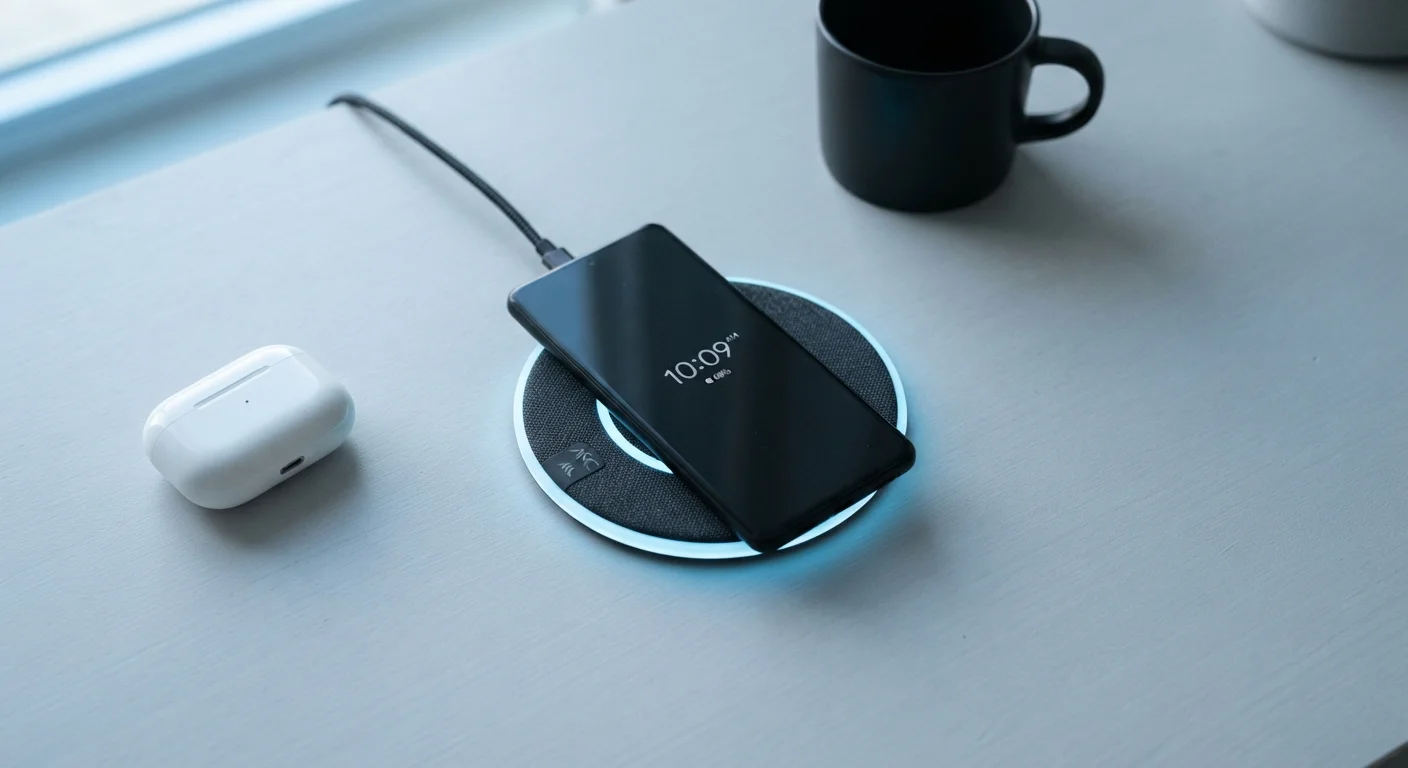
Wireless charging is a method of transferring electrical energy from a charging pad to a device — such as a smartphone — without a physical cable. It works by using electromagnetic fields to move energy between two coils: one inside the pad and one inside the device. When the device is placed on or near the pad, the coils work together to replenish the battery.
Most consumer wireless charging relies on electromagnetic induction operating at frequencies around 100–205 kHz, as defined by the Qi standard developed by the Wireless Power Consortium.
From Coil to Current: The Core Physics
Wireless charging is grounded in a principle discovered in the 19th century: electromagnetic induction. When alternating electrical current flows through a copper coil, it generates a fluctuating magnetic field around it. If a second coil sits within that field, the changing magnetism induces a new electrical current in the second coil — no physical contact needed.
In a wireless charger, the pad's internal coil is the transmitter. Your device's internal coil is the receiver. The pad converts AC power from the wall outlet into a high-frequency alternating current, which drives the transmitter coil. Your phone's receiver coil picks up the resulting magnetic field and converts it into DC current — the form of electricity that actually charges the battery.
This is essentially the same physics principle used in electric transformers and induction stovetops, just miniaturized and tuned for consumer electronics.
15W
Standard Qi fast wireless charging output
The Qi 1.3 specification supports up to 15W for certified devices, though many base chargers deliver 5W–7.5W.
~80–85%
Typical wireless charging energy efficiency
Energy transfer efficiency for inductive charging is generally lower than wired connections, with the remainder lost as heat.
4mm
Maximum effective air gap for induction
Most consumer wireless charging coils function reliably only within a few millimeters of the transmitter surface.
The Qi Standard: How Devices Agree to Talk
Having two coils in proximity isn't enough on its own — the charger and device also need to communicate. That's where the Qi standard comes in. Qi defines a two-way communication protocol that lets the charging pad and device negotiate the correct power level, monitor temperature, and detect foreign objects (like coins or keys) that shouldn't be on the pad.
When you place a Qi-compatible phone on a Qi pad, the pad sends a low-power signal. The phone responds with information about how much power it needs. The pad then adjusts its output accordingly. This handshake happens automatically and continuously during the charging session. If something goes wrong — say, a metal object is detected — the pad reduces or cuts power to prevent overheating.
The Qi standard has evolved over time to support higher wattages, enabling what manufacturers market as wireless fast charging. Understanding the battery that receives all this power is equally important — see our explainer on lithium-ion battery chemistry for a deeper look at how charge cycles and voltage work.
Match Wattage for Fastest Charging
Your wireless charging speed is limited by whichever component — pad or device — supports the lower wattage. Placing a phone that supports 15W on a 5W pad will charge at 5W. Check both the pad's output rating and your device's supported wattage to get the fastest wireless speed available to you.
Efficiency, Heat, and Real-World Trade-offs
Wireless charging is convenient, but it isn't as efficient as plugging in a cable. Some energy is lost in the transfer between coils — typically as heat. A wired charger might convert over 90% of drawn power into stored battery energy, while a wireless charger often converts roughly 80–85%, with the remainder dissipated as warmth in the pad and device.
This heat is worth noting because sustained elevated temperatures can accelerate wear on lithium-ion cells over time. It's one reason many wireless charging pads include thermal management features, and why placing a device in a thick insulating case during wireless charging isn't ideal.
Alignment also matters more than many users realize. Coils that are significantly misaligned waste more energy and may trigger the pad to reduce output or stop charging entirely. Some premium pads address this with multi-coil arrays or magnetically guided alignment systems.
Foreign Object Detection Is a Safety Feature
Qi chargers are designed to detect metallic objects — like coins or keys — placed on the pad alongside a device. When detected, the pad reduces or stops power output to prevent the object from heating up. This is an intentional safety mechanism, not a flaw. Remove any metal objects from the pad surface before placing your device.
What Wireless Charging Isn't
A common misconception is that wireless charging works like Wi-Fi or Bluetooth — broadcasting energy across a room. It doesn't. Electromagnetic induction requires close proximity, typically within a few millimeters to centimeters. The term "wireless" simply means no physical cable connector, not that energy travels any meaningful distance.
Longer-range wireless power transmission does exist in research and some niche applications, but the technology used in everyday consumer charging pads is strictly short-range induction. For comparison, the wireless protocols that actually do transmit data across rooms — like the standards explored in our guide to smart home wireless protocols — operate on entirely different physical principles and use radio frequency waves rather than magnetic fields.
Understanding this distinction helps set accurate expectations: wireless charging is an ergonomic convenience, not a fundamentally new form of energy delivery. Its value lies in eliminating wear on charging ports and reducing cable clutter — practical benefits that have made it a standard feature in modern smartphones, earbuds, and smartwatches.