

Key Takeaways
Lithium-Ion Battery
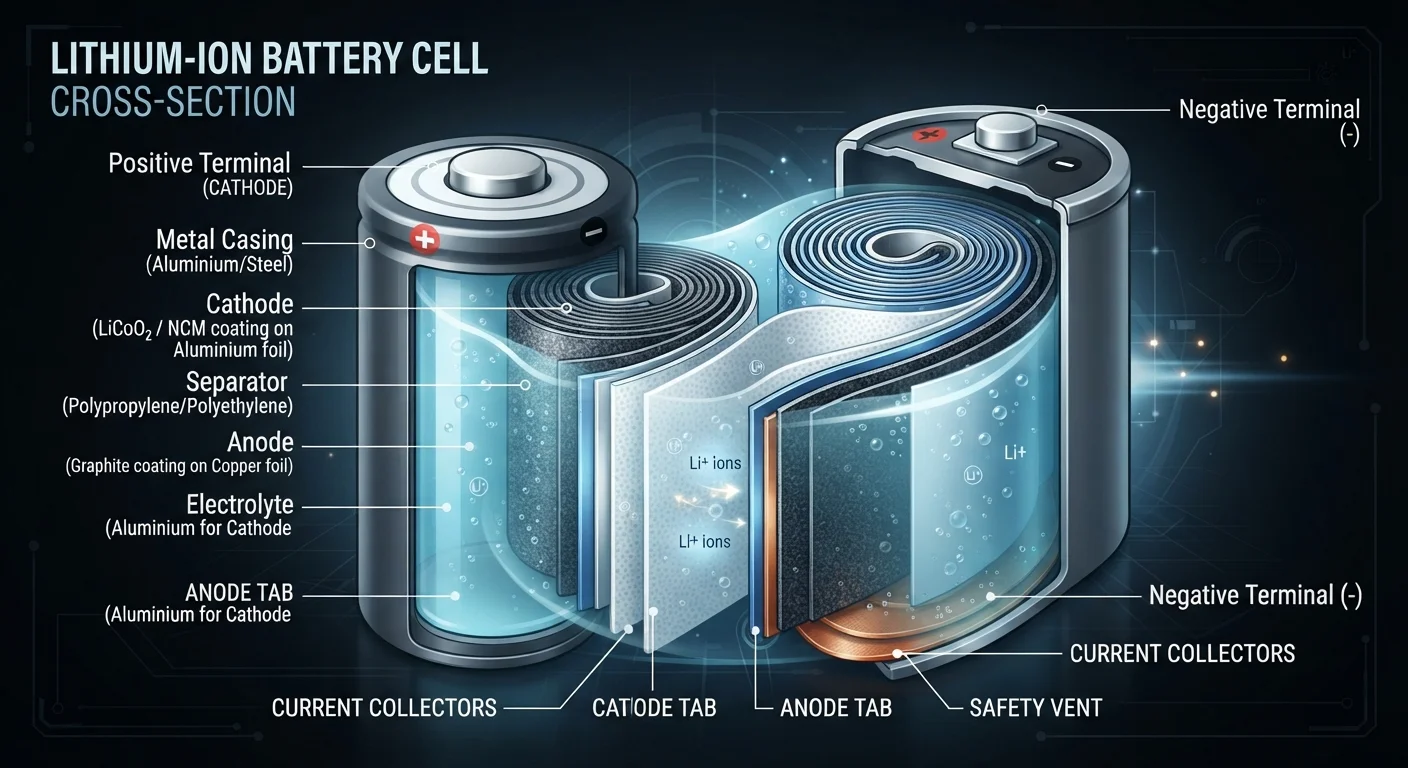
A lithium-ion battery is a rechargeable energy storage device that works by moving lithium ions between two electrodes — the anode and cathode — through a liquid electrolyte. When you charge the battery, ions travel one direction; when the device draws power, they flow back. This reversible movement is what makes the battery rechargeable. They are the dominant power source in smartphones, laptops, electric vehicles, and countless other modern devices.
The anode is typically made of graphite, while the cathode commonly uses lithium metal oxides such as lithium cobalt oxide (LiCoO₂) or lithium iron phosphate (LiFePO₄). The electrolyte is usually an organic solvent containing a dissolved lithium salt.
How Energy Is Actually Stored
Despite powering nearly every device in your home, the lithium-ion battery is widely misunderstood. The word "battery" calls to mind a container of stored electricity, but that's not quite what's happening. Energy is stored chemically — specifically, in the position of lithium ions relative to two electrodes called the anode and the cathode.
When you plug in your phone, an external current forces lithium ions from the cathode, through the electrolyte, and into the graphite anode, where they nestle between layers of carbon atoms. When your device runs, those ions migrate back to the cathode, and the movement generates an electric current. The electrolyte acts as a highway for ions but blocks electrons, forcing them to travel through the device's circuit instead — which is what powers your screen, processor, and everything else.
This elegant back-and-forth is what makes lithium-ion chemistry so practical: it's energy-dense, relatively stable, and can repeat the process hundreds of times. For a look at how this stored energy relates to your overall home power use, see our article on how everyday devices consume electricity.
300–500
Typical full charge cycles before significant capacity loss
Most lithium-ion cell manufacturers rate their cells to retain roughly 80% capacity within this cycle range under standard conditions.
~80%
Capacity retained at end of rated cycle life
Industry convention defines end-of-life for a battery cell as the point at which it holds 80% or less of its original energy capacity.
3.0V–4.2V
Safe operating voltage range per cell
Lithium-ion cells are designed to operate within this narrow window; exceeding these limits risks damage or, in extreme cases, thermal runaway.
What a Charge Cycle Really Means
You've probably heard that batteries have a limited number of "charge cycles" — but the definition surprises most people. A single charge cycle isn't one plug-in session. It represents using 100% of the battery's total capacity, which can happen across multiple partial charges.
Use 40% of your battery today, top it back up, then use another 60% tomorrow — that's one full cycle. Most lithium-ion cells are rated for roughly 300–500 full cycles before capacity drops to about 80% of the original. Some newer formulations, particularly in electric vehicles, are engineered to handle far more.
Partial discharges are actually gentler on the battery than full ones. Letting a battery run to near-zero repeatedly stresses the anode more than keeping the charge in a comfortable middle range. This is why many battery researchers suggest staying between approximately 20% and 80% for everyday use — though the practical difference for typical phone users is modest.
The 20–80 Rule for Everyday Charging
For devices you use daily, many battery researchers suggest keeping the charge level between roughly 20% and 80% rather than cycling from 0% to 100% regularly. This reduces peak voltage stress on the cathode and deep-discharge stress on the anode. Most modern smartphones have settings that can automate this behavior.
The Real Enemy: Heat and Voltage Extremes
If charge cycles are the clock of battery life, heat is what speeds it up. Elevated temperatures accelerate the chemical reactions inside a cell — including the unwanted ones, like electrolyte decomposition and the buildup of a layer on the anode called the solid electrolyte interphase (SEI). As the SEI thickens over time, it traps lithium ions permanently, reducing the total charge the battery can store.
Leaving a device in a hot car, charging it while running intensive tasks, or using it in direct sunlight all add heat stress that compounds with every cycle. Cold is a different problem — it temporarily slows ion movement, reducing available power, but the effect is largely reversible when the device warms up.
Voltage extremes matter too. Cells operate within a narrow safe voltage window — typically 3.0V to 4.2V per cell. Consistently charging to the absolute maximum strains the cathode material. This is why some devices offer an "optimized charging" setting that caps regular charging at around 80%, only completing to 100% when needed.
Understanding how your battery receives its charge — especially through wireless charging pads — adds another dimension to this picture. See how inductive charging works in our explainer on the technology behind wireless charging.
Making Your Battery's Hidden Life Last Longer
The chemistry inside a lithium-ion cell is fixed by the manufacturer, but how long it stays healthy depends significantly on everyday habits. The biggest gains come from temperature management and avoiding sustained extremes of charge.
Battery Health Varies by Device Type
The degradation patterns described here apply broadly to lithium-ion chemistry, but specific behavior varies by cell design, device thermal management, and software. Electric vehicle batteries, for example, use more sophisticated thermal regulation systems and are engineered for considerably more cycles than typical consumer electronics cells. Always check manufacturer guidance for your specific device.
Software has also become a significant factor. Modern operating systems on phones and laptops actively monitor battery health and adjust charging behavior automatically. Features like adaptive charging, battery health dashboards, and charge-limiting modes give users more visibility and control than ever before.
For a broader set of practical habits — covering charging behavior, software upkeep, and physical care — our guide on keeping gadgets running longer goes into greater depth. Understanding what's happening inside the cell makes those recommendations far easier to follow consistently.