

| Formula to calculate kWh | (Watts × Hours used) ÷ 1,000 |
| Formula: Watts from Amps & Volts | W = Amps × Volts |
| Standard US outlet voltage | 120 V |
| Typical US electricity rate range | $0.10–$0.20 per kWh (US Energy Information Administration) |
| EnergyGuide label authority | US Federal Trade Commission (FTC) |
| ENERGY STAR program authority | US Environmental Protection Agency (EPA) |
What Watts and Kilowatt-Hours Actually Mean
Every electrical device in your home is rated in watts (W) — a unit that describes how fast it consumes energy at any given moment. A 60-watt light bulb uses energy at that rate continuously while it's on. A kilowatt-hour (kWh) is what you actually pay for: one kilowatt (1,000 watts) of power used for one hour. Run that 60W bulb for roughly 17 hours and you've consumed one kWh.
Your utility bill is priced in kWh, typically somewhere between $0.10 and $0.20 per kWh depending on your location and provider. Understanding this relationship — watts describe the rate, kWh describes the total — is the foundation of reading any device label meaningfully.
| Formula to calculate kWh | (Watts × Hours used) ÷ 1,000 |
| Formula: Watts from Amps & Volts | W = Amps × Volts |
| Standard US outlet voltage | 120 V |
| Typical US electricity rate range | $0.10–$0.20 per kWh (US Energy Information Administration) |
| EnergyGuide label authority | US Federal Trade Commission (FTC) |
| ENERGY STAR program authority | US Environmental Protection Agency (EPA) |
The label on most devices lists either a wattage or an amperage and voltage figure. If you see amps (A) and volts (V) but no watts, multiply them together: W = A × V. A device drawing 2 amps on a standard US 120V outlet uses approximately 240 watts.
Standby Power: The Draw You Don't See
Most devices don't fully power off when you press the power button — they enter a low-power standby or idle state, continuing to draw electricity. This is sometimes called phantom load or vampire power. A TV in standby might use 1–5 watts; a gaming console left in rest mode can draw considerably more — sometimes 10–15 watts — depending on its configuration.
Individually, these figures seem trivial. Multiplied across every device in a home running 24 hours a day, the aggregate can meaningfully contribute to a household's baseline energy consumption. The Lawrence Berkeley National Laboratory has studied standby power extensively, estimating that always-on and standby loads account for a notable share of residential electricity use in the US.
Standby Draw Adds Up Across Devices
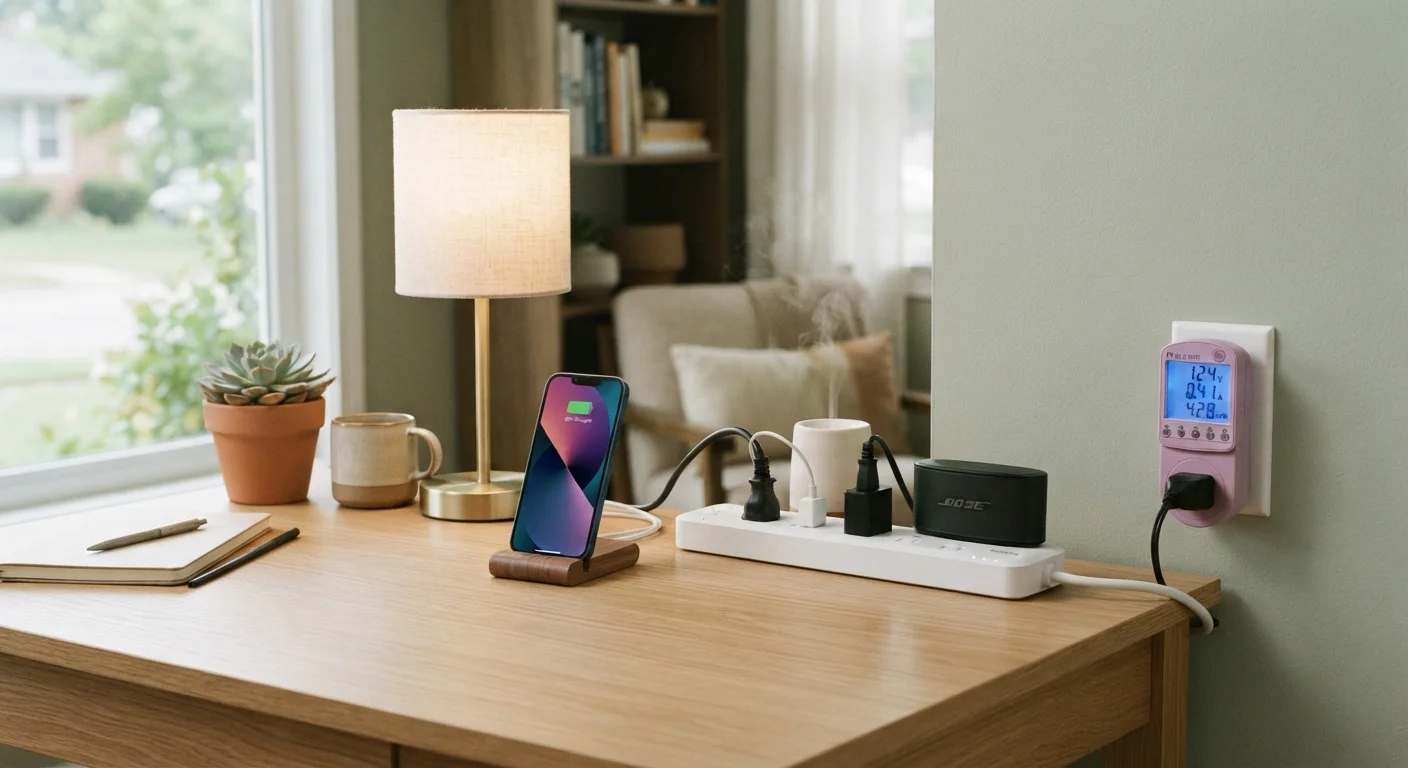
A single device in standby may seem insignificant, but a home with a TV, gaming console, cable box, router, and several phone chargers always plugged in can accumulate dozens of watts in continuous background draw. Over a full year, that translates to a measurable portion of your electricity bill. Unplugging devices not in regular use — or using a smart power strip — can reduce this load without changing your daily habits.
Smart plugs with energy-monitoring features can reveal exactly how much standby power individual devices draw. See how smart plugs track energy consumption for a practical look at putting that data to use.
Reading Device Labels and Energy Ratings
Regulatory labels like the ENERGY STAR certification (a US EPA program) indicate that a device meets defined efficiency thresholds compared to baseline models in its category. The yellow EnergyGuide label found on major appliances goes further, estimating annual energy use in kWh and approximate yearly operating cost based on a national average electricity rate.
Watt (W)
A unit of power describing the rate at which a device consumes electricity at any given moment. Higher wattage means faster energy consumption.
Kilowatt-hour (kWh)
The standard unit used by utilities to measure and bill electricity consumption. One kWh equals 1,000 watts used continuously for one hour.
Standby power
The electricity a device consumes while switched off or in a low-power idle state. Also called phantom load or vampire power, it can accumulate significantly across many devices.
EnergyGuide label
A federally required yellow label on major US appliances that estimates annual energy consumption in kWh and approximate operating cost based on average electricity rates.
ENERGY STAR
A voluntary certification program run by the US Environmental Protection Agency indicating that a product meets established energy-efficiency standards for its category.
Phantom load
Energy drawn by a device that is plugged in but not actively in use. Common in televisions, gaming consoles, and cable boxes left in standby mode.
When comparing two similar appliances, the EnergyGuide's kWh figure — not the price tag or the wattage alone — gives you the clearest picture of long-term operating cost. A larger refrigerator might list a higher wattage but run fewer compressor cycles and ultimately consume less energy annually than a smaller model with a less efficient motor.
For smaller electronics, the wattage printed on the device or its power adapter is the maximum rated draw, not necessarily the typical operating draw. Actual consumption varies depending on workload — a laptop under heavy processing load can draw close to its rated maximum, while the same laptop streaming video at moderate brightness may draw half that.
Understanding wireless protocols used by smart devices also plays into their energy footprint. How wireless protocols like Zigbee and Thread affect energy use is worth knowing if you're building out a connected home.
Common Device Categories and Typical Ranges
Energy use varies widely by device type. The ranges below reflect general, publicly available data and are meant as orientation, not guarantees for any specific model.
~10–15 W
Typical gaming console standby draw
Consoles left in rest/standby mode can draw this continuously, per published measurements from energy research organizations.
4,000–6,000 W
Electric clothes dryer rated power
Heat-generating appliances rank among the highest single-use energy draws in a typical US home.
300–600 kWh
Typical annual refrigerator energy use
Actual use varies significantly by age, size, and efficiency rating of the unit.
- Refrigerators: 100–400 W rated; typically 300–600 kWh annually depending on size and age
- Televisions: 30–200 W during active use; modern LED sets are substantially more efficient than older plasma models
- Desktop computers: 60–250 W under load; idle draw is much lower
- Phone chargers: 5–25 W while actively charging; near zero when idle with no phone connected
- Electric clothes dryers: 4,000–6,000 W — among the highest-draw household appliances
Heat-generating appliances (dryers, electric ovens, space heaters, hair dryers) consistently sit at the top of household energy use because converting electricity to heat is inherently power-intensive. Smart home ecosystems can help schedule these loads thoughtfully — see how smart home devices coordinate for context on how that coordination works.
Device longevity also affects overall energy footprint over time. Habits that extend device lifespan can reduce the energy and resources tied to frequent replacements.