

Key Takeaways
Start here
Why Megapixels Aren't the Whole Story
Core concept
How Light Becomes a Photo: Sensors and Aperture Explained
Go deeper
The Role of Multiple Lenses
Modern twist
Computational Photography: Software Doing Heavy Lifting
Apply it
What Specs Actually Matter When You're Taking Photos
Why Megapixels Aren't the Whole Story
Walk into any conversation about smartphone cameras and megapixels come up almost immediately. It's an easy number to compare, but treating it as the primary measure of camera quality leads to a lot of confusion. A megapixel (MP) is simply one million pixels — the individual dots that make up a digital image. Higher megapixel counts allow you to crop images more aggressively or print at larger sizes without losing detail. But they say nothing about how well the camera performs in a dim restaurant or how accurate its colors are.
Several other variables shape image quality far more meaningfully in everyday shooting: sensor size, aperture, lens quality, and the software running behind the scenes. Understanding each of these helps explain why two phones with similar megapixel counts can produce strikingly different results. For a useful parallel, see our plain-language display glossary — the same principle applies to screens, where raw pixel count tells only part of the story.
Megapixel
One million pixels. Describes the resolution of an image — how many individual dots of color it contains — but does not directly indicate photo quality.
Image sensor
The silicon chip inside a camera that converts incoming light into digital data. Larger sensors generally produce cleaner images, especially in low light.
Aperture
The size of the opening in a lens that allows light through, expressed as an f-number. A lower f-number means a wider opening and more light reaching the sensor.
Optical zoom
Magnification achieved using physical lens elements, which preserves image sharpness. Different from digital zoom, which simply crops and enlarges the existing image.
Computational photography
The use of software algorithms to create or enhance photos — for example, by combining multiple exposures or simulating depth-of-field blur.
Bokeh
The blurred, soft appearance of the background in a photo. Naturally produced by wide-aperture lenses; often simulated digitally in smartphone portrait modes.
How Light Becomes a Photo: Sensors and Aperture Explained
When you tap the shutter button, light travels through the lens and strikes an image sensor — a silicon chip covered in millions of tiny light-sensitive sites called photosites. Each photosite measures how much red, green, or blue light hits it, and the phone's processor combines those readings into a full-color image.
Sensor size matters enormously here. Larger sensors have more physical space for each photosite, meaning each one can collect more light. More light means a cleaner signal — and less random noise, which shows up as grain in dark photos. This is why standalone cameras with much larger sensors still have an advantage in challenging lighting, even though the gap has narrowed significantly.
Aperture is the size of the opening in the lens, expressed as an f-number (f/1.8, f/2.4, etc.). A lower f-number indicates a wider opening that admits more light, which helps in low-light conditions and creates a naturally blurred background — a look often called bokeh. Most smartphone lenses have a fixed aperture rather than one that adjusts, which is one reason software plays such a large role in the final image.
Low-Light Shooting? Check the Sensor First
If you frequently take photos indoors or in the evening, sensor size and aperture matter more than megapixels. A phone with a physically larger sensor and a wide aperture (f/1.6 or lower) will produce noticeably cleaner results in dim conditions. Night mode processing can help, but it works best when the hardware underneath is already capable.
The Role of Multiple Lenses
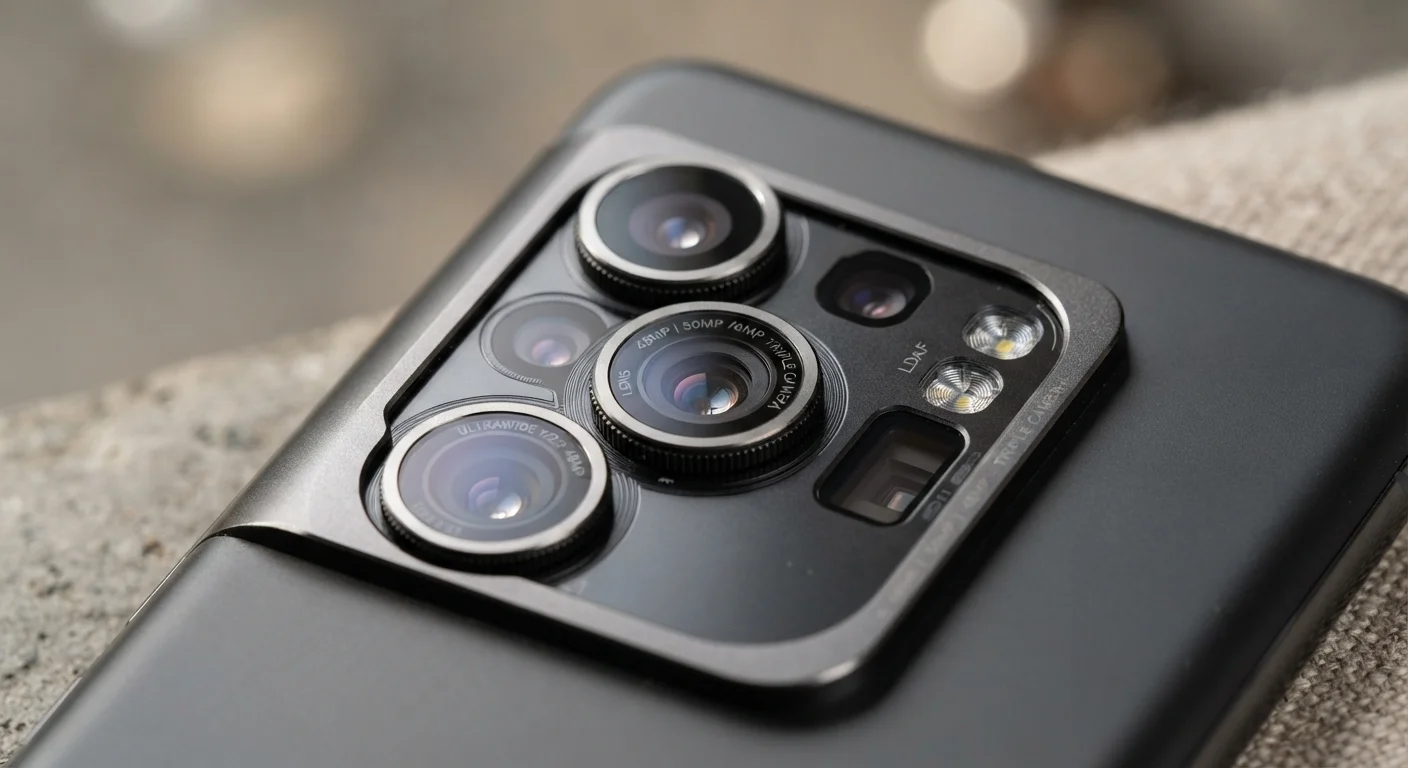
Contemporary smartphones almost always include two or more rear cameras, each with a distinct purpose. A typical setup includes:
- Main (standard) lens: The primary camera optimized for everyday shots, usually housing the largest sensor and widest aperture in the system.
- Ultra-wide lens: Uses a much wider field of view to capture expansive landscapes, architecture, or group photos in tight spaces.
- Telephoto lens: A physically longer focal length that magnifies distant subjects optically — without the quality loss of digital zoom.
Optical zoom happens when the phone switches to the telephoto lens to bring a subject closer using real glass and focal length. Digital zoom simply crops and enlarges the image, which reduces sharpness. The camera app switches between lenses seamlessly as you pinch to zoom, and some phones use interpolation to blend between lenses smoothly.
The front-facing camera follows the same basic principles on a smaller scale — a sensor, a lens, and increasingly capable software — though its aperture and sensor tend to be more limited than the rear system.
The Periscope Telephoto Difference
Some flagship smartphones use a periscope-style telephoto design, which routes light through the lens system sideways using a prism before it reaches the sensor. This allows for a much longer optical focal length within a thin phone body, enabling 5× or even 10× optical zoom without the camera module protruding excessively. It's a clever engineering workaround for the physical constraints of a slim device.
Computational Photography: Software Doing Heavy Lifting
The most dramatic advances in smartphone photography over recent years haven't come from optics — they've come from software. Computational photography refers to the use of algorithms and the phone's dedicated image-processing chips to enhance or construct images in ways that optics alone cannot.
Common examples include:
- HDR (High Dynamic Range): The camera captures multiple frames at different exposures in rapid succession, then merges them. The result retains detail in both bright highlights and dark shadows — something a single exposure often can't achieve.
- Night mode: The sensor captures several frames over a second or two, aligns them to correct for hand movement, and stacks them to brighten the scene while reducing noise.
- Portrait mode bokeh: Software analyzes depth information (sometimes from a second lens or sensor) to blur the background artificially, simulating the look of a wide-aperture lens.
- Scene recognition: The camera identifies what it's looking at — food, a pet, a landscape — and applies tuned processing profiles automatically.
These techniques run invisibly in the background, usually completing within milliseconds of the shutter tap. The image you see on screen is often a composite of multiple captures, processed and refined before it's saved. To understand what else is happening inside your device while you shoot, see our guide on what happens when you tap the screen.
What Specs Actually Matter When You're Taking Photos
With a clearer picture of how these systems work, the camera specs on a product page become easier to interpret. Here's a practical framework:
- Sensor size
- Larger is generally better, especially for low-light shooting. Sometimes listed in fractions of an inch (e.g., 1/1.28") — a smaller denominator means a physically bigger sensor.
- Aperture
- For the main lens, a lower f-number (f/1.5 to f/1.9) captures more light. Useful when comparing cameras for indoor or nighttime performance.
- Optical zoom range
- Look for how many dedicated lenses the phone has and what their optical zoom equivalents are — 2×, 3×, 5× optical zoom each represent a separate physical lens.
- Megapixels
- Relevant mainly if you regularly crop images or print large. For most social sharing and on-screen viewing, 12–24 MP is more than sufficient.
Beyond specs, the software and image processing pipeline differ meaningfully between devices and can be evaluated more reliably through real-world sample photos than through numbers on a spec sheet. Lighting conditions, color science, and how the system handles noise are better judged by looking at actual images — ideally in the scenes you shoot most often.
DPReview Smartphone Camera Comparisons
A well-established photography publication offering in-depth analysis and real-world sample images from smartphone cameras, useful for evaluating how different devices actually perform.
GSMArena Camera Specs Database
A comprehensive phone specification database where you can look up sensor size, aperture, and zoom details for virtually any smartphone released in recent years.