

Key Takeaways
Animal Play Behaviour
Animal play is voluntary, repeated activity that appears pleasurable but serves no immediate survival purpose. It often mimics real-world behaviours — like hunting or fighting — but in a safe, controlled context. Across species, play is widely recognised by researchers as a key driver of physical, cognitive, and social development.
Behavioural scientists classify play into three broad categories: locomotor play (running, jumping), object play (manipulating items), and social play (interactions between individuals). Each type activates distinct neural circuits and serves different developmental functions.
More Than Goofing Around: What Play Actually Is
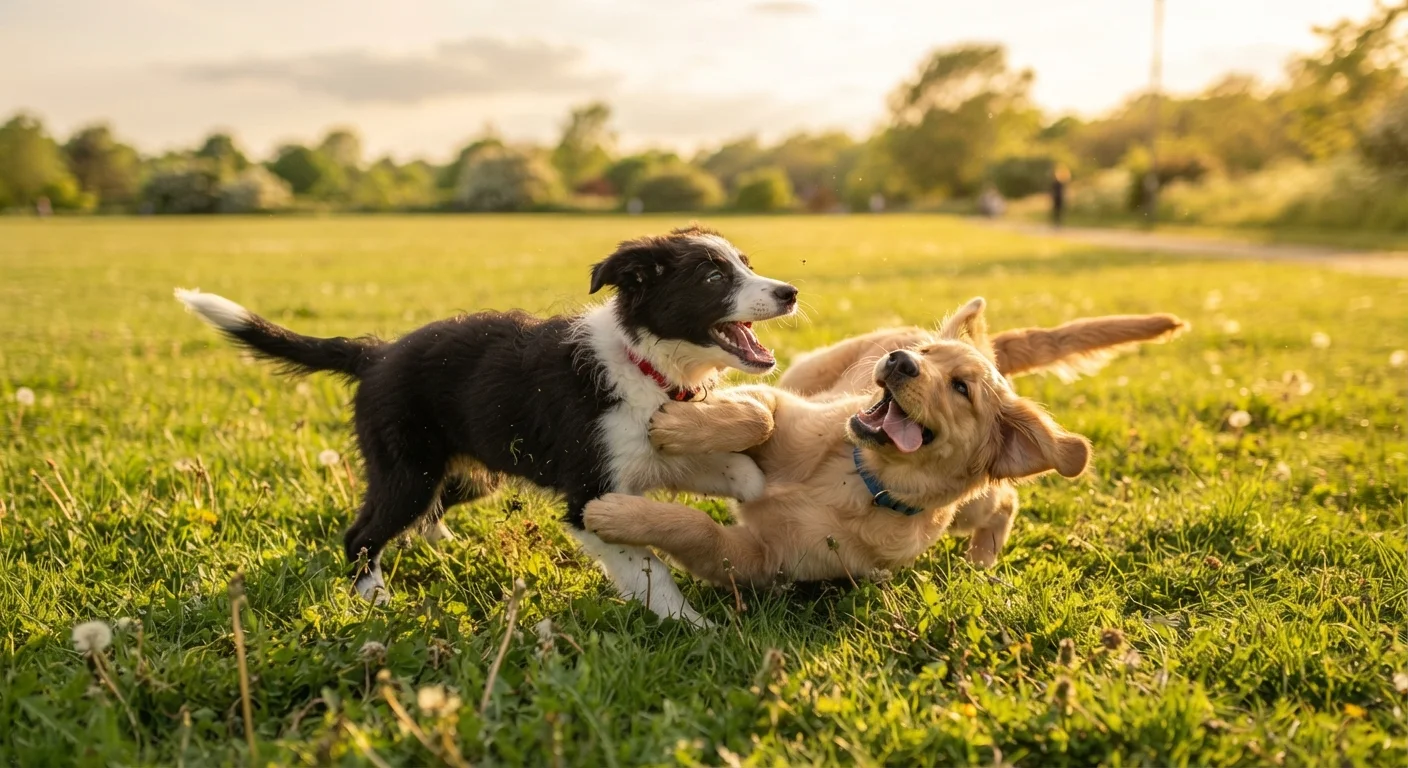
Watch a kitten pounce on a dangling string, or two puppies tumbling across a living room floor, and it's tempting to describe what you're seeing as pure silliness. But researchers who study animal behaviour have spent decades demonstrating that play is among the most purposeful activities an animal can engage in.
Play is defined not just by what animals do, but by how they do it. It's voluntary, intrinsically motivated, and structurally distinct from the real behaviours it mimics. A dog mock-biting a littermate uses far less force than it would in genuine conflict — a phenomenon called self-handicapping, which signals the interaction is cooperative, not competitive.
Understanding play as a signal, not just an activity, helps pet owners build stronger relationships with their animals. To go deeper on how animals communicate through movement and posture, see how animals use body language to communicate.
3
Core categories of animal play identified by researchers
Locomotor, object, and social play are consistently distinguished in peer-reviewed animal behaviour literature.
~15%
Daily energy budget juveniles may spend on play
Some studies of wild mammal juveniles estimate play can consume a significant portion of daily energy, underscoring its biological importance.
17+
Mammal orders with documented play behaviour
Research compiled across decades of ethological study shows play is widespread across the mammal class, not limited to domesticated species.
The Three Functions Science Has Identified
Animal play researchers generally agree on three core functions, each supported by distinct evidence:
- Skill development. Play rehearses behaviours animals will need later — prey-catching sequences in young predators, for example, or flight patterns in fledgling birds. Studies of hand-reared animals who missed social play often show deficits in adult coordination and hunting success.
- Social bonding and trust-building. Play requires a shared agreement to keep interactions safe. Animals that play together regularly show stronger affiliative bonds, better conflict resolution, and more cooperative behaviour in adulthood. This is especially well-documented in primates, dogs, and wolves.
- Cognitive flexibility. Problem-solving games — like a crow dropping objects to test physics — appear to develop adaptability. Animals raised in play-enriched environments often perform better on novel-task tests than those raised in barren conditions.
These functions are not mutually exclusive. A single play session can simultaneously build a skill, reinforce a social bond, and exercise creative thinking.
“Play is the work of childhood — and for animals, it is serious business. The neural circuits exercised during play are the same ones recruited for problem-solving, social negotiation, and emotional regulation throughout life.”
— Marc Bekoff, Professor Emeritus of Ecology and Evolutionary Biology, University of Colorado Boulder; author of works on animal emotions and play
Reading Play Signals: What Your Pet Is Telling You
One of the most practically useful things pet owners can learn is how to recognise genuine play signals versus stress or aggression. Animals use a consistent vocabulary of postures and movements to initiate and sustain play safely.
- The play bow (dogs): Forelegs stretched forward, hindquarters raised, tail wagging. This is an explicit invitation to play and a reset signal mid-session.
- The play face: A relaxed, open mouth with no tension in the facial muscles — seen in dogs, primates, and some rodents. Distinct from a stress pant or threatening display.
- Role reversal: In healthy social play, dominant individuals will voluntarily take submissive positions. Consistent one-sidedness — where one animal is always on the bottom and never initiates escape — warrants closer observation.
- Bouncy, exaggerated movement: Cats often display a loose, sideways hop or a puffed tail during play that would never appear in genuine threat behaviour.
Learning this vocabulary is a direct investment in your relationship with your pet. For context on how these social instincts differ across species, explore how dogs and cats are wired differently.
Use Play Sessions as Observation Time
Set aside a few minutes during each play session to simply watch how your pet moves, engages, and responds. Note whether they initiate play, how long they sustain it, and whether their signals are relaxed or tense. Over weeks, you'll develop a reliable baseline for what's normal — making it much easier to spot early changes.
Play as a Wellbeing Indicator — and What Absence Signals
Because play is voluntary and intrinsically rewarding, animals in poor health or chronic stress tend to stop playing — or never start. This makes play frequency a useful, low-tech window into an animal's welfare state.
Researchers studying farm animals, shelter dogs, and zoo populations consistently find that enriched environments with opportunities for play produce animals with lower stress hormone levels, more stable social hierarchies, and better immune function. Conversely, animals deprived of play during critical developmental windows can show lasting behavioural abnormalities.
For pet owners, this means monitoring changes in your animal's play behaviour over time. A gradual decline in a previously playful dog or cat is worth a veterinary conversation — it can be an early indicator of pain, anxiety, or underlying illness that hasn't yet produced obvious physical symptoms.
Providing consistent play opportunities is a cornerstone of good pet care. See practical enrichment ideas to keep your pet mentally stimulated for species-specific suggestions. To understand how early life shapes a young animal's capacity for play and social interaction, learn about socialisation windows and critical developmental periods.