

Key Takeaways
Why Mental Stimulation Matters for Your Pet
Most pet owners focus on the basics — food, water, veterinary care, and exercise. But mental stimulation is often the missing piece. Pets, like people, have evolved brains that need regular challenges to stay healthy. When those needs go unmet, boredom sets in, and boredom rarely stays quiet. It tends to express itself as destructive chewing, excessive barking, repetitive pacing, or anxious behaviours that can puzzle even experienced owners.
Understanding the why behind enrichment makes it easier to stick with it consistently. For dogs, sniffing and problem-solving tap into instincts honed over thousands of years of working alongside humans. For cats, hunting-sequence play — stalk, pounce, catch — is neurologically rewarding, not merely entertaining. For small animals like rabbits or guinea pigs, foraging opportunities mirror behaviours that occupy a significant portion of their wild day. When we replicate these natural patterns at home, pets become calmer, more confident, and more socially engaged. You can explore how animal behaviour science underpins these instincts more deeply in our behaviour hub.
The good news: enrichment does not need to be expensive or elaborate. The strategies below are practical, adaptable, and designed for everyday life.
Match Enrichment to Your Pet's Age and Energy
Enrichment activities should be scaled to your individual pet's life stage and physical condition. Senior pets may need lower-intensity options — gentle scent games rather than high-energy play — while puppies and kittens often benefit from shorter, more frequent sessions to avoid overstimulation. If your pet has a health condition that affects mobility or stamina, discuss suitable enrichment approaches with your veterinarian before introducing new activities.
7 Practical Enrichment Strategies for Everyday Pet Owners
Use Meals as a Mental Challenge
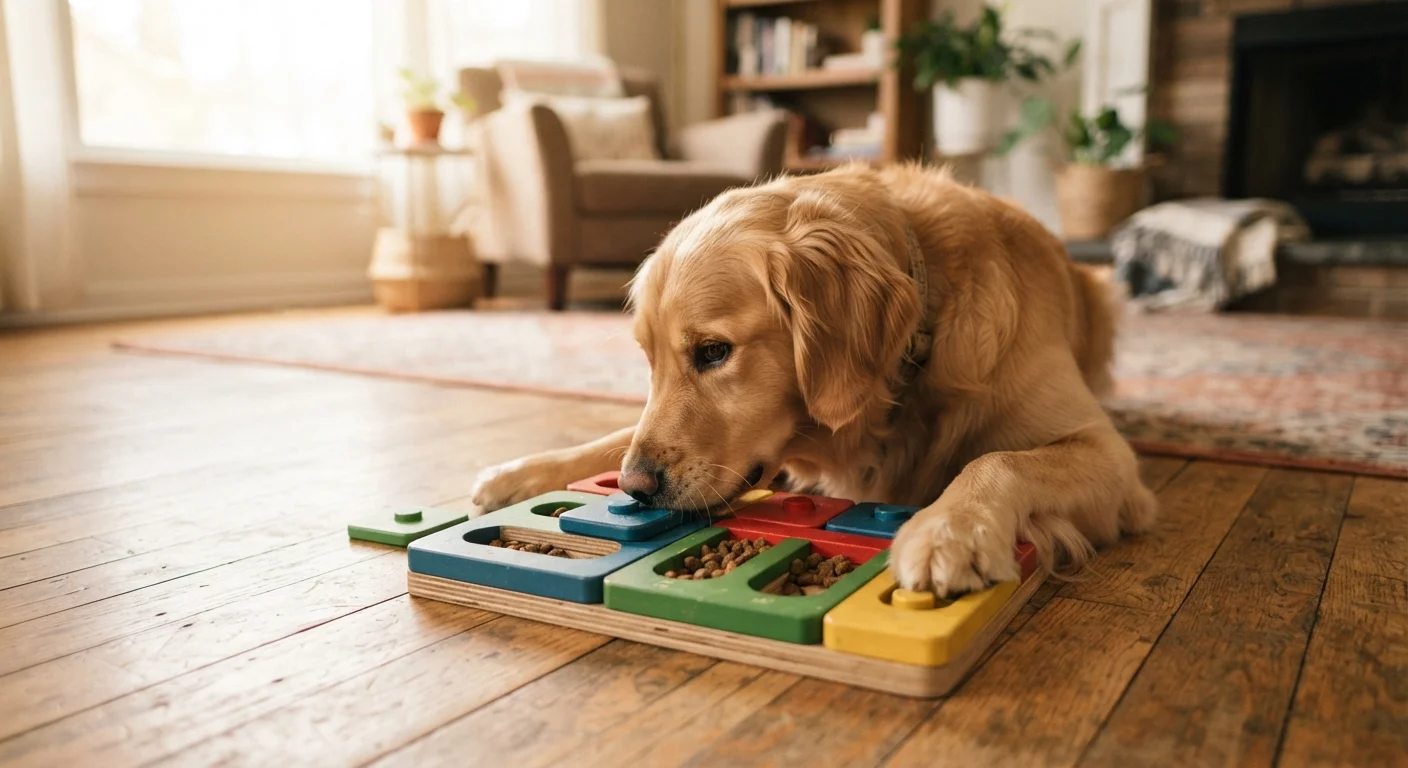
Replacing a standard food bowl with a puzzle feeder, snuffle mat, or stuffed foraging toy turns every meal into a problem-solving exercise. Dogs and cats have to use nose, paws, and problem-solving instincts to access their food, extending mealtime and reducing post-meal restlessness. For small herbivores like rabbits, scatter-feeding hay or hiding leafy greens around their enclosure mimics natural foraging behaviour. Start with simpler feeders and gradually increase difficulty as your pet gains confidence.
Turning mealtime into a puzzle is one of the simplest and most effective daily enrichment strategies.
Prioritise Scent Work for Dogs
A dog's nose contains up to 300 million olfactory receptors — sniffing is cognitively intensive and genuinely tiring in a healthy way. Structured nose work, where dogs search for a specific hidden scent, is used by professional trainers to build focus and confidence. At home, you can start with a simple find it game: hide small food rewards around a room and let your dog locate them. Even 10 minutes of active sniffing can be as exhausting as a longer walk. This is particularly valuable for dogs recovering from surgery or those with mobility limitations.
Ten minutes of active scent work can be as mentally tiring for a dog as a much longer physical walk.
Offer Cats a Hunting-Sequence Play Session
Cats are most satisfied by play that mimics the full hunting sequence: stalk, chase, pounce, catch, and consume. Using a wand toy to simulate prey movement, then ending the session with a small food treat, completes this cycle and prevents the frustrated, restless energy that can follow truncated play. Aim for two or three short sessions daily — five to ten minutes each — rather than one long session. Indoor cats especially benefit from this structured play, as they lack the environmental novelty that outdoor access provides.
Completing the full hunt-to-catch sequence in play leaves cats calmer and more satisfied than brief bursts of activity.
Rotate Toys to Restore Novelty
Familiarity breeds indifference in most species. A toy your dog or cat ignores today may become fascinating again after a week out of sight. Divide your pet's toys into two or three groups and rotate them on a weekly basis, keeping only one group accessible at a time. This simple management strategy leverages the natural curiosity response to novel objects without requiring any new purchases. Introduce a small novel item occasionally — a cardboard box, a paper bag, a new texture — to provide genuine novelty alongside the rotation cycle.
Rotating toys weekly restores novelty and keeps pets engaging with items they previously ignored.
Create Environmental Complexity for Small Animals
Rabbits, guinea pigs, rats, and similar small mammals need environments that encourage exploration, hiding, and problem-solving. Tunnels, platforms, wooden chews, and foraging opportunities are not luxury additions — they address genuine behavioural needs. For rats, which are highly social and intelligent, rotating novel objects into their enclosure, offering litter-tray foraging, and allowing supervised exploration outside their cage are all valuable. Avoid sparse, static environments; they are a primary cause of stereotype behaviours (repetitive, purposeless actions) in small animals.
Environmental complexity prevents the stereotype behaviours that develop in small animals kept in bare, unchanging spaces.
Teach New Skills Through Positive Reinforcement
Learning new behaviours — tricks, cues, or tasks — is cognitively demanding and rewarding for most pets. Short, frequent training sessions of three to five minutes are more effective than long sessions and more sustainable for owners. Dogs can learn to identify named objects, navigate obstacle courses, or perform chained behaviours. Cats can learn to sit, come when called, and even navigate agility equipment. Positive reinforcement (rewarding desired behaviour with food, play, or praise) is the most evidence-supported training approach and strengthens the human-animal bond simultaneously. You can connect training curiosity to broader animal play science for deeper context.
Short, frequent training sessions build cognition, confidence, and the bond between pet and owner simultaneously.
Provide Safe Sensory Variety
Enrichment does not need to be interactive — passive sensory experiences also stimulate the brain. For dogs, access to a safely fenced garden, a car ride with the window cracked, or even wildlife videos can provide olfactory and visual novelty. Cats benefit from window perches with outdoor views, bird feeders positioned outside windows, and safe indoor herbs like catnip or silver vine (a catnip alternative that affects some cats who are unresponsive to catnip). Always supervise introductions to new sensory experiences and ensure the environment remains safe and escape-proof.
Passive sensory experiences — sights, smells, and sounds — provide genuine cognitive stimulation with minimal owner effort.
When Behaviour Changes Signal More Than Boredom
While enrichment addresses many common behavioural issues rooted in under-stimulation, some signs — persistent anxiety, compulsive repetition, sudden aggression, or significant appetite changes — may indicate a medical or psychological issue that goes beyond what enrichment alone can address. If your pet's behaviour changes noticeably or does not improve with consistent enrichment, consult a veterinarian or a certified applied animal behaviourist for a proper assessment.
Building Enrichment Into Your Routine
The most effective enrichment is consistent enrichment. Rather than planning elaborate one-off activities, look for small windows in your existing daily schedule — mealtimes, brief breaks, or the 15 minutes before bed. Feeding meals through a puzzle feeder instead of a bowl, hiding treats during your morning coffee, or rotating a set of foraging toys throughout the week all add up without demanding significant extra time.
If you are introducing enrichment to a new pet, start simple and observe their response. Some animals need time to build confidence before they can engage with novel objects or challenges. For guidance on those critical early days, see our article on settling in a new pet. As your pet matures and their preferences become clear, you can tailor activities to their species, breed, age, and individual personality — making enrichment a genuinely personalised part of their care. For a broader view of how enrichment fits into complete pet ownership, our complete owner's reference is a useful companion.
This article provides general educational information about pet enrichment. It is not a substitute for guidance from a qualified veterinarian or certified animal behaviourist. If your pet shows signs of significant anxiety or distress, consult a veterinary professional.