

Key Takeaways
Why Textiles Earn Their Place in Every Room
Soft furnishings are often treated as finishing touches — the last items added after the 'real' decorating is done. That mindset undersells them considerably. Rugs, throws, and curtains actively shape how a room functions: they absorb sound, regulate visual warmth, define circulation paths, and signal where one zone ends and another begins.
Understanding balance and proportion in interior design is the foundation, but textiles are where those principles become tangible and tactile. A rug that's the wrong size throws off a seating group's proportions; curtains hung too low compress a ceiling visually; a throw draped carelessly reads as clutter rather than comfort.
The tips below treat each textile category as a design tool with a specific job to do — not just a decorative layer to bolt on at the end.
Size your rug to anchor the entire furniture grouping
A common and costly mistake is choosing a rug that's too small — one where only the coffee table sits on it while sofa legs float on bare floor. A properly sized rug should have at least the front legs of every major seating piece resting on it, visually collecting the furniture into a unified group.
In living rooms, an 8×10 ft or 9×12 ft rug is typically the minimum for a standard sofa-and-chairs arrangement. In dining rooms, the rug should extend at least 24 inches beyond the table on all sides so chairs remain on the rug when pulled out. Getting the size right transforms a rug from a decorative mat into a spatial anchor.
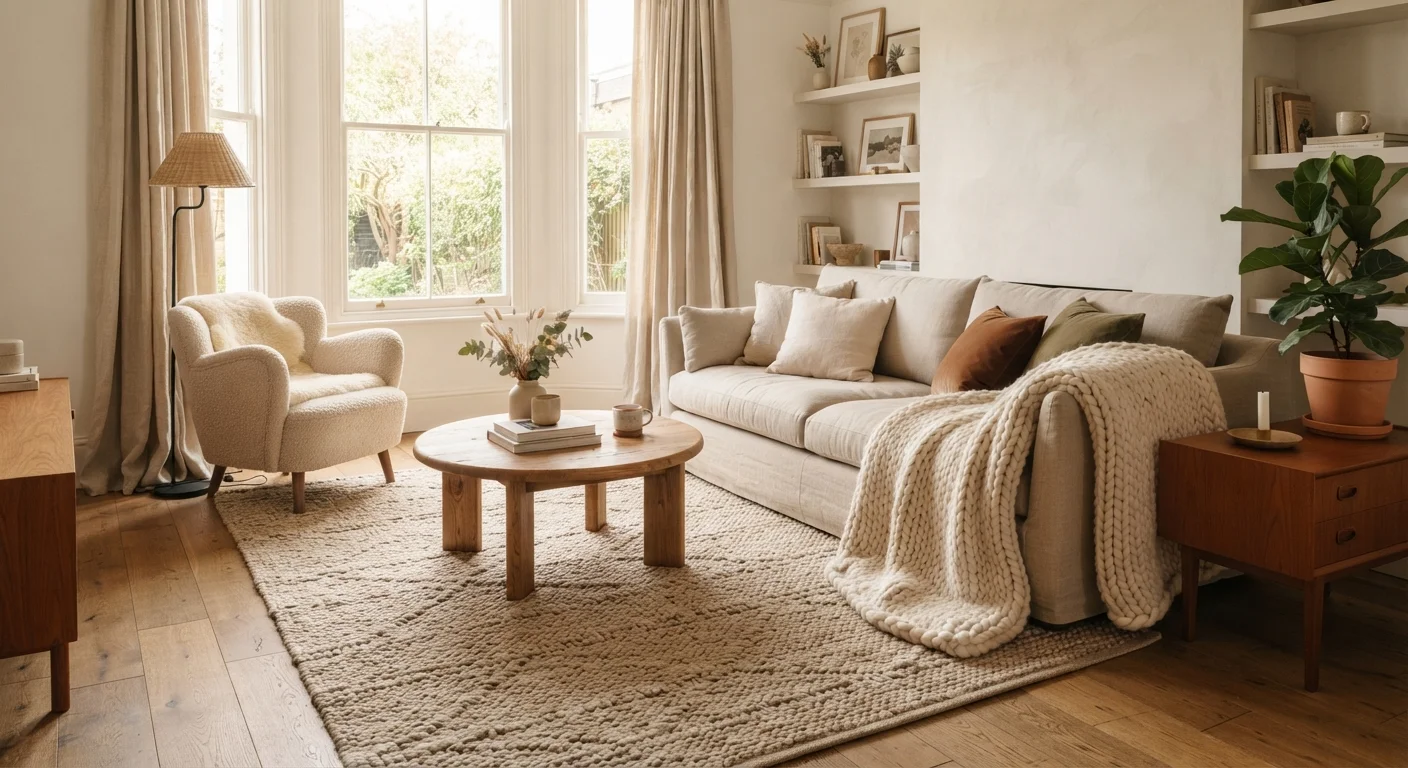
At least the front legs of every seating piece should rest on the rug to unify the grouping.
Hang curtains high and wide to reshape perceived room dimensions
Where a curtain rod is mounted tells the eye where the ceiling is. Hanging rods 4 to 6 inches below the ceiling — rather than just above the window frame — draws the eye upward and makes ceiling height feel more generous. Extending the rod 6 to 12 inches beyond the window frame on each side allows curtains to stack off the glass entirely when open, maximising natural light and making windows appear wider.
This single adjustment, which costs nothing extra, is one of the most effective spatial tricks available to a home decorator. It works equally in rooms with standard 8-foot ceilings and those with taller proportions. Avoid the common décor myths that keep curtains pinned to window frames.
Mounting rods close to the ceiling draws the eye upward and makes any room feel taller.
Use throws to introduce texture and test accent colours
A throw is the lowest-commitment way to introduce a new colour or material into a room. Before committing to repainting walls or reupholstering furniture, draping a throw in a proposed accent colour lets you live with that hue across different lighting conditions — morning sun, lamplight, overcast afternoons — before making a permanent decision.
Beyond colour testing, throws add tactile contrast. A chunky knit throw on a smooth leather sofa, or a woven cotton throw on a linen armchair, introduces the layering of textures that distinguishes a professionally styled room from one that reads as flat. Fold or drape them with intention: casually draped over one arm suggests relaxed comfort; folded in thirds over a footstool reads as more tailored.
A throw lets you audition an accent colour across real lighting before committing to permanent changes.
Choose curtain weight and opacity based on the room's function
Sheer curtains diffuse light beautifully and maintain privacy during the day, but they offer no meaningful light control at night. Blackout linings are near-essential in bedrooms — particularly east-facing rooms that catch early morning sun. In home offices, where screen glare is a practical concern, medium-weight curtains with some opacity often serve better than pure sheers.
The fabric weight also affects how curtains hang. Heavier fabrics like velvet or lined linen fall in cleaner, more structured pleats, while unlined sheers billow and move. Neither is inherently superior — but matching the fabric's behaviour to the room's mood (structured and calm vs. soft and breezy) is part of the design decision.
Match curtain opacity to the room's function — light control matters as much as visual style.
Layer textiles to improve room acoustics
Hard surfaces — timber floors, plaster walls, glass windows — reflect sound and create echo. Soft furnishings absorb sound waves and reduce reverberation, making a room feel quieter and more comfortable to spend time in. This is particularly noticeable in open-plan layouts and rooms with high ceilings.
A large area rug is the single most acoustically effective textile you can add to a room, followed by floor-length curtains and upholstered furniture. Throws and cushions contribute modestly but cumulatively. If a room sounds echoey or conversations feel effortful, adding textile layers — especially underfoot and at windows — is a practical first response before considering structural acoustic treatments.
A large area rug is the single most effective textile for reducing echo in hard-surfaced rooms.
Use rugs to define zones in open-plan spaces
Without interior walls to signal where one area ends and another begins, open-plan rooms can feel spatially ambiguous. A rug placed beneath a dining table and chairs creates a clear dining zone; a separate rug anchoring a sofa arrangement delineates the living area. The two rugs don't need to match, but they should share at least one element — colour family, pile height, or material — so the overall space reads as cohesive rather than disconnected.
This zoning technique also works in smaller rooms. A rug under a desk and chair in a bedroom corner defines a workspace without any physical partition. Understanding how design vocabulary like 'negative space' and 'sightline' helps you articulate what each zone is doing in relation to the whole.
In open-plan spaces, separate rugs create distinct zones without walls or partitions.
Repeat textile colours to create a cohesive colour story
A colour that appears in only one location in a room tends to look accidental. When a hue recurs across multiple textiles — a terracotta cushion echoed in a woven rug's border, then picked up again in a throw — it reads as intentional and anchors the palette. Interior designers often refer to this as 'calling back' a colour.
You don't need exact colour matches; tonal variation within the same colour family (dusty rose, brick, rust) tends to look more sophisticated than identical repetition. The principle applies equally to neutrals: repeating the same warm cream across curtains, a rug, and a throw creates cohesion without visual monotony. This approach pairs naturally with understanding how art scale and placement interact with a room's palette.
Repeating a colour across multiple textiles makes it read as intentional rather than accidental.
Putting It All Together
Textiles reward intention. When you approach rugs, throws, and curtains as purposeful design elements — each carrying acoustic, spatial, and visual responsibilities — the result is a room that feels considered rather than assembled. If you're decorating a room from scratch, plan your textile layers early rather than retrofitting them.
Start with the rug, build outward
When planning a room's textiles, selecting the rug first often makes subsequent decisions easier. A patterned rug with multiple colours gives you a ready-made palette to draw from when choosing curtain colour, throw accents, and cushion fabrics. Solid rugs offer more flexibility but require more active colour planning at each subsequent layer.
For colour guidance, pairing your textile choices with an understanding of how different hues affect a room's mood will help you make decisions you won't second-guess later.