

Key Takeaways
Built-in accountability keeps attendance consistent
Knowing a class starts at a set time — and that others expect to see you — creates gentle social pressure that many people find helpful for showing up, especially early in a routine.
Instructor-led form guidance reduces injury risk
Qualified group fitness instructors cue technique in real time, which is particularly valuable for beginners learning movement patterns for the first time.
Social energy can elevate effort and enjoyment
Research on group exercise has found that people often work harder and report higher enjoyment when exercising alongside others, an effect sometimes called social facilitation.
Pre-planned structure removes decision fatigue
When a class determines warm-up, intervals, cool-down, and duration, you simply follow along — removing the cognitive load of programming your own session.
Fixed schedules limit flexibility for busy lives
Classes run at set times, and missing one may mean waiting days for the next available session, which can disrupt momentum for people with variable schedules.
Pace may not match your individual fitness level
Group classes are designed for a range of participants, meaning the intensity may be too high for beginners or insufficiently challenging for more advanced exercisers.
Crowded environments can feel intimidating
For people new to exercise or returning after a long break, performing movements in front of others can create self-consciousness that detracts from the experience.
Cost can be a barrier to regular participation
Boutique fitness classes and gym memberships with robust class offerings often carry significant monthly costs, which may be unsustainable for some budgets over the long term.
Our Verdict
Group exercise and solo training each deliver real fitness benefits, and the research consistently shows that the workout you'll actually do is the one that fits your lifestyle. If social energy, structure, and accountability keep you consistent, group classes may be your anchor. If autonomy, flexibility, and a personalized pace matter more, solo training likely suits you better.
Anyone building or rebuilding a fitness routine who wants a clear framework for choosing — or blending — both approaches without guilt or guesswork.
Why the Format of Your Workout Matters
The content of your workouts — how hard you push, which muscle groups you train, how often you rest — gets most of the attention. But the format of how you exercise shapes whether you show up consistently in the first place. Group classes and solo sessions each create distinct psychological and logistical conditions that affect adherence, enjoyment, and progress over time.
Before weighing the specifics, it helps to recognize that the "best" workout format is the one you'll sustain. As you consider both sides, think about what readiness factors — from goals to schedule to current fitness level — genuinely guide a durable routine.
The Case for Group Exercise
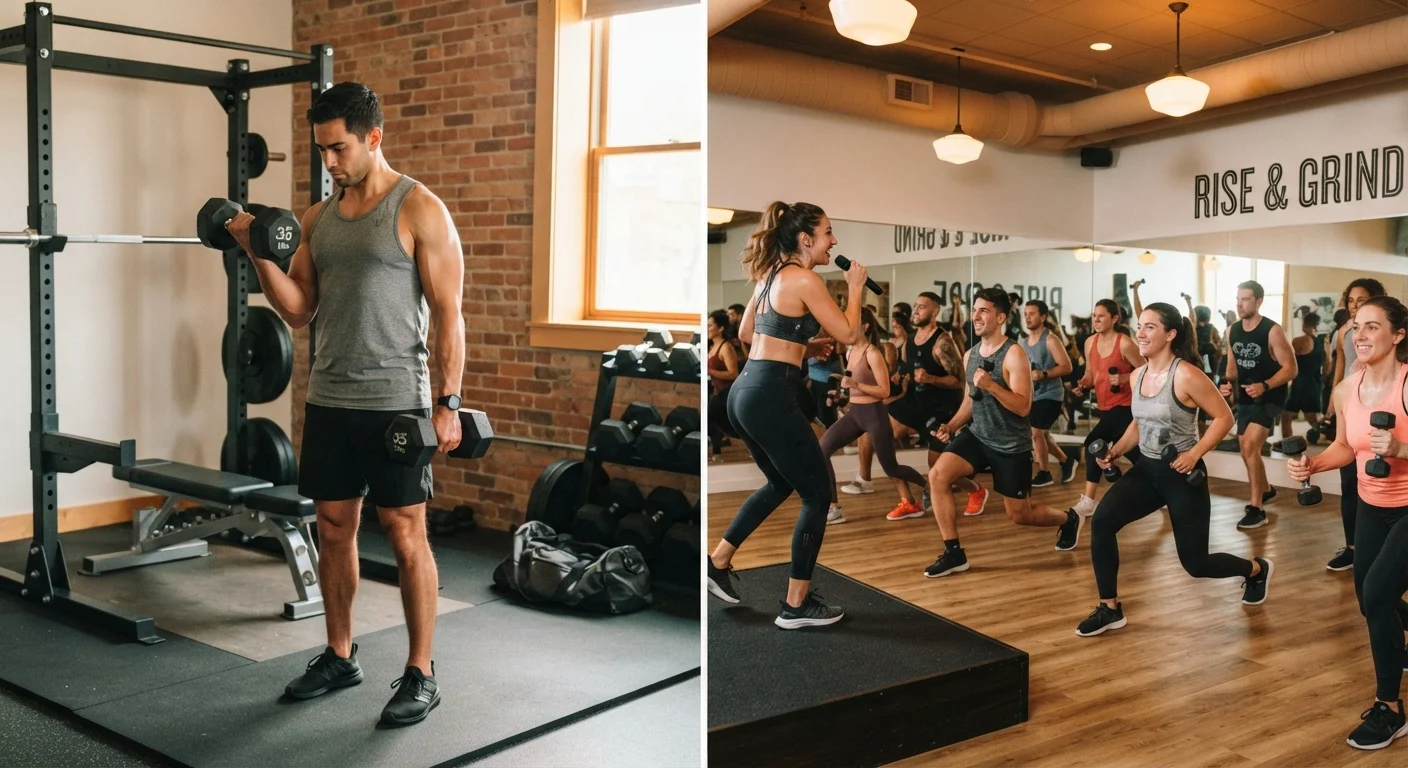
Group fitness classes — whether in a gym, community center, or virtual format — offer a structured environment that many people find genuinely motivating.
Built-in accountability keeps attendance consistent
Knowing a class starts at a set time — and that others expect to see you — creates gentle social pressure that many people find helpful for showing up, especially early in a routine.
Instructor-led form guidance reduces injury risk
Qualified group fitness instructors cue technique in real time, which is particularly valuable for beginners learning movement patterns for the first time.
Social energy can elevate effort and enjoyment
Research on group exercise has found that people often work harder and report higher enjoyment when exercising alongside others, an effect sometimes called social facilitation.
Pre-planned structure removes decision fatigue
When a class determines warm-up, intervals, cool-down, and duration, you simply follow along — removing the cognitive load of programming your own session.
~26%
Higher well-being scores in group exercisers
A study published in the Journal of the American Osteopathic Association found that people who participated in group fitness reported significantly higher mental well-being and lower stress than those who exercised alone.
~50%
Adults who meet physical activity guidelines
According to the CDC, only about half of U.S. adults meet recommended aerobic activity guidelines, underscoring that consistency — not format — is the primary challenge for most people.
Beyond motivation, group settings provide access to qualified instruction. Most classes are led by certified instructors who cue proper form and modify movements for different ability levels, reducing the guesswork that beginners often face. This can be especially useful if you're new to a particular discipline like cycling, yoga, or HIIT.
The Drawbacks of Group Settings
Group exercise has real limitations that can undermine its benefits for certain people or circumstances.
Fixed schedules limit flexibility for busy lives
Classes run at set times, and missing one may mean waiting days for the next available session, which can disrupt momentum for people with variable schedules.
Pace may not match your individual fitness level
Group classes are designed for a range of participants, meaning the intensity may be too high for beginners or insufficiently challenging for more advanced exercisers.
Crowded environments can feel intimidating
For people new to exercise or returning after a long break, performing movements in front of others can create self-consciousness that detracts from the experience.
Cost can be a barrier to regular participation
Boutique fitness classes and gym memberships with robust class offerings often carry significant monthly costs, which may be unsustainable for some budgets over the long term.
Schedule dependency is one of the most practical obstacles. Classes run at fixed times, which may not align with shift work, caregiving responsibilities, or unpredictable days. If you miss a class, the next option may be hours or days away. Fitting exercise into a busy schedule often requires formats that bend around your life — not the other way around.
The Case for Solo Training
Training on your own puts full control in your hands: when, where, how long, and at what intensity. For people with established exercise habits or specific performance goals, that autonomy is genuinely valuable.
Solo sessions allow you to match effort to how you feel on a given day without social pressure to keep pace with a class. You can pair complementary workout types based on your own programming — for instance, understanding the differences explored in cardio vs. strength training becomes more actionable when you're designing your own schedule.
Timing Can Also Influence Your Preference
Whether you train better in the morning or evening can interact with your format choice. Early-morning solo sessions may suit independent exercisers who dislike waiting for class availability, while evening group classes can provide a social wind-down. For a deeper look at how timing affects your training, see morning vs. evening workouts.
Solo training also scales naturally across settings — a hotel room, a park, a home gym, or a commercial facility — making it more resilient to disruptions like travel or gym closures.
How to Think About Combining Both
The group-versus-solo framing is useful for analysis, but many people find the most sustainable routine sits somewhere in between. A few group classes per week can provide social accountability and variety, while solo sessions fill scheduling gaps and allow individualized work.
Consider your current barriers honestly. If motivation is the primary challenge, adding one or two group classes can help. If rigidity is the problem, giving yourself more unscheduled training time may increase consistency. If gyms feel intimidating altogether, it's worth knowing that plenty of effective exercise happens outside traditional gym settings.
This article is for general informational purposes only and does not constitute medical or fitness advice. Consult a qualified healthcare provider or certified fitness professional before beginning or significantly changing an exercise programme, particularly if you have any underlying health conditions.