

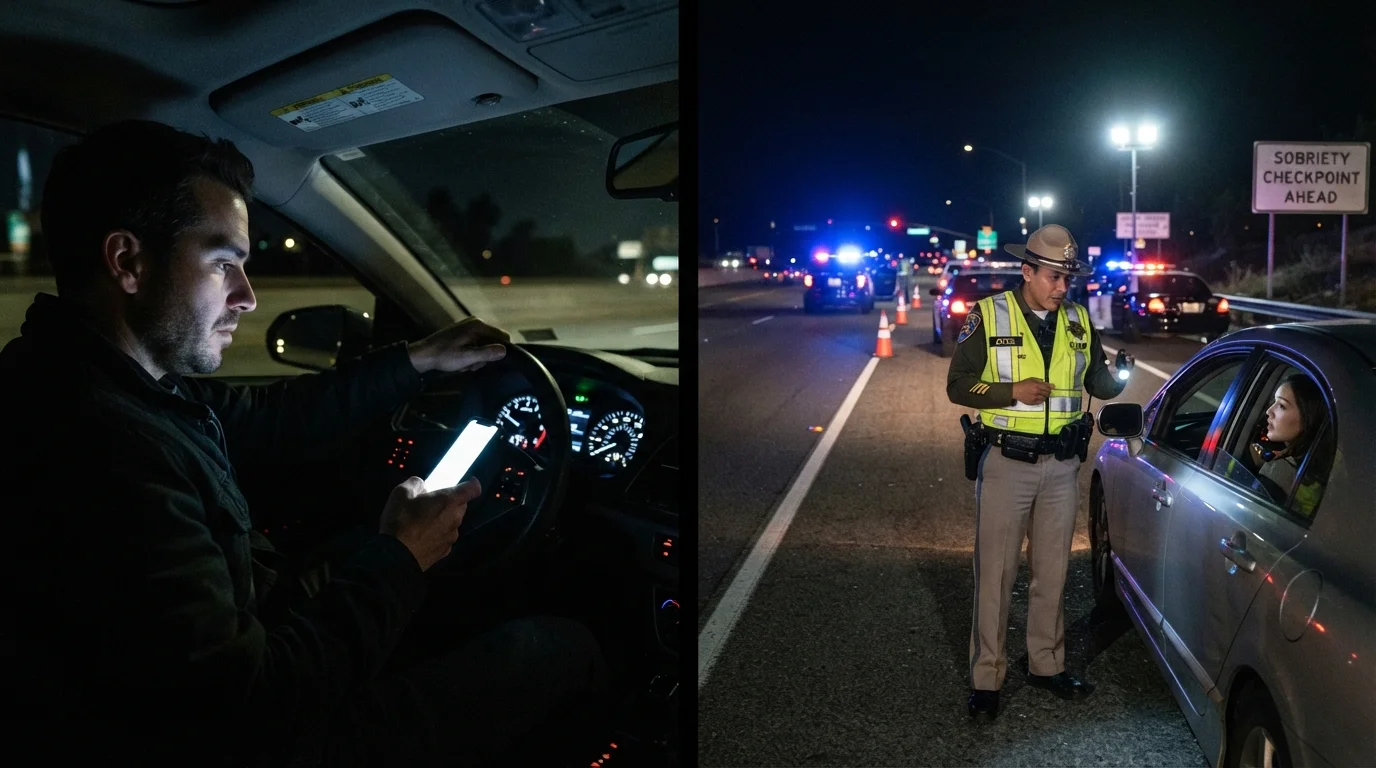
Key Takeaways
Option A
Distracted Driving
The attention-based offense governed mainly by traffic statutes.
Best for: Understanding how laws regulate manual, visual, and cognitive diversions behind the wheel.
Option B
Impaired Driving
The substance-based offense carrying the most severe criminal penalties.
Best for: Understanding how alcohol, drugs, and measurable impairment trigger criminal charges and license consequences.
If you want to understand the criminal implications of driving after drinking or drug use
Impaired Driving
Impaired driving triggers criminal charges, mandatory court appearances, and potential incarceration — understanding this offense is essential for grasping the full weight of DUI/DWI law.
If you want to know what phone or device laws apply to you on the road
Distracted Driving
Distracted driving law governs handheld device use, texting, and other attention diversions — and these rules vary significantly by state.
If you are a new or teen driver learning your legal obligations
Distracted Driving
Many states impose stricter phone bans on new and teen drivers specifically, making distracted driving law the most immediate legal responsibility to understand early on.
If you face a traffic stop and need to understand what officers can legally test for
Impaired Driving
Impaired driving involves standardized field sobriety tests and chemical testing with defined legal thresholds — knowing your rights and obligations in this context is critical.
How Each Offense Is Legally Defined
Distracted driving refers to any activity that diverts a driver's attention from the primary task of operating a vehicle. Courts and traffic codes generally recognize three categories: manual (taking hands off the wheel), visual (taking eyes off the road), and cognitive (taking your mind off driving). Texting while driving is uniquely dangerous because it involves all three simultaneously.
Impaired driving — prosecuted as DUI (Driving Under the Influence) or DWI (Driving While Intoxicated) depending on the state — means operating a motor vehicle while one's ability is compromised by alcohol, controlled substances, or certain prescription medications. Every state sets a BAC threshold of 0.08% for most drivers, with lower limits for commercial drivers (0.04%) and drivers under 21 (commonly 0.02% or zero-tolerance).
The key legal distinction: distracted driving is an attention failure addressed primarily by traffic statutes, while impaired driving is a capacity failure prosecuted as a criminal offense. For a deeper look at DUI and DWI charges, see our guide to DUI and DWI charges.
| Criterion | Distracted Driving | Impaired Driving |
|---|---|---|
| Legal Classification | Traffic infraction (usually) | Criminal offense in all states |
| Primary Cause | Divided attention (phone, eating, etc.) | Alcohol, drugs, or impairing substances |
| Detection Method | Officer observation | Field sobriety tests + chemical testing |
| Typical First Offense Penalty | $50–$500+ fine; possible points | Fines, license suspension, possible jail |
| License Impact | Points added in some states | Suspension or revocation |
| Legal BAC/Threshold | No measurable threshold | 0.08% BAC (most drivers) |
| Federal Standardization | Limited; state-by-state variation | More uniform via federal highway funding |
| Criminal Record Risk | Rare (except in injury/death cases) | Common from first offense |
Penalties: How Serious Is Each Charge?
Most distracted driving violations are classified as civil infractions — meaning a fine, and in some states, points added to your driving record. Fines typically range from around $50 to over $500 depending on the state and whether it is a repeat offense. However, if distracted driving causes injury or death, prosecutors may escalate the charge to reckless driving or vehicular manslaughter — a criminal matter.
Impaired driving carries criminal consequences from the first offense. A first-offense DUI commonly includes fines of $500–$2,000, mandatory license suspension, possible jail time, and required completion of alcohol education programs. Repeat offenses, high BAC readings, or incidents involving injury dramatically increase these penalties. Some states mandate ignition interlock devices — which require a breath sample before the engine starts — for all DUI convictions.
3,308
US distraction-related traffic fatalities (2022)
According to NHTSA's Distracted Driving report, 3,308 people were killed in crashes involving distracted drivers in 2022.
13,524
Alcohol-impaired driving deaths (2022)
NHTSA data indicates that 13,524 people died in alcohol-impaired driving crashes in 2022, representing 32% of all US traffic fatalities.
0.08%
Legal BAC limit for most US drivers
All 50 states and the District of Columbia set 0.08% blood alcohol concentration as the legal limit for non-commercial drivers aged 21 and over.
For new drivers, both offense categories come with amplified stakes. Many states apply stricter phone restrictions and zero-tolerance BAC limits to drivers under 21 or those on a graduated license. See how those rules work in our article on graduated driver licensing laws.
Enforcement: How Police Detect Each Violation
Enforcing distracted driving is largely observational. Officers must witness the behavior directly — a driver holding a phone, looking down, or weaving — before issuing a citation. This makes consistent enforcement challenging, and detection rates vary widely by jurisdiction. Some states allow secondary enforcement only (meaning police can only cite a driver for phone use if they were already pulled over for another violation), while others permit primary enforcement.
For a state-by-state breakdown of what's permitted, hands-free and handheld phone laws vary considerably and are worth reviewing before you travel.
Impaired driving enforcement follows a structured, multi-step protocol. Officers look for erratic driving patterns before initiating a stop. They then conduct field sobriety tests — standardized by the National Highway Traffic Safety Administration (NHTSA) — which assess balance, coordination, and eye movement. A breathalyzer provides a preliminary BAC reading, and drivers may be taken to a station for blood or urine testing. Refusing chemical testing typically triggers automatic license suspension under implied consent laws present in all 50 states.
Implied Consent: What It Means at a Traffic Stop
By holding a driver's license in the US, you have legally agreed — under implied consent laws — to submit to chemical testing if an officer has probable cause to suspect impairment. Refusing a breathalyzer or blood test typically triggers an automatic administrative license suspension, separate from any criminal DUI charges. This suspension can apply even if you are ultimately not convicted of impaired driving.
Why Both Remain Major Road Safety Concerns
Despite their legal differences, distracted and impaired driving share a troubling commonality: both dramatically increase crash risk. The NHTSA consistently identifies these behaviors among the primary factors in fatal traffic crashes each year in the United States.
Research has compared reaction times of drivers using handheld phones to those with a 0.08% BAC — both show meaningful degradation in response speed and hazard detection. This has led some safety advocates to argue that cognitive distraction deserves stricter legal treatment than current statutes reflect in many states.
Understanding your responsibilities begins with knowing the rules. New driver essentials covers the legal framework every US driver should know from day one — including how these two offense categories fit into the broader traffic law landscape. Both impaired and distracted driving illustrate a core principle of road safety law: the privilege of driving comes with a legal and moral obligation to remain fully capable and attentive at all times.
This article is for general informational and educational purposes only and does not constitute legal advice. Traffic laws vary by state and are subject to change. Consult a licensed attorney or your state's motor vehicle authority for guidance specific to your situation.