

Key Takeaways
Canine Tail Communication
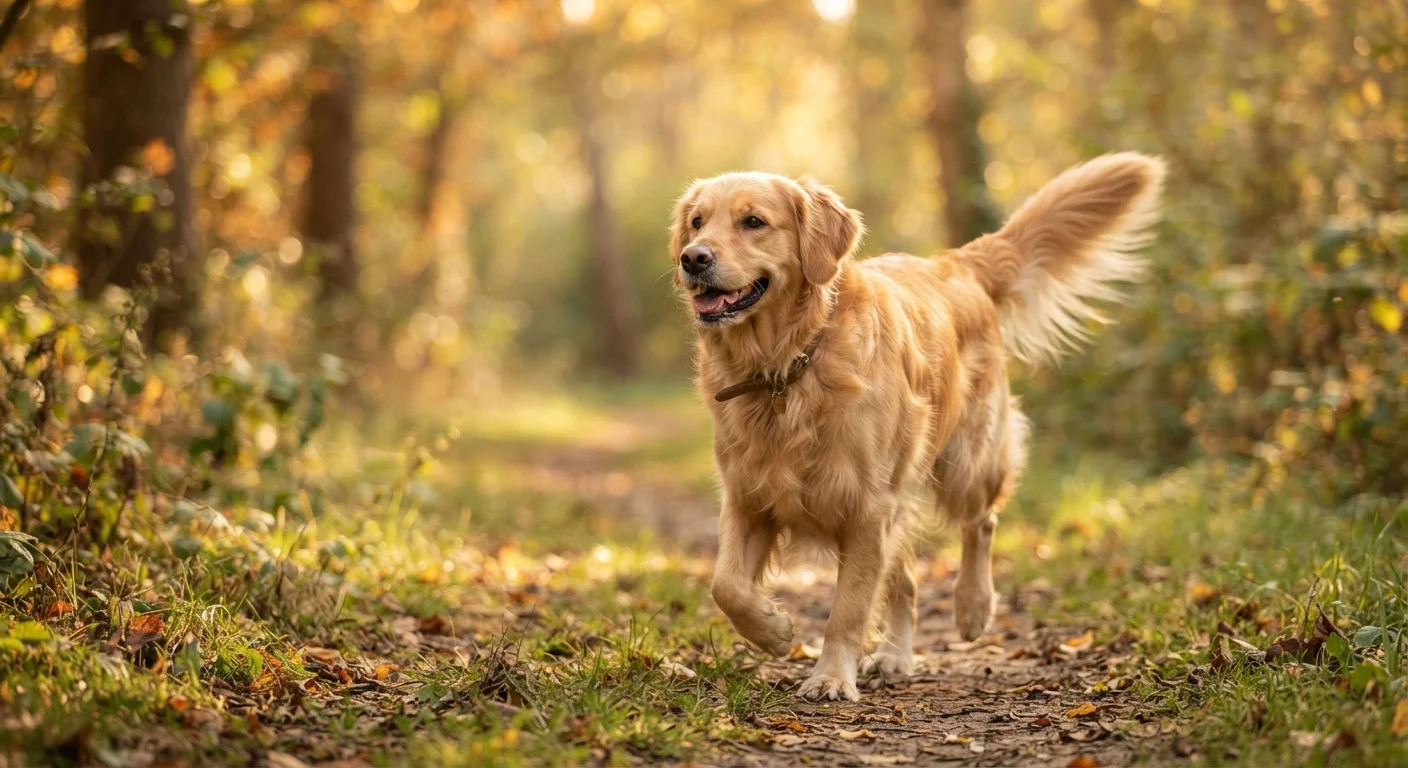
Dogs use their tails as a primary visual communication tool, signaling emotional states through a combination of position, speed, and direction of movement. A wagging tail does not automatically mean a happy dog — context matters enormously. Reading tail signals accurately requires observing the whole body alongside the tail.
Research in animal behavior, including studies on lateralized tail wagging, suggests that the direction of a tail wag — left or right bias — may reflect different emotional valences in dogs, with right-biased wags linked to positive arousal and left-biased wags to negative states.
Why 'Wagging Means Happy' Falls Short
Most people learn from an early age that a wagging dog is a safe, friendly dog. It's an understandable shortcut — but it's incomplete enough to cause real problems. A tail in motion simply means a dog is emotionally activated. What that emotion actually is depends on three things: the position of the tail, the speed of the wag, and the direction of movement.
Ignoring these variables leads to misread signals, and misread signals can lead to unexpected bites, missed distress cues, or failed introductions between dogs. Understanding tail language more precisely is one of the most practical skills a dog owner can develop — and it pairs directly with reading the dog's broader body language. For a broader look at how owners commonly misinterpret their pets, see common pet behavior misreadings.
~77%
Dog bites involving familiar dogs
According to the American Veterinary Medical Association, the majority of dog bites occur from dogs known to the victim, often because subtle warning signals like tail position were missed.
2 directions
Distinct emotional signals in tail wag direction
Published research in Current Biology found that dogs respond differently to left- vs. right-biased tail wags in other dogs, suggesting the direction encodes real emotional information.
36 muscles
Muscles involved in tail movement
Canine tail anatomy involves a complex network of muscles and vertebrae, reflecting how integral tail communication is to a dog's physical design as a social species.
Position: Where the Tail Sits Tells the Story
Think of tail height as a confidence dial. A tail carried high above the back signals alertness, confidence, or assertiveness — the dog is engaged and potentially dominant in the interaction. A tail held at mid-height, roughly parallel to the ground, typically reflects a relaxed, neutral state. A tail lowered below the body suggests uncertainty, deference, or mild anxiety. A tail tucked tightly between the hind legs is a clear signal of fear or submission — the dog is communicating that it feels threatened and is trying to reduce its social presence.
Breed anatomy matters here. Breeds like Beagles or Labrador Retrievers carry their tails naturally higher, while Greyhounds and Whippets typically carry theirs lower even when relaxed. Knowing your dog's neutral baseline makes deviations far easier to spot.
Establish Your Dog's Neutral Baseline
Spend a few minutes observing your dog's tail position when it's calm and relaxed at home — this is its neutral baseline. Any significant deviation from that position in a new situation is a meaningful signal worth paying attention to. Knowing your individual dog's resting posture makes reading departures from it much more accurate.
Speed and Direction: The Details That Change Everything
Speed adds another layer of meaning. A fast, loose wag that involves the whole rear end — often called the full-body wag — is associated with genuine excitement and positive engagement. A slow, stiff wag, where only the tail moves while the body remains rigid, is often a warning signal. It can indicate that a dog is uncertain, overstimulated, or on the verge of reacting defensively. This is the wag that bites sometimes follow.
Direction is subtler but meaningful. Research in animal behavior science suggests that right-biased tail wags (the tail sweeps more to the dog's right) are linked to positive emotional states — like seeing a familiar, trusted person. Left-biased wags have been associated with more negative or cautious emotional states. Observing this in real time is difficult, but it adds scientific weight to the idea that a wag is never just a wag.
The "helicopter wag" — a full circular tail rotation — is widely regarded as one of the most reliable markers of genuine joy, most often seen when a dog greets someone it truly loves.
“The tail is not a simple on/off happiness switch. It is a nuanced signaling system, and learning to read it accurately changes how you understand and relate to your dog.”
— Patricia McConnell, Applied animal behaviorist and author on canine communication
Reading the Tail Within the Whole Picture
No single body part tells the complete story. A tail should always be read alongside ear position (forward and alert vs. pinned back), body posture (weight shifted forward vs. crouched low), and facial expression (soft eyes vs. hard stare, relaxed mouth vs. closed and tense). A dog with a high tail, forward ears, stiff posture, and a slow wag is communicating something very different from a dog with a mid-height tail, loose body, and fast wag.
Dogs with docked tails, or naturally short tails like Bulldogs and Pugs, have limited ability to express these signals — which can sometimes create friction in dog-to-dog communication. Owners of these breeds benefit from becoming especially attuned to other body language cues. If you're also curious how another companion animal communicates, our guide on feline body language covers cats in similar detail.
Learning to read these signals accurately can also help you catch early stress responses before they escalate — something explored further in our article on how pets signal stress before it escalates.