

| Primary communication mode | Body posture, facial expression, and tail position |
| Number of distinct ear positions | Up to 32 individual ear muscle movements (Comparative anatomy research, general consensus) |
| Slow blink meaning | Trust, relaxation, and non-threatening intent |
| Tail-high greeting | Confident, friendly approach — most common social greeting signal |
| Puffed tail indicates | Fear or defensive arousal |
| Belly-up posture | Trust signal — does not always mean invitation to touch |
Why Cat Body Language Is Its Own Language
Cats are not subtle creatures — they are simply misread ones. Unlike dogs, who evolved alongside humans over millennia as cooperative hunters, cats domesticated themselves largely on their own terms. That history shaped a communication style that is quieter, more context-dependent, and easier for humans to miss or misinterpret.
Feline body language works as a system: ears, eyes, tail, posture, and whiskers all send signals simultaneously. Reading one feature in isolation — say, a wagging tail — can lead you astray. (Cat tail movement, unlike dog tail movement, often signals agitation rather than happiness. See also how canine tail signals differ.)
The goal of decoding these signals is not to anthropomorphize your cat, but to respond to what they are actually communicating — and in doing so, build a relationship grounded in mutual understanding rather than guesswork.
| Primary communication mode | Body posture, facial expression, and tail position |
| Number of distinct ear positions | Up to 32 individual ear muscle movements (Comparative anatomy research, general consensus) |
| Slow blink meaning | Trust, relaxation, and non-threatening intent |
| Tail-high greeting | Confident, friendly approach — most common social greeting signal |
| Puffed tail indicates | Fear or defensive arousal |
| Belly-up posture | Trust signal — does not always mean invitation to touch |
The Eyes: Slow Blinks, Dilated Pupils, and Hard Stares
A cat's eyes are among the most expressive tools in its communication repertoire.
- Slow blink: When a cat looks at you and blinks slowly, closing and reopening the eyes in an unhurried way, it signals relaxation and trust. Ethologists sometimes call this a "cat kiss." You can return the gesture; many cats respond by blinking back.
- Dilated pupils: Wide, round pupils can indicate excitement, fear, or overstimulation. Context matters — a cat with dilated pupils crouched low is frightened; one with dilated pupils in a playful crouch is probably ready to pounce at a toy.
- Constricted pupils: Narrow, slit-like pupils in bright light are normal. In dim light, they can suggest high arousal, tension, or aggression — particularly when paired with a fixed stare.
- Direct, unblinking stare: In feline communication, a prolonged hard stare is a challenge or threat signal. If a cat locks eyes and does not blink, give it space.
Misreading pupil signals is one of the most common errors owners make. For a deeper look at frequently misunderstood feline cues, explore common pet behaviour misconceptions.
Ears and Whiskers: The Mood Compass
Ear position shifts rapidly and reliably tracks a cat's emotional state.
Piloerection
The involuntary raising of fur along the back and tail, making the cat appear larger. It occurs in response to fear or strong arousal and is controlled by the autonomic nervous system.
Displacement behavior
An out-of-context action — such as sudden grooming mid-interaction — that signals internal conflict or stress. Cats use displacement behaviors when they feel uncertain or anxious.
Slow blink
A deliberate, unhurried closing and reopening of the eyes directed at another individual. In cats, it functions as a trust and affiliative signal, indicating the cat feels safe and unthreatened.
Overstimulation
A state in which a cat becomes overwhelmed by physical contact or stimulation, even if it was initially welcome. Signs include skin twitching, tail lashing, and sudden biting or scratching.
- Forward and upright: Alert, curious, and engaged. Your cat is paying attention to something interesting.
- Slightly rotated outward: Mild uncertainty or ambivalence — a transitional state between relaxed and concerned.
- Flattened sideways ("airplane ears"): Anxiety or fear. The cat is signaling discomfort and may be looking for an exit.
- Pinned flat against the skull: Defensive aggression or extreme fear. This is a clear warning signal — do not approach or restrain the cat.
Whiskers reinforce what the ears say. Whiskers fanned forward indicate curiosity or predatory focus. Whiskers pulled back tight against the face signal fear or defensiveness. Because whiskers are sensitive to touch, a cat with pinned-back whiskers is also trying to protect them from perceived threat.
Tail, Posture, and the Full-Body Picture
No single body part tells the whole story. Train yourself to read the whole cat.
- Tail high and upright: A confident, friendly greeting. When the tip quivers slightly, it often signals particular excitement toward a favored person.
- Tail curved in a question-mark shape: Playful and approachable.
- Tail low or tucked: Submission, anxiety, or illness. A cat that consistently carries its tail low warrants a veterinary check.
- Puffed tail: Fear or defensive aggression. The cat is trying to appear larger.
- Slow, deliberate tail lash: Irritation or overstimulation — a signal to stop petting or back off.
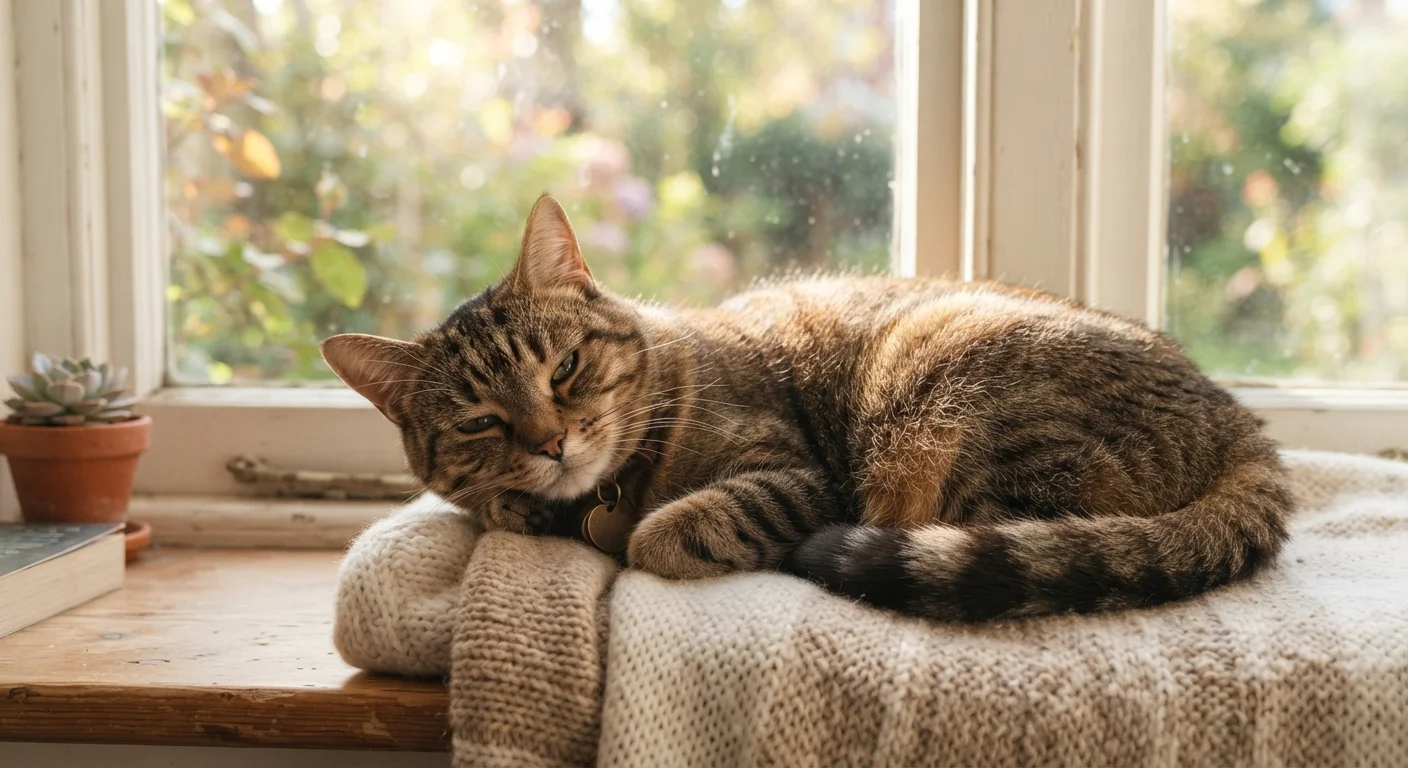
Posture adds the final layer. A cat rolled onto its back with belly exposed is not necessarily inviting a belly rub (unlike many dogs). This posture signals trust, but the belly remains a vulnerable area — many cats will swipe if touched there. A loaf position (legs tucked under the body) signals contentment and calm. A crouched, tense posture with weight shifted backward signals fear and a possible escape or defensive response.
Because stress signals often appear in clusters before escalating, learning to spot early warning signs matters. Recognizing early pet stress signals can help prevent anxiety from building into behavioral problems.
Body language also works alongside vocalization. Understanding what meows and other sounds communicate gives you a more complete picture of how cats "talk" to their owners.
This article provides general educational information about feline behavior. If your cat shows sudden or dramatic changes in body language or behavior, consult a licensed veterinarian or certified animal behaviorist.