

Key Takeaways
Why Debt Myths Are So Costly
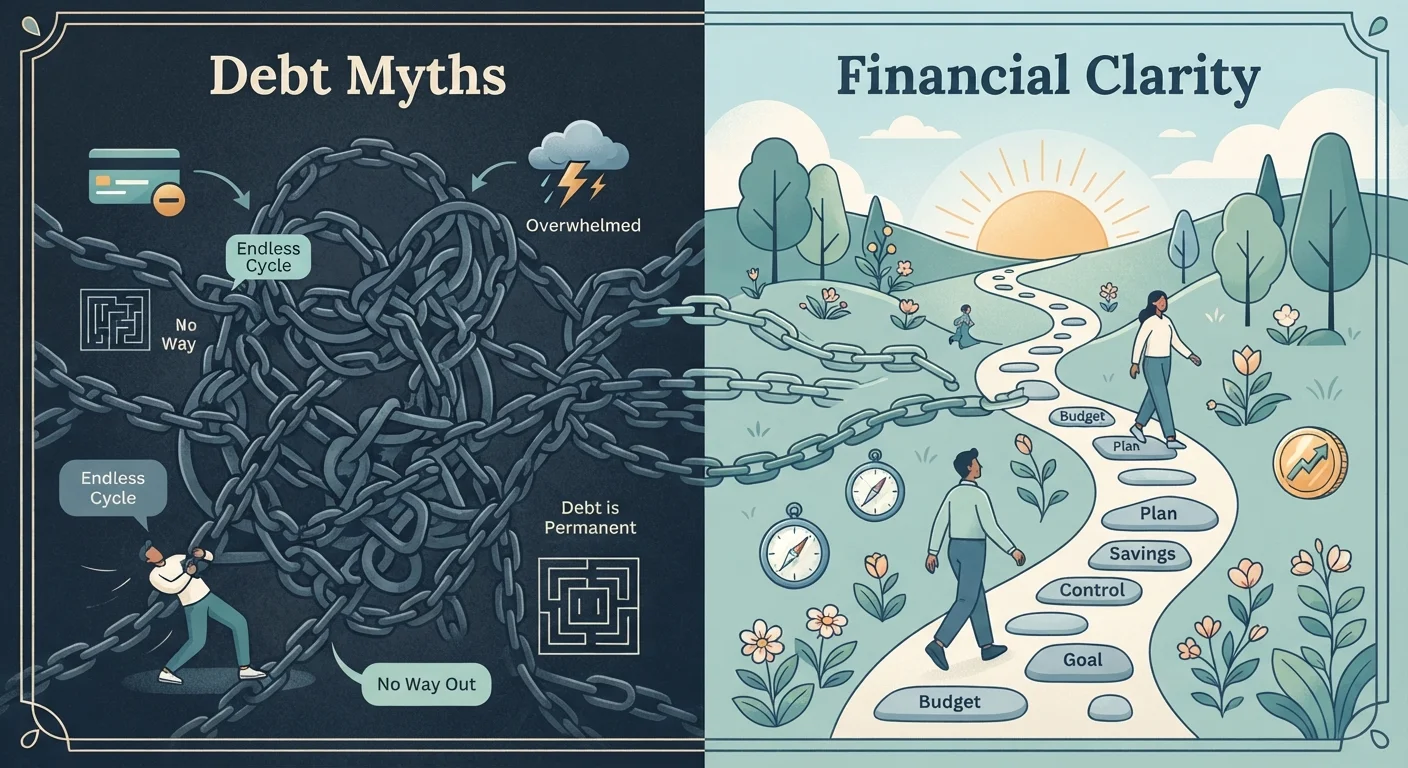
Misinformation about debt is everywhere — passed down at kitchen tables, shared in online forums, and sometimes repeated by well-meaning friends. The problem is that acting on a myth can add months or years to your repayment journey and cost hundreds or thousands of dollars in unnecessary interest. Understanding where common beliefs go wrong is one of the most practical steps you can take toward financial stability.
This article examines some of the most persistent misconceptions about debt and replaces them with what research and established financial guidance actually show. As always, your personal situation is unique — a licensed financial adviser or nonprofit credit counsellor can help you apply these principles to your specific circumstances.
Myth
Carrying a balance on your credit card helps build your credit score.
Fact
Paying your balance in full each month is better for your score and eliminates interest charges entirely.
This myth likely stems from the idea that lenders want to see active credit use. That part is true — but active use does not mean carrying a balance. Credit scoring models look at your credit utilisation ratio (how much of your available credit you're using) and your payment history. Keeping utilisation low and paying on time is what helps. Carrying a balance only adds interest costs on top, with no scoring benefit whatsoever. Learn more about related misconceptions in our piece on money myths that affect spending habits.
Myth
All debt is bad and should be eliminated as fast as possible, no matter what.
Fact
Debt carrying very low interest rates may not need to be rushed, especially if repaying it means missing out on employer retirement matches or going without an emergency fund.
Urgency in debt repayment should be proportional to cost. A credit card charging 22% APR is a financial emergency; a fixed-rate student loan at 4% is a manageable long-term obligation. Aggressively overpaying a low-rate loan while neglecting a small savings cushion can leave you vulnerable — one unexpected expense forces you back into high-rate borrowing. The goal is to minimise total financial harm, not simply to have a zero balance at any cost.
Myth
You should always pay off your smallest debt first, regardless of interest rate.
Fact
Paying off the highest-interest debt first typically costs you less money overall, though the 'smallest balance first' approach can work well as a motivation strategy for some people.
Two repayment methods are widely discussed: the avalanche method (highest interest rate first) and the snowball method (smallest balance first). Mathematically, the avalanche method reduces total interest paid. The snowball method produces quicker early wins that some people find motivating. Neither is universally wrong — the best method is the one you will actually stick with. If you tend to lose momentum, a quick early payoff may be worth the small extra interest cost. Explore structured repayment strategies for a fuller breakdown.
Myth
Debt settlement is a smart shortcut to getting rid of what you owe.
Fact
Debt settlement — negotiating to pay less than the full balance — typically damages your credit score significantly and may result in taxable income on the forgiven amount.
When a lender agrees to accept less than you owe, the forgiven portion may be reported to the IRS as cancellation of debt income, meaning you could owe taxes on money you never actually received. Additionally, missed payments required to reach a settlement severely hurt your credit history, making future borrowing more expensive. For most people, working with a nonprofit credit counselling agency to create a debt management plan is a safer, less damaging path than settlement.
Myth
You should stop saving entirely until all your debt is gone.
Fact
Going without any savings while repaying debt leaves you exposed — one emergency can force you to take on new, possibly higher-rate debt.
This myth treats savings and debt repayment as mutually exclusive. In practice, having even a small emergency fund — commonly suggested in the range of one to three months of essential expenses — acts as a financial buffer. Without it, a car repair or medical bill can derail your repayment plan entirely. The savings-versus-debt dilemma is real, but the answer for most people is a balanced approach, not an all-or-nothing one.
Getting Debt Repayment Right
Clearing up these myths is useful only if it leads to better action. A few principles tend to hold across most debt situations.
Know your interest rates. The cost of debt lives in the annual percentage rate (APR). High-interest debt — typically credit cards and some personal loans — drains money fastest and generally deserves priority attention.
Make more than the minimum payment whenever possible. Paying only the minimum balance is one of the most common ways people inadvertently extend their debt for years. Even a modest extra payment each month can significantly reduce overall interest paid.
Build a small safety net at the same time. The question of whether to pay off debt or build savings first has a nuanced answer: for most people, maintaining a small emergency fund alongside debt repayment helps prevent a setback from creating new debt.
Use a structured repayment strategy. If you carry balances on multiple accounts, structured repayment approaches — such as targeting the highest-rate balance first or tackling the smallest balance for a quick win — can keep you motivated and efficient.
Be Cautious of For-Profit Debt Relief Companies
Some companies aggressively market debt settlement or debt consolidation services for a fee. Results vary widely, and some consumers end up worse off after paying fees and experiencing credit damage. If you need help managing debt, consider reaching out to a nonprofit credit counselling agency accredited by the National Foundation for Credit Counseling (NFCC) before engaging any paid service.
This article is for general informational and educational purposes only and does not constitute personalised financial, legal, or tax advice. Consult a qualified financial professional before making decisions about your debt repayment strategy.