

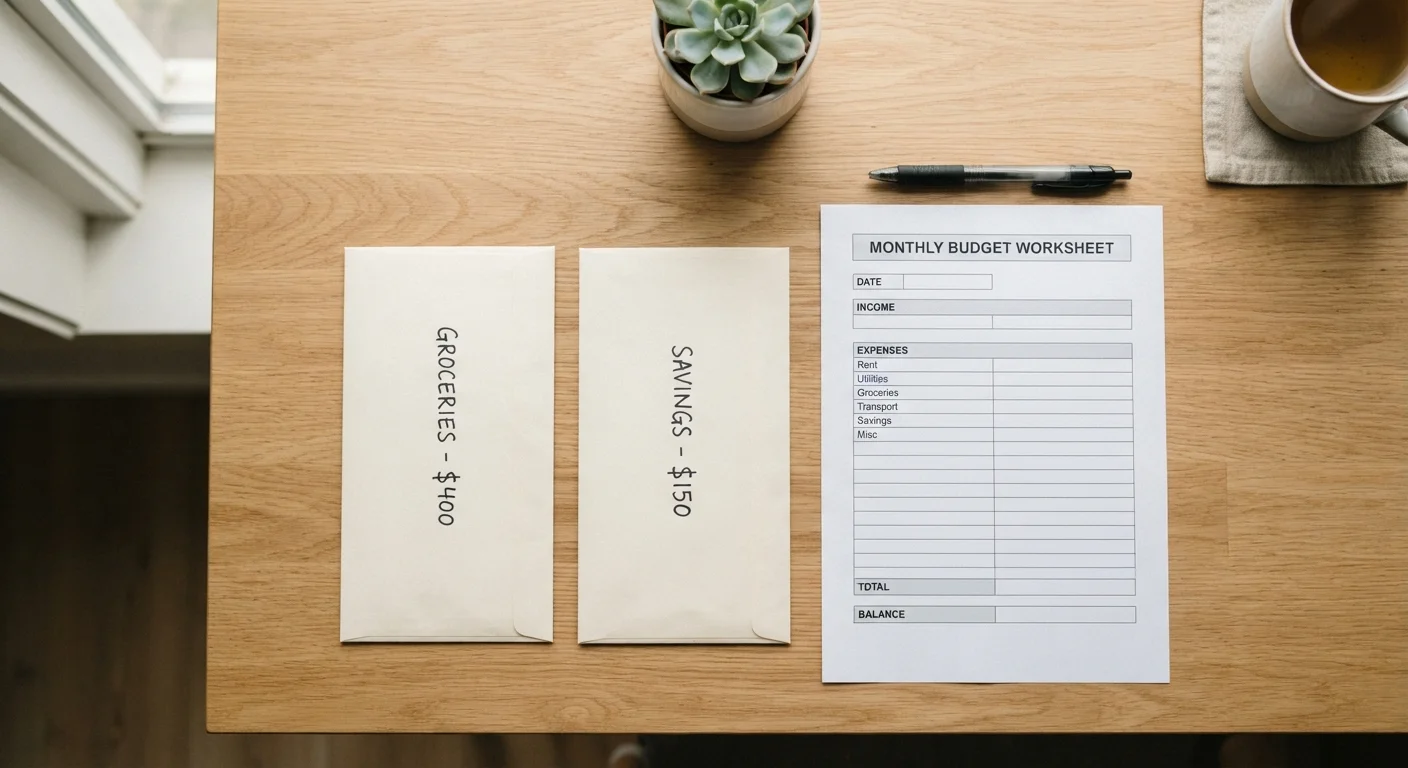
Key Takeaways
Option A
Envelope Budgeting
The tactile, category-by-category spending guard.
Best for: People who overspend in specific categories and need a hard, physical or visual stop when money runs out.
Option B
Zero-Based Budgeting
The precise, every-dollar-has-a-job planning system.
Best for: People who want total control over every dollar and are comfortable planning their full income allocation each pay period.
If you consistently overspend on groceries, dining, or entertainment
Envelope Budgeting
The hard category limits make it immediately clear when you've reached your ceiling, stopping overspending before it compounds.
If you want to plan for irregular expenses like car repairs or annual subscriptions
Zero-Based Budgeting
Zero-based budgeting encourages you to build those irregular costs into your monthly plan, so nothing catches you off guard.
If you prefer a simple, low-maintenance system with minimal math
Envelope Budgeting
Allocating cash into envelopes at the start of the month is straightforward and requires no formulas or spreadsheets.
If you have variable income or multiple savings goals to juggle simultaneously
Zero-Based Budgeting
Its line-item structure lets you reallocate dollars precisely each period, adapting to income changes without losing track of priorities.
If you are new to budgeting and want a fast, concrete starting point
Envelope Budgeting
The concept is intuitive — when the envelope is empty, spending stops — making it easier to adopt without prior budgeting experience.
How Each System Works
Understanding how these two methods operate in practice is the clearest way to decide which one fits your life. For a broader look at how these and other frameworks compare, see budgeting approaches compared.
Envelope Budgeting
At its core, envelope budgeting divides your take-home pay into spending categories — groceries, gas, dining out, clothing — and pre-loads each category with a fixed dollar amount. Traditionally, that meant physical cash in labeled envelopes. Once an envelope is empty, spending in that category stops until the next funding cycle. Today, many people replicate the same structure digitally using dedicated apps or separate bank accounts. The mechanics are the same; only the medium changes. For a deeper look at the digital translation, see how envelope budgeting works in a digital age.
Zero-Based Budgeting
Zero-based budgeting starts with your total monthly income and subtracts every planned expense — bills, groceries, debt payments, savings contributions, and discretionary spending — until the remaining balance reaches exactly zero. "Zero" does not mean spending every dollar; it means every dollar is assigned a job, including dollars sent to savings or an emergency fund. You rebuild the plan from scratch each pay period, which forces you to revisit priorities regularly rather than running on autopilot.
| Criterion | Envelope Budgeting | Zero-Based Budgeting |
|---|---|---|
| Core mechanism | Cash or virtual category limits | Every dollar assigned a purpose |
| Setup effort | Low — divide cash, done | Moderate — full line-item plan required |
| Ongoing maintenance | Minimal between resets | Regular check-ins recommended |
| Flexibility mid-month | Limited — rigid by design | High — reallocate freely to zero |
| Savings integration | Optional savings envelope | Built directly into the plan |
| Best for irregular income | Challenging without discipline | Adapts well each pay period |
| Learning curve | Very low — intuitive concept | Moderate — requires planning skills |
Key Differences in Day-to-Day Practice
Both systems require you to know your income and track your spending — the real differences show up in daily execution and flexibility.
Rigidity vs. flexibility: Envelope budgeting is deliberately rigid by design. The physical or virtual constraint stops overspending automatically. Zero-based budgeting is structured but adjustable — you can reallocate dollars between categories mid-month as long as the total still equals zero.
Time commitment: Envelope budgeting front-loads its effort. Divide your cash or set your digital limits at the start of the month, then simply spend until each category runs out. Zero-based budgeting typically involves more regular check-ins — many practitioners review their allocations weekly — to keep the running total accurate.
Handling irregular income: For variable earners, zero-based budgeting adapts more naturally. You re-build the plan around whatever income arrives each period. Envelope budgeting can work with irregular income too, but requires discipline to resist topping up envelopes when a stronger paycheck arrives.
~33%
US adults without a monthly budget
Gallup polling has found roughly one in three American adults does not track their spending with any formal budget, underscoring how much room there is for either system to add structure.
20%+
More spent with card vs. cash in studies
Multiple consumer behavior studies have found that people tend to spend measurably more when paying by card compared with cash, a core behavioral insight behind the envelope method.
If you are managing finances on a very tight margin, see building a budget when living paycheck to paycheck for grounded guidance on where to start.
Strengths, Limitations, and Who Benefits Most
No budgeting method is universally superior — each has trade-offs worth weighing honestly.
Envelope Budgeting: Strengths and Limits
Its greatest strength is behavioral: when money is tangible and finite, overspending feels real. Research in behavioral economics consistently finds that people tend to spend more freely with abstract payment methods (cards, apps) than with cash. The envelope system exploits this tendency in your favor. Its limitation is flexibility — it can feel punishing if a true necessity arises and an envelope is empty, requiring you to borrow from another category.
Zero-Based Budgeting: Strengths and Limits
Zero-based budgeting builds a complete financial picture each month, making it harder for subscriptions, fees, or small recurring costs to go unnoticed. It also integrates savings goals explicitly rather than treating them as an afterthought. The limitation is effort: rebuilding a detailed budget from zero each period takes time and consistency. It can feel overwhelming for someone just beginning to budget.
You Can Combine Both Approaches
Some budgeters use a hybrid: they build a zero-based plan for the full month, then fund physical or digital envelopes for the specific categories where they tend to overspend. This gives them the comprehensive visibility of zero-based budgeting alongside the hard limits of the envelope system. Experimentation is a normal part of finding a method that sticks.
For a solid foundation before choosing either method, personal budgeting fundamentals covers the core concepts you will need regardless of which structure you adopt.
This article is for general informational and educational purposes only and does not constitute personalised financial advice. For guidance tailored to your specific circumstances, consider consulting a licensed financial professional.