

Key Takeaways
Envelope Budgeting
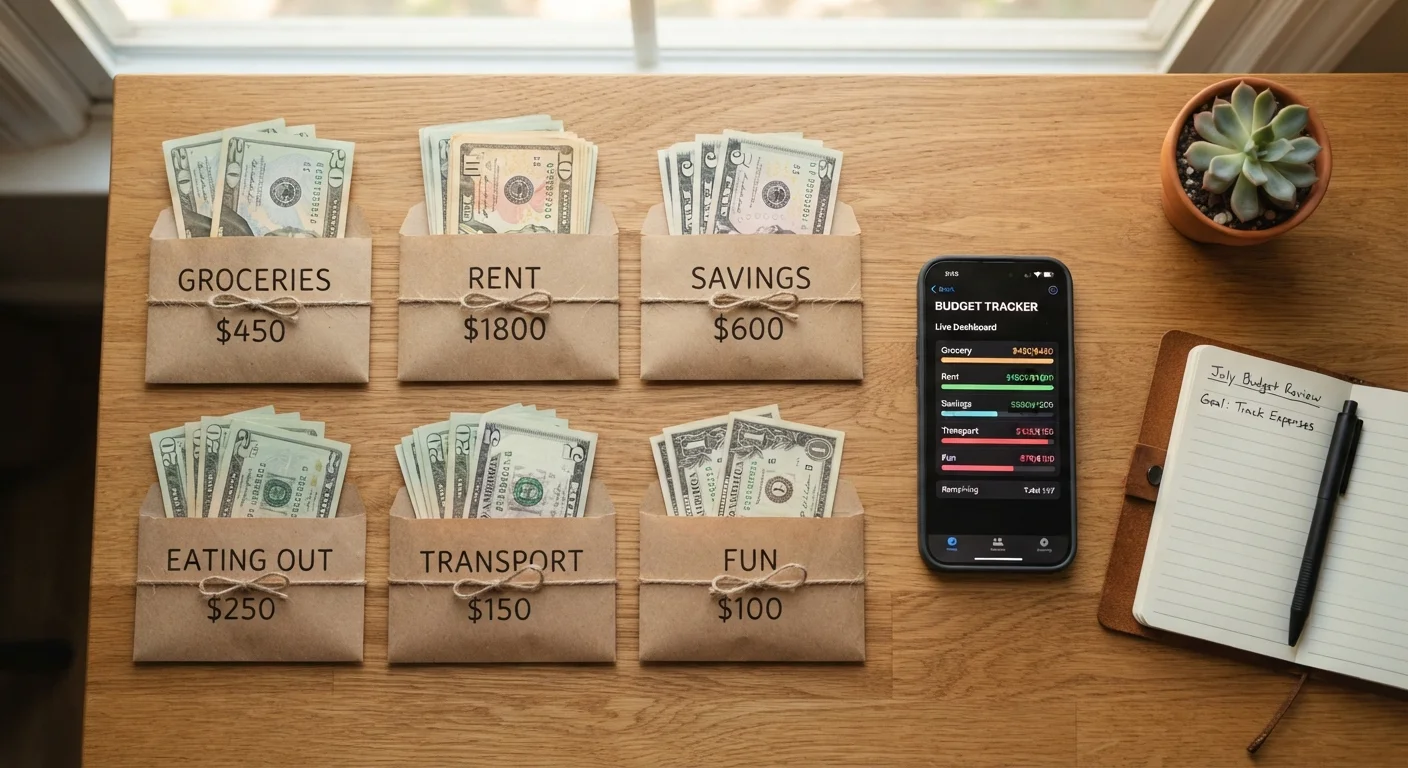
Envelope budgeting is a cash-management system where you divide your monthly income into separate physical envelopes, each labeled for a specific spending category — groceries, gas, dining out, and so on. Once the cash in an envelope runs out, you stop spending in that category until the next budget period. The method creates a hard, visible boundary around every dollar you earn.
In its digital form, envelope budgeting uses virtual "envelopes" or spending buckets rather than physical cash, preserving the same allocation logic while accommodating card-based transactions.
The Core Idea Behind Envelope Budgeting
The envelope method has roots in pre-credit-card America, when households physically divided their paycheck into envelopes to cover different expenses. The logic is straightforward: when the cash is gone, the spending stops. There is no credit line to tap, no vague mental accounting — just a finite amount of money and a clear limit.
Each envelope represents a single spending category. Before the month starts, you calculate how much income you have, assign a dollar amount to each category, and distribute the cash accordingly. Common envelopes include groceries, transportation, dining out, entertainment, and clothing. Fixed obligations — like rent, utilities, and insurance — are typically paid directly and don't require an envelope, since those amounts don't change month to month.
The defining feature is its rigidity. If your grocery envelope holds $400 and you spend $420, you've gone over — and the system demands you acknowledge that by pulling $20 from somewhere else. That visible trade-off is where much of the method's power lies. For a broader look at how this fits alongside other approaches, see our overview of popular budgeting frameworks.
36%
Americans with a detailed monthly budget
According to Gallup polling data, roughly one-third of U.S. adults report following a detailed household budget — highlighting how much room there is for structured approaches like envelope budgeting to help.
18%
More spent using cards vs. cash
Consumer behavior studies, including research summarized by the Journal of Consumer Research, suggest people tend to spend meaningfully more when paying with cards compared to physical cash.
Why Physical Cash Still Has Psychological Value
Behavioral research consistently suggests that people spend more when paying with cards than with cash — a phenomenon sometimes called the "pain of paying." Handing over physical bills feels more tangible than a card swipe, which can create a natural brake on impulsive purchases.
For people who struggle with overspending on discretionary items, the envelope method's cash requirement can be genuinely useful. Watching a grocery envelope thin out mid-month makes the budget real in a way that a bank app balance often doesn't. You can see exactly what's left and what it means for the rest of the month.
“The envelope system forces you to make a plan before the money arrives — and that single habit is what separates people who control their spending from those who wonder where it went.”
— Dave Ramsey, Personal finance author and radio host, known for popularizing the envelope method for modern audiences
That said, using cash also has practical drawbacks. It requires trips to the ATM, creates security concerns if envelopes are lost or stolen, and doesn't integrate with digital receipts or expense tracking tools. These friction points are why many people now turn to digital adaptations of the system.
Envelope Budgeting in a Digital World
Several budgeting apps replicate the envelope method digitally, letting users create virtual spending categories, set limits, and track transactions without handling cash. The underlying logic is identical: you pre-allocate income before spending begins, and the app tracks every transaction against your category limit in real time.
Start With Just Three or Four Envelopes
Beginners often create too many categories, making the system feel overwhelming and hard to maintain. Start with the two or three spending categories where you most often overspend — groceries, dining, and entertainment are common starting points. Add more envelopes only once the core habit is established.
Digital envelope tools work particularly well for people who use debit or credit cards for daily purchases. Transactions import automatically, categories update instantly, and alerts notify you when a budget is running low. The psychological edge of physical cash is reduced, but the structural discipline of pre-committed spending remains.
If you're new to structured budgeting altogether, building a simple personal budget first can help you identify realistic category amounts before adopting any specific method. Understanding your actual spending patterns makes envelope allocations far more accurate.
Strengths, Limitations, and Who It Suits
Envelope budgeting works best for people who overspend in specific discretionary categories and want a concrete, category-by-category limit. It also suits those who prefer simplicity over complex spreadsheets — the system requires no formulas, just basic addition and the discipline to stop when an envelope empties.
Its limitations are real, though. The method can be cumbersome for households with many income sources or irregular pay. It doesn't inherently encourage saving or debt paydown unless you create dedicated envelopes for those goals — something worth pairing with a broader savings strategy from the Saving & Debt resources. And the physical cash version offers no fraud protection.
For a direct comparison of envelope budgeting against the zero-based approach — another method that assigns every dollar a purpose — see our Zero-Based Budgeting vs. 50/30/20 guide. Understanding the trade-offs helps you choose a system you'll actually maintain. The best budget is always the one you stick with.
This article is for general informational and educational purposes only and does not constitute personalized financial advice. Consult a qualified financial professional for guidance tailored to your individual circumstances.
Envelope Budgeting Is a Tool, Not a Rule
No single budgeting method suits every household. Envelope budgeting is most effective when it reflects your actual spending patterns and income structure. If the system creates more stress than clarity, that's a signal to adjust your category limits or try a different framework — not an indication that budgeting itself is impossible.