

Key Takeaways
Option A
Zero-Based Budgeting
The meticulous, every-dollar-counts approach.
Best for: People who want full control over every spending decision and are willing to invest time each month building a detailed plan.
Option B
50/30/20 Method
The streamlined, percentage-driven framework.
Best for: People who want a simple structure that divides income into broad categories without tracking every individual expense.
If you have irregular or variable income each month
Zero-Based Budgeting
Rebuilding your budget from scratch each month lets you respond precisely to income fluctuations rather than applying fixed percentages to an unpredictable paycheck.
If you want a quick, low-maintenance structure
50/30/20 Method
Three broad categories are easy to monitor and require minimal setup time, making it sustainable for people who find detailed budgets discouraging.
If you are actively working to eliminate debt or build an emergency fund fast
Zero-Based Budgeting
Assigning every dollar deliberately makes it easier to redirect funds toward debt repayment or savings goals with precision and intention.
If you are new to budgeting and want to build a habit gradually
50/30/20 Method
Its simplicity lowers the barrier to entry, helping beginners stay engaged without feeling overwhelmed by granular tracking.
If your spending habits vary significantly from month to month
Zero-Based Budgeting
Category-by-category planning lets you anticipate seasonal or one-off costs rather than absorbing them awkwardly within a fixed percentage framework.
How Each Method Works
Understanding the mechanics of both approaches is the first step to choosing the one that fits your life. For a broader look at how these and other frameworks compare, see budgeting approaches compared.
Zero-Based Budgeting
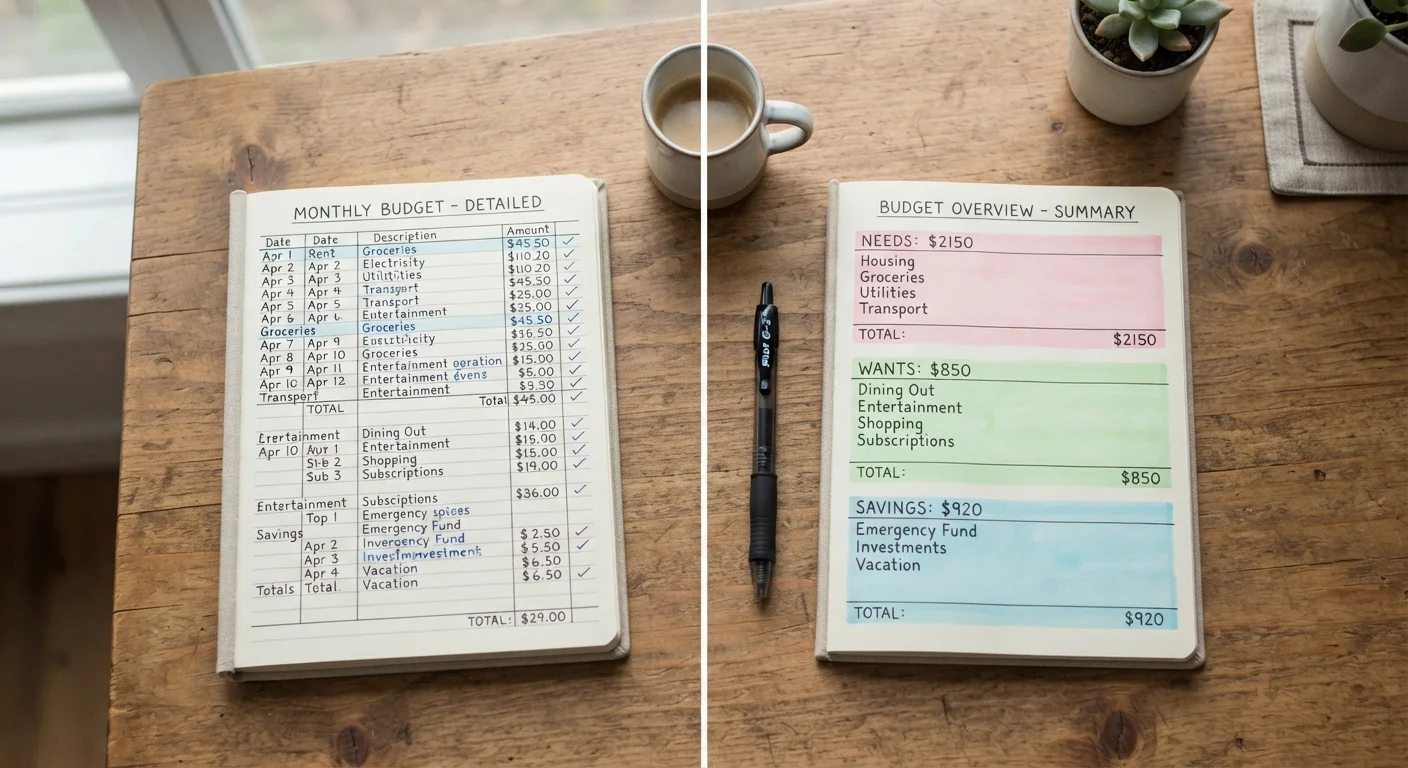
Zero-based budgeting (ZBB) starts with a simple principle: income minus expenses equals zero. That does not mean spending everything you earn — it means every dollar is intentionally assigned to a category before the month begins. Those categories can include groceries, rent, utilities, savings contributions, debt payments, and even discretionary spending. Nothing sits in a vague "leftover" pile.
Each month is treated as a fresh start. You list your expected income, then allocate funds category by category until the balance reaches zero. If your income or expenses change, you rebuild the plan. This monthly reset is both the strength and the demand of the method.
The 50/30/20 Method
The 50/30/20 rule, popularized by Senator Elizabeth Warren and her daughter Amelia Warren Tyagi in their book All Your Worth, divides after-tax income into three buckets: 50% toward needs (housing, utilities, groceries, minimum debt payments), 30% toward wants (dining out, entertainment, subscriptions), and 20% toward savings and extra debt repayment. You can read a deeper breakdown in our 50/30/20 rule explainer.
The appeal is its simplicity. Once you know your after-tax income, the math takes seconds. You monitor three numbers rather than dozens of line items, which reduces the ongoing effort considerably.
| Criterion | Zero-Based Budgeting | 50/30/20 Method |
|---|---|---|
| Core principle | Every dollar assigned a purpose | Income split into three percentages |
| Setup time | High — detailed monthly plan required | Low — three categories only |
| Ongoing effort | High — track every category | Low — monitor three buckets |
| Best income type | Variable or irregular income | Stable, predictable income |
| Granularity | Very detailed | Broad and flexible |
| Suited for debt payoff | Highly effective | Moderate — built into the 20% bucket |
| Learning curve | Steeper | Gentle |
Key Trade-Offs to Consider
Both methods have genuine strengths — and real limitations that are worth understanding before you commit.
~33%
Americans with a detailed monthly budget
Gallup polling has consistently found that fewer than one in three US adults maintains a detailed household budget, suggesting many could benefit from a structured approach.
20%
Income allocated to savings under 50/30/20
The 50/30/20 framework explicitly reserves 20% of after-tax income for savings and debt repayment, giving this goal a defined place in the plan.
Time and Effort
Zero-based budgeting is time-intensive. Setting up detailed categories, tracking spending against them, and reconciling at month's end can take several hours monthly. Apps and spreadsheets help, but the mental load remains higher than most percentage-based systems.
The 50/30/20 method requires minimal ongoing attention. A quick monthly check of whether spending in each of the three zones is on track is often enough. For people managing demanding schedules, that simplicity is a meaningful advantage.
Flexibility vs. Precision
ZBB excels at precision. If you are aggressively paying down a car loan or building a three-month emergency fund, you can redirect specific dollar amounts with clarity. The 50/30/20 rule offers flexibility — if your needs exceed 50% of income (common in high-cost cities), the framework still works as a general guide, though the percentages may need adjusting.
Suitability for Variable Income
Freelancers, gig workers, or anyone with month-to-month income swings often find ZBB more practical because each budget is built around actual income for that period. Fixed percentages can feel abstract when the base number shifts regularly.
Combining Elements of Both Methods
Some people find success blending approaches — using the 50/30/20 percentages as a starting framework and then applying zero-based detail within the savings or needs category. There is no rule requiring you to adopt one method exclusively. What matters most is that your system is specific enough to guide real decisions and simple enough that you actually maintain it. Experiment and adjust until the method fits your habits, not the other way around.
For practical guidance on building savings alongside either method, the Saving & Debt hub offers actionable strategies. You can also explore personal budgeting fundamentals for a complete foundation before choosing your framework.
This article is for general informational and educational purposes only and does not constitute personalised financial advice. Consider consulting a qualified financial professional for guidance specific to your circumstances.