

Key Takeaways
The 50/30/20 Rule
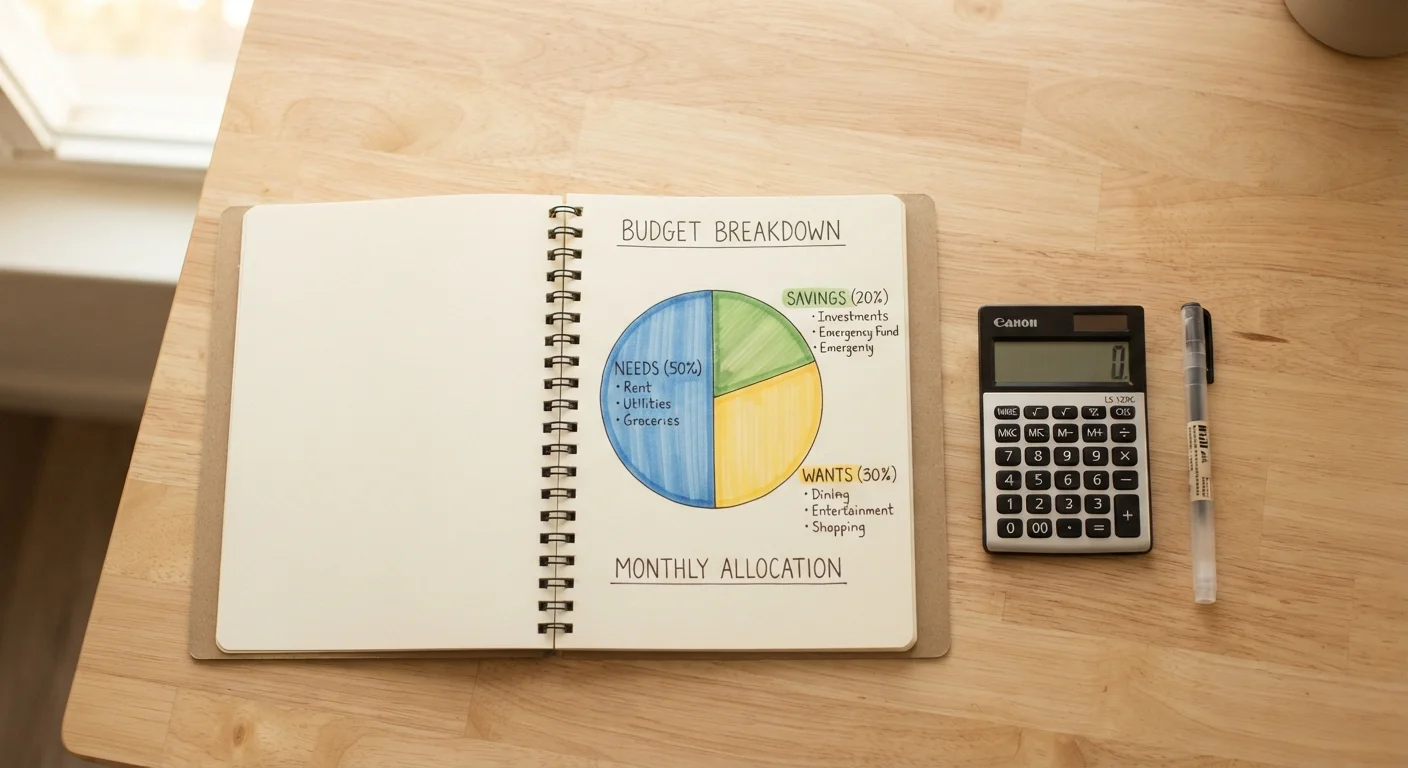
The 50/30/20 rule is a percentage-based budgeting framework that divides your after-tax income into three categories: 50% toward needs, 30% toward wants, and 20% toward savings and debt repayment. It offers a simple starting structure for anyone who wants to manage money without tracking every individual dollar. The goal is balance — covering essentials, enjoying life, and building financial security simultaneously.
The framework is often attributed to Senator Elizabeth Warren and her daughter Amelia Warren Tyagi, who described it in their 2005 book 'All Your Worth.' It is based on after-tax (net) income, not gross income.
How the Three Categories Work
The 50/30/20 rule organizes your monthly after-tax income into three buckets, each with a defined purpose. Understanding what belongs in each category is the first practical step toward using it effectively.
50% — Needs
This category covers essential expenses: housing, groceries, utilities, health insurance premiums, minimum loan or credit card payments, and basic transportation. These are costs that would create serious hardship if unpaid. As a rule of thumb, if you could not function without it, it is a need.
30% — Wants
Wants are the discretionary spending that improves your quality of life but is not strictly necessary. This includes dining out, entertainment subscriptions, gym memberships, travel, and clothing beyond the basics. This category gives the framework flexibility — it acknowledges that life is not only about survival or saving.
20% — Savings and Debt Repayment
The final 20% is directed toward building financial security. This includes contributions to an emergency fund, retirement accounts such as a 401(k) or IRA, and any debt repayment above the minimum payment. Paying down high-interest debt faster belongs here because it reduces the long-term cost of borrowing.
For a deeper grounding in budgeting principles before applying any framework, see our complete foundation for personal budgeting.
33%
Average share of income spent on housing in the US
According to the U.S. Bureau of Labor Statistics Consumer Expenditure Survey, housing typically represents the single largest expense category for American households.
57%
Americans without enough savings to cover a $1,000 emergency
A Bankrate survey found that a majority of U.S. adults could not cover an unexpected $1,000 expense from savings alone, highlighting the importance of the 20% savings allocation.
20%
Recommended minimum savings and debt-repayment rate
The 50/30/20 rule's savings target aligns with widely cited guidance from consumer finance organizations encouraging households to direct at least a fifth of take-home pay toward financial security.
Applying the Rule to Your Own Income
To put the 50/30/20 rule into practice, start with your monthly after-tax income. If your take-home pay is $4,000 per month, the target allocations would be:
- $2,000 for needs (50%)
- $1,200 for wants (30%)
- $800 for savings and debt repayment (20%)
Next, list your actual monthly expenses by category and compare them to these targets. Most people discover their spending does not match the intended split on the first attempt — and that is entirely normal. The point is to identify where money is going and make deliberate adjustments over time.
Start With One Month of Real Data
Before adjusting your spending, pull one month of actual bank and credit card statements and categorize each transaction as a need, want, or savings item. Many people are surprised to find wants consuming 40–45% of income without realizing it. A single month of real data gives you a factual baseline to work from rather than estimates.
If your needs reliably consume more than 50% of your income, you have two levers: increase income or reduce fixed costs. Reducing fixed costs is slower but often more sustainable. Refinancing a high-interest loan, moving to a more affordable area, or eliminating an underused subscription are examples of permanent reductions rather than one-time cuts.
The 50/30/20 framework works best alongside regular check-ins. Use our monthly budget review checklist to track whether your ratios stay on target month to month.
When the Rule Fits — and When It May Not
The 50/30/20 rule works best for people with steady, predictable incomes who want a low-maintenance structure. It requires minimal tracking — knowing your broad spending by category is enough — which makes it more sustainable for those who find detailed budgets overwhelming.
However, the framework has real limitations. In high cost-of-living metropolitan areas, housing alone can consume 40–50% of net income for a median earner, leaving almost no room for other needs before the cap is reached. Similarly, households carrying significant student loan or medical debt may find the 20% savings allocation unrealistic until higher-interest obligations are reduced.
Low-income households often face structural constraints where needs genuinely exceed 50%, and applying the standard ratios can feel discouraging rather than helpful. In these cases, adjusting the percentages to reflect your actual circumstances — while keeping the spirit of intentional allocation — is more useful than forcing an ill-fitting split.
If the 50/30/20 rule does not align well with your lifestyle, other frameworks may suit you better. Our comparison of budgeting approaches outlines methods like zero-based budgeting and pay-yourself-first strategies so you can evaluate options side by side.
“The goal of a budget is not perfection — it is awareness. When you know where your money goes, you can start directing it with purpose.”
— Consumer Financial Protection Bureau, U.S. government agency for consumer financial education
Whatever structure you choose, the underlying goal of any budget is the same: to ensure your money moves in the direction you choose, rather than disappearing by default. The 50/30/20 rule is a widely accessible entry point toward that goal, and its simplicity is precisely what makes it a practical starting framework for most people.
This article is for general informational and educational purposes only. It does not constitute personalized financial, tax, or investment advice. Consult a qualified financial professional for guidance specific to your situation.