

Key Takeaways
Personal Budget
A personal budget is a written plan that shows how much money you expect to receive — from your job, benefits, or other sources — and how you intend to spend or save it over a set period, usually a month. It is not a rigid rulebook or a sign that you are struggling financially. It is simply a tool that helps you make intentional decisions about your money before the money is already gone.
In personal finance, a budget functions as a cash-flow management framework: it compares projected income against planned expenditures across defined categories to identify surpluses or shortfalls before they occur.
The Simplest Way to Understand a Budget
Strip away everything complicated and a personal budget comes down to one question: Where is your money going, and does that match what you actually want?
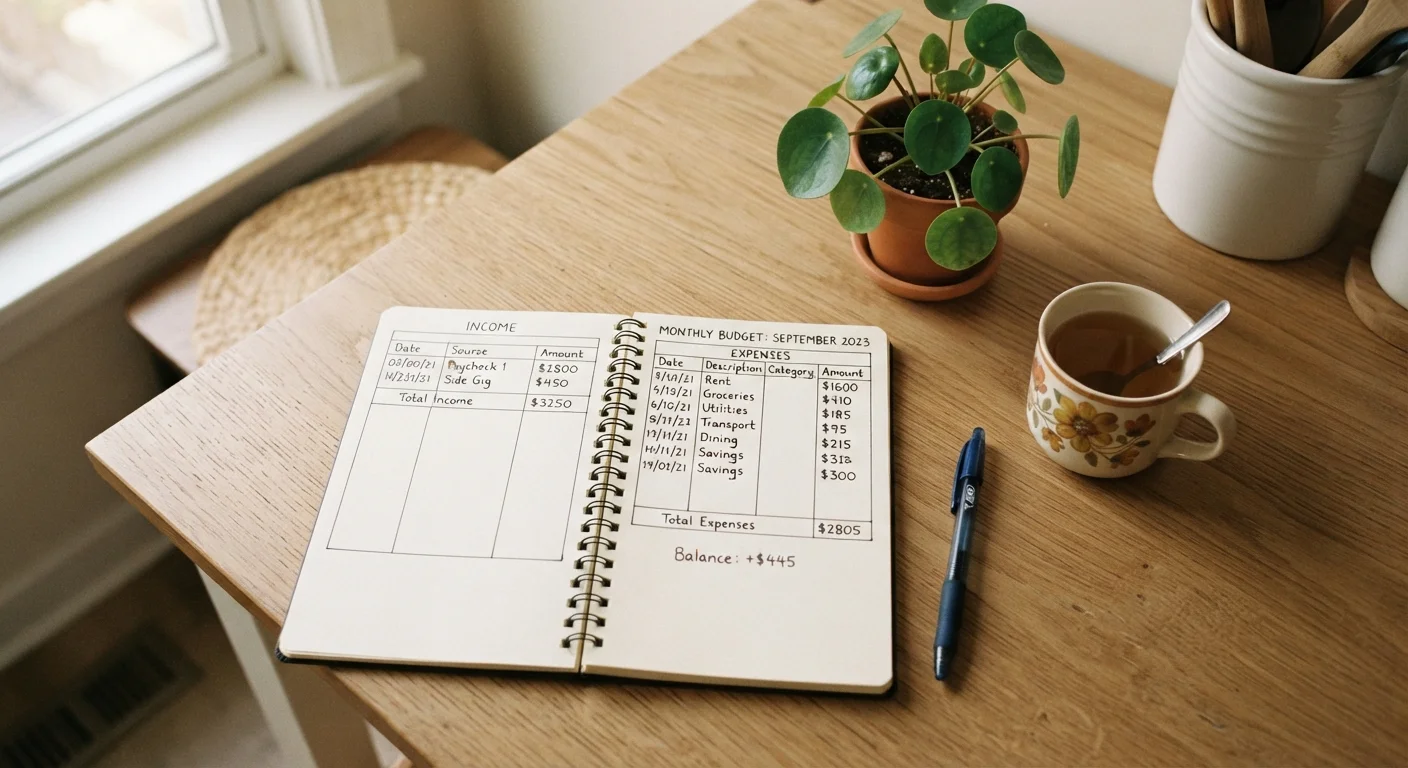
At its most basic, a budget has two sides. On one side is your income — every dollar coming in during the month. On the other side are your expenses — every dollar going out, from rent and groceries to streaming subscriptions and coffee. When you write both sides down, you can see at a glance whether your outgoing spending fits within your incoming money, or whether there's a gap you need to address.
That's it. A budget is not a spreadsheet you need a finance degree to understand. It is not a confession that you've made mistakes. It is a snapshot of your financial life that you create on purpose, before the month begins, so you are steering instead of just reacting.
For a deeper look at building one from scratch, see our step-by-step first budget guide.
The Four Building Blocks of Every Budget
No matter which budgeting style you use, nearly every personal budget is built from the same four components:
- Income: All money you receive — wages, freelance pay, government benefits, child support, or any other source. Use the amount you actually take home after taxes, not your gross salary.
- Fixed expenses: Costs that stay the same each month and are difficult to change quickly — rent or mortgage, car payments, insurance premiums, and loan minimums.
- Variable expenses: Costs that fluctuate — groceries, gas, utilities, dining out, clothing, and entertainment. These are where most budget flexibility lives.
- Savings and debt repayment: Money deliberately set aside for future goals or to pay down balances faster than required. Treating savings as an expense — something you "pay" each month — is a common budgeting strategy.
When you subtract all your planned expenses and savings from your income, the result should be zero or close to it. Every dollar has a job. If the number is negative, you know you need to adjust before the month begins rather than discovering the problem afterward.
~33%
Americans who follow a detailed monthly budget
A Gallup survey found that only about one in three Americans maintains a detailed household budget, suggesting most people manage money reactively rather than by plan.
3–6 months
Recommended emergency fund duration
Consumer financial guidance widely recommends holding three to six months of essential expenses in an accessible savings account — a goal that typically requires deliberate budgeting to achieve.
Why Budgets Have an Unfair Reputation
Many people associate budgeting with restriction, shame, or financial failure. That association is understandable — in popular culture, being told to "stick to a budget" often implies that someone has been irresponsible. That framing is both unhelpful and inaccurate.
A budget is a neutral tool. A hammer is neither good nor bad; it depends entirely on what you use it for. The same logic applies here. High earners use budgets to channel money toward investments and large goals. People managing tight cash flow use budgets to make sure essentials are covered first. Both uses are valid.
“A budget is telling your money where to go instead of wondering where it went.”
— Dave Ramsey, Personal finance author and radio host
Research in behavioral economics consistently suggests that people who give their money a written plan — even a rough one — tend to feel more in control of their finances, regardless of how much they earn. The act of planning itself changes how you relate to money. If you've heard reasons why budgeting supposedly doesn't apply to you, our article on common budgeting myths addresses many of them directly.
What a Budget Actually Does for You Day-to-Day
The practical value of a budget shows up in small, everyday decisions. When you know you've set aside $300 for groceries this month and you've already spent $240, you make different choices at the store. When you've planned a $50 "fun money" category, you spend that $50 without guilt because it was already accounted for.
This is what financial awareness looks like in practice. You're not guessing. You're not hoping things work out. You have a reference point.
Start with One Month of Real Numbers
Before building a budget from estimates, look back at one actual month of bank and credit card statements. Categorize what you actually spent — not what you planned to spend. Real data gives you a much more honest starting point than guesswork, and it often reveals surprises that make your budget immediately more useful.
Budgets also help you spot patterns you might not notice otherwise — like a subscription you forgot you were paying, or the fact that your "small" daily purchases add up to a significant monthly total. Seeing those patterns is not meant to induce guilt; it's simply information you can act on.
If your income is stretched thin each month, the principles are the same even when the margin is small. Our guide on budgeting paycheck to paycheck walks through how to prioritize when every dollar is already spoken for. And if you want a comprehensive foundation covering budgeting from core concepts to long-term habits, the complete personal budgeting guide covers it all in one place.
This article is for general informational and educational purposes only and does not constitute personalized financial advice. For guidance specific to your situation, consider speaking with a qualified financial professional.