

Key Takeaways
Why Energy-Efficiency Renovations Are Worth Prioritising
Rising utility costs and growing awareness of home energy use have pushed energy-efficiency upgrades to the top of many renovation lists. Unlike cosmetic projects, these improvements deliver ongoing, measurable benefits — reduced energy consumption, improved comfort, and lower monthly bills over time. They also tend to hold their value well, since buyers increasingly factor running costs into purchase decisions.
Before committing to any major upgrade, it pays to understand where your home is currently losing the most energy. A professional home energy audit can identify priority areas, but even a careful self-assessment — checking for draughts around doors and windows, inspecting attic insulation depth, and reviewing heating and cooling equipment age — gives you a working starting point. Our renovation planning checklist can help you organise scope and requirements before work begins.
The projects below are ranked roughly by accessibility and upfront cost, starting with straightforward DIY tasks and moving toward more involved professional upgrades.
Air Sealing and Draught-Proofing
Air infiltration — uncontrolled air movement through gaps in a home's envelope — accounts for a substantial share of heating and cooling loss in many older homes. Draught-proofing targets the most common leakage points: door frames, window surrounds, attic hatches, electrical outlets on exterior walls, and penetrations where pipes or cables pass through walls.
Materials such as weatherstripping, door sweeps, foam backer rod, and low-expansion spray foam sealant handle most of these tasks without specialist skills. Focus first on the attic floor and basement ceiling if you have them — these junctions between conditioned and unconditioned space are often the largest combined source of leakage. A candle or incense stick held near suspect areas on a windy day can reveal air movement before you commit to any material.
Targeting attic and basement junctions first often yields the greatest draught-proofing return.
Attic and Roof Insulation
Heat rises, and in under-insulated homes a significant portion escapes through the ceiling and roof assembly. The US Department of Energy provides recommended insulation R-values by climate zone — most temperate US regions benefit from R-38 to R-60 in the attic, though many existing homes fall well short of that range.
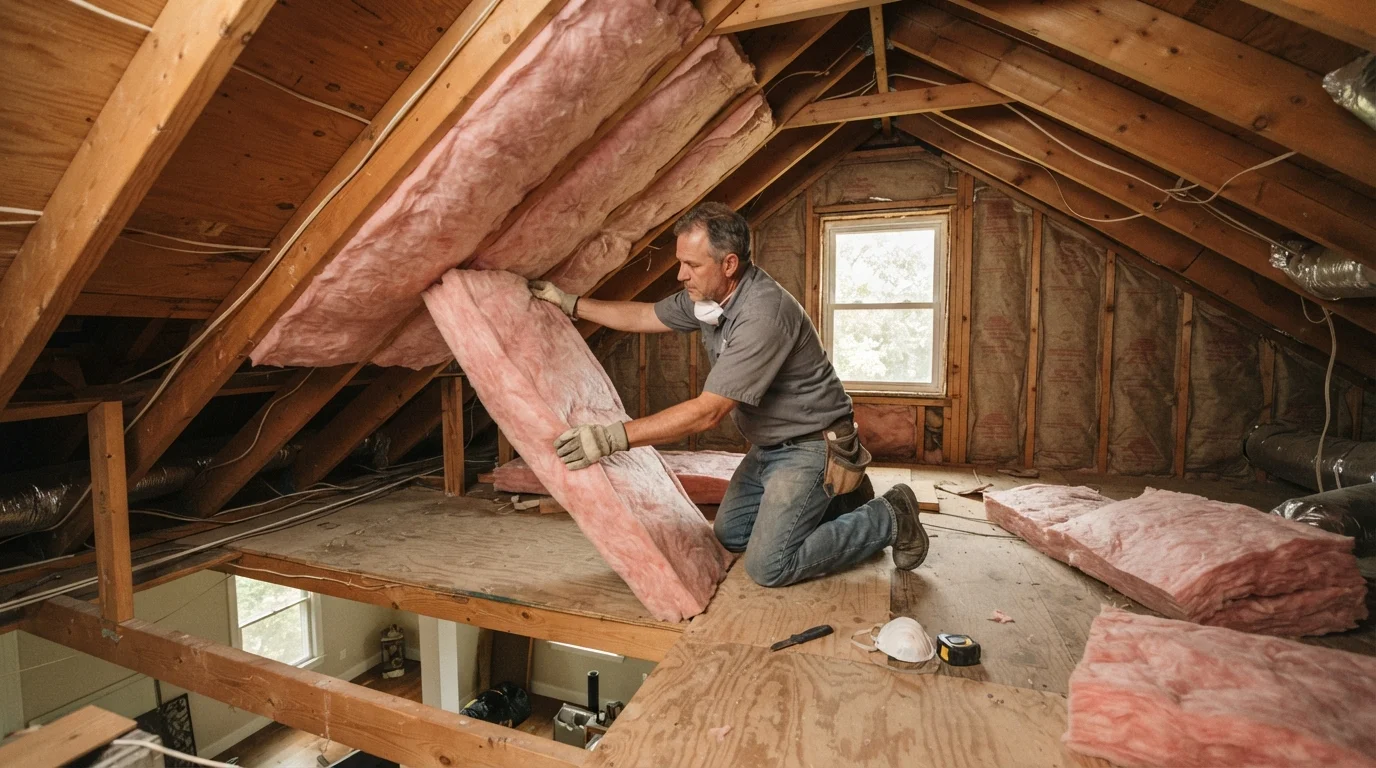
Blown-in cellulose or fibreglass can often be added over existing insulation, making attic upgrades one of the more straightforward professional installations. Air-sealing the attic floor before blowing in additional material is essential — insulation slows heat transfer but doesn't stop airflow on its own. For a quick comparison of insulation types and where each is typically used, see our insulation types overview.
Blown-in insulation added over existing material is one of the most cost-effective attic upgrades available.
Wall Insulation
Exterior walls are a significant source of heat loss, particularly in homes built before insulation standards became standard practice. In wood-framed homes with hollow stud cavities, blown-in insulation can be installed by drilling small holes in the exterior or interior wall surface, injecting material, and patching — a much less disruptive process than opening walls entirely.
Homes with masonry or solid wall construction present a more involved challenge: interior or exterior rigid insulation board is typically required, each with trade-offs around interior space loss or exterior appearance. Consult a licensed insulation contractor to assess which approach suits your wall assembly, and check whether local building codes require vapour control layers as part of the assembly.
Blown-in cavity wall insulation can be installed with minimal disruption to finished interior surfaces.
Window Upgrades and Secondary Glazing
Single-pane windows are a significant thermal weak point. Full window replacement with double- or triple-pane units improves both insulation and condensation control, but it carries a higher upfront cost and typically requires professional installation. As a more accessible alternative, secondary glazing — a second pane installed on the interior side of an existing window — can meaningfully reduce heat loss and noise without the cost or disruption of full replacement.
DIY secondary glazing kits using acrylic or polycarbonate panels are available for straightforward installations, though custom-fitted systems offer better long-term performance. Regardless of approach, ensure window frames are in good repair and any gaps between frame and wall are sealed before treating the glass itself.
Secondary glazing offers a lower-cost alternative to full replacement while still reducing window heat loss.
HVAC System Maintenance and Upgrades
Heating and cooling equipment that is poorly maintained or past its service life uses significantly more energy to achieve the same output. Regular filter changes, annual professional servicing, and keeping vents and returns clear of obstruction are baseline maintenance tasks that preserve efficiency at minimal cost.
When equipment replacement becomes necessary, modern high-efficiency units — including heat pumps, which can serve both heating and cooling functions — can offer substantial efficiency gains over older systems. Federal tax credits under the Inflation Reduction Act currently cover a portion of costs for qualifying high-efficiency HVAC equipment; consult a licensed HVAC contractor and a tax professional to confirm eligibility for your specific situation, as rules and limits can change.
Annual professional HVAC servicing preserves efficiency and can catch problems before they become costly failures.
Water Heater Efficiency Improvements
Water heating typically accounts for a meaningful share of a home's total energy use. If your water heater is more than ten to twelve years old, replacement with a high-efficiency model is worth considering — heat pump water heaters, in particular, can use significantly less electricity than conventional resistance models, and may also qualify for federal or utility incentives.
For homeowners not yet ready to replace, pipe insulation on hot-water supply lines reduces standby heat loss, and lowering the tank thermostat to 120°F (where it's safe to do so and hot enough to inhibit bacterial growth) reduces the energy required to maintain stored water temperature. Always confirm safe operating temperatures with the unit's documentation or a licensed plumber.
Heat pump water heaters use substantially less electricity than conventional resistance tank models.
Making the Most of Your Energy Upgrades
These projects work best as a coordinated strategy rather than isolated fixes. Sealing air leaks before upgrading insulation, for example, ensures the insulation performs as intended. Similarly, improving the building envelope first — walls, roof, windows — reduces the load on your heating and cooling systems, which can allow you to right-size equipment when replacements are due.
Prioritise the Envelope Before Equipment
Improving your home's thermal envelope — insulation, air sealing, and windows — before replacing heating or cooling equipment is generally the more efficient sequence. A tighter, better-insulated home may allow you to install smaller, less expensive HVAC equipment when the time comes. Doing it in reverse risks oversizing new equipment for a home that will soon have lower heating and cooling loads.
For technology-driven savings, pairing insulation improvements with a programmable or smart thermostat can amplify results. Our companion piece on smart thermostat trade-offs walks through what these devices do well and where they fall short — useful reading before you invest.
If your renovation scope extends to larger structural changes, such as adding a garden room or extension, insulation and energy performance become even more critical design considerations early on. See our guide on adding a garden room or outbuilding for factors that affect whether such additions can be made energy-efficient from the start.
This article is for general informational purposes only. Always verify local building codes, permit requirements, and applicable regulations with the relevant authorities before beginning renovation work. For electrical, gas, structural, or HVAC work, engage a licensed professional.