

Key Takeaways
Our Verdict
No single insulation type wins across every scenario. The right choice depends on where you are insulating, your home's existing construction, your budget, and whether DIY installation is feasible. Most homes benefit from a combination of materials used strategically across different areas.
| Best for | Recommended |
|---|---|
| Unfinished walls, floors, and attic rafters in new construction | Fiberglass or mineral wool batts |
| Air sealing around irregular gaps, rim joists, and crawl spaces | Spray foam |
| Existing attics, finished walls, or hard-to-access cavities | Blown-in (loose-fill) |
| Basement walls, under slabs, and exterior continuous insulation | Rigid foam board |
Why Insulation Type Matters
Insulation is one of the highest-impact upgrades a homeowner can make — but walking into a home improvement store without a clear sense of which product fits your project can lead to wasted materials and underperforming results. The four main types — batts, spray foam, blown-in (loose-fill), and rigid board — differ in how they're installed, where they work best, and how well they resist heat transfer.
A key metric across all types is R-value, which measures thermal resistance per inch of thickness. The higher the R-value, the more effective the material is at slowing heat movement. Local building codes specify minimum R-values by climate zone and application, so always verify requirements with your local building department before starting a project. For a broader look at energy-saving upgrades, see renovation projects that improve energy efficiency.
Comparing the Four Main Insulation Types
The table below summarizes each type across the criteria that matter most for a typical home project.
| Batts | Spray Foam | Blown-In | Rigid Board | |
|---|---|---|---|---|
| Typical R-value per inch | R-3 to R-4 | R-3.5 to R-7 | R-2.5 to R-3.8 | R-3.8 to R-6.5 |
| Best locations | Open wall cavities, attic bays | Rim joists, gaps, crawl spaces | Attic floors, existing walls | Basements, exterior walls, slabs |
| DIY-friendly | Yes, widely manageable | Small gaps only; large jobs need pros | Moderate with machine rental | Yes, panels easy to cut and fit |
| Acts as air barrier | No | Yes (closed-cell) | No | Partially, with taped seams |
| Handles irregular spaces | Poor — gaps around obstacles | Excellent — expands to fill | Good — flows around obstructions | Poor — flat surfaces only |
| Relative material cost | Low to moderate | High | Low to moderate | Moderate to high |
Each type has meaningful trade-offs beyond what a table can capture — the sections below unpack those details.
Batts: The Familiar Starting Point
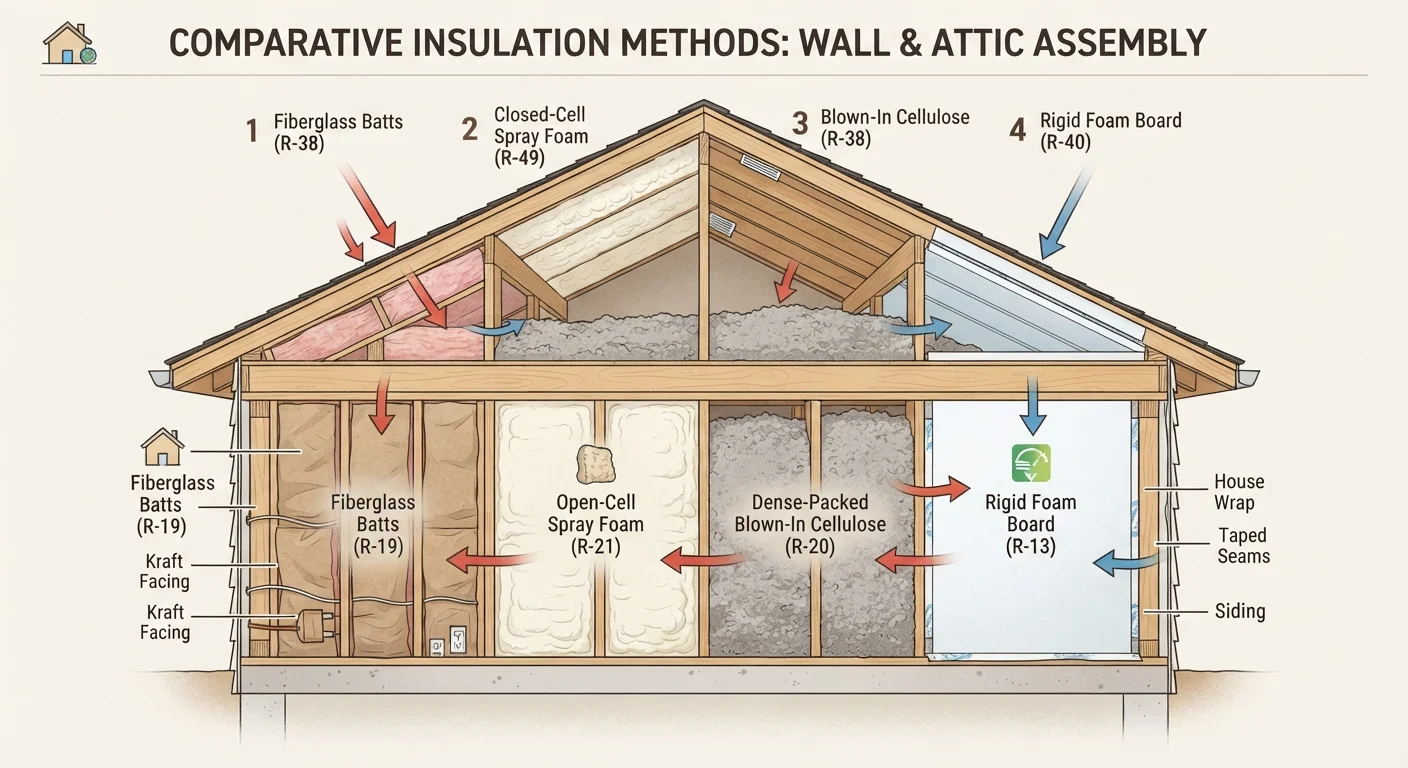
Fiberglass batts (and their mineral wool counterpart) are pre-cut panels sized to fit standard stud and joist spacing. They're the most widely recognized insulation format and are straightforward to install in open, unfinished wall cavities, floors, and attic bays — making them a common DIY choice.
The trade-off is fit. Batts must be cut cleanly around obstacles like pipes and electrical boxes. Gaps, compression, or improper vapor barrier placement significantly reduce real-world performance even if the product's rated R-value looks good on paper. Mineral wool batts carry a higher R-value per inch than fiberglass and are naturally fire- and moisture-resistant, though they cost more.
Cut Batts Accurately for Best Results
When sizing batts, measure each cavity individually rather than assuming all are the same width — framing irregularities are common in older homes. A straightedge and sharp utility knife produce cleaner cuts than scissors. Batts should fit snugly without being compressed, since squeezing the material reduces its effective R-value.
Spray Foam: The Air-Sealing Option
Spray polyurethane foam (SPF) expands after application, filling irregular cavities, cracks, and penetrations that other insulation types cannot reach. Closed-cell spray foam offers the highest R-value per inch of any common insulation (approximately R-6 to R-7 per inch) and doubles as a vapor and air barrier. Open-cell spray foam is lighter and less expensive but has a lower R-value and is permeable to moisture.
Spray foam is particularly effective at rim joists, around window rough openings, and in crawl spaces. However, professional installation is strongly recommended for large applications — improperly mixed or applied foam can off-gas harmful chemicals during curing and may not adhere correctly. Small canned spray foam for gap-filling around outlets or plumbing penetrations is a manageable DIY task.
Professional Installation Advised for Large Foam Jobs
Two-component spray foam kits generate heat during the curing reaction and release isocyanates — chemicals that can irritate the respiratory system. Always wear appropriate PPE including eye protection and an appropriate respirator when working with spray foam products. For whole-wall or crawl-space applications, engaging a licensed spray foam contractor is strongly recommended to ensure proper mixing ratios, adhesion, and safe curing.
Blown-In Insulation: Covering Existing Spaces
Loose-fill insulation — typically made from cellulose (recycled paper fiber) or fiberglass — is blown into place using a specialized machine. This makes it ideal for attic floors, where it can be distributed quickly over a large area, and for existing finished walls, where small holes are drilled and later patched to introduce insulation without full demolition.
Cellulose has a higher recycled content and can conform tightly around obstructions, reducing air gaps. Machine rental is available at many home centers, but achieving consistent depth across an attic floor or successfully retrofitting wall cavities typically benefits from at least one experienced helper. Depth gauges (small cardboard markers) help ensure target R-values are met uniformly.
R-2.5 to R-3.8
Blown-in cellulose R-value per inch
Cellulose loose-fill typically achieves this range, with performance dependent on settled depth and application density.
~20–30%
Estimated heat loss through uninsulated walls
The U.S. Department of Energy estimates that walls and ceilings account for a significant share of a home's heating and cooling losses when under-insulated.
Rigid Foam Board: Continuous Insulation Without Gaps
Rigid foam panels — available in expanded polystyrene (EPS), extruded polystyrene (XPS), and polyisocyanurate — are installed in flat, continuous layers. Unlike batt insulation, rigid board spans across studs, eliminating thermal bridging (heat loss through the framing itself). This makes it especially valuable on basement walls, under concrete slabs, and as exterior continuous insulation on walls.
Rigid foam must be covered with a fire-rated material (such as drywall) when used in interior living spaces — most building codes require this. XPS and polyisocyanurate offer higher R-values per inch than EPS but cost more. Cutting rigid board is straightforward with a utility knife and straightedge, and panels can be stacked or combined with other insulation types to hit target R-values.
When planning any insulation project, always check whether your jurisdiction requires a building permit, particularly for spray foam applications or work involving vapor retarders. Consulting a licensed insulation contractor for a whole-home assessment is a sound investment before committing to materials.