

Key Takeaways
Option A
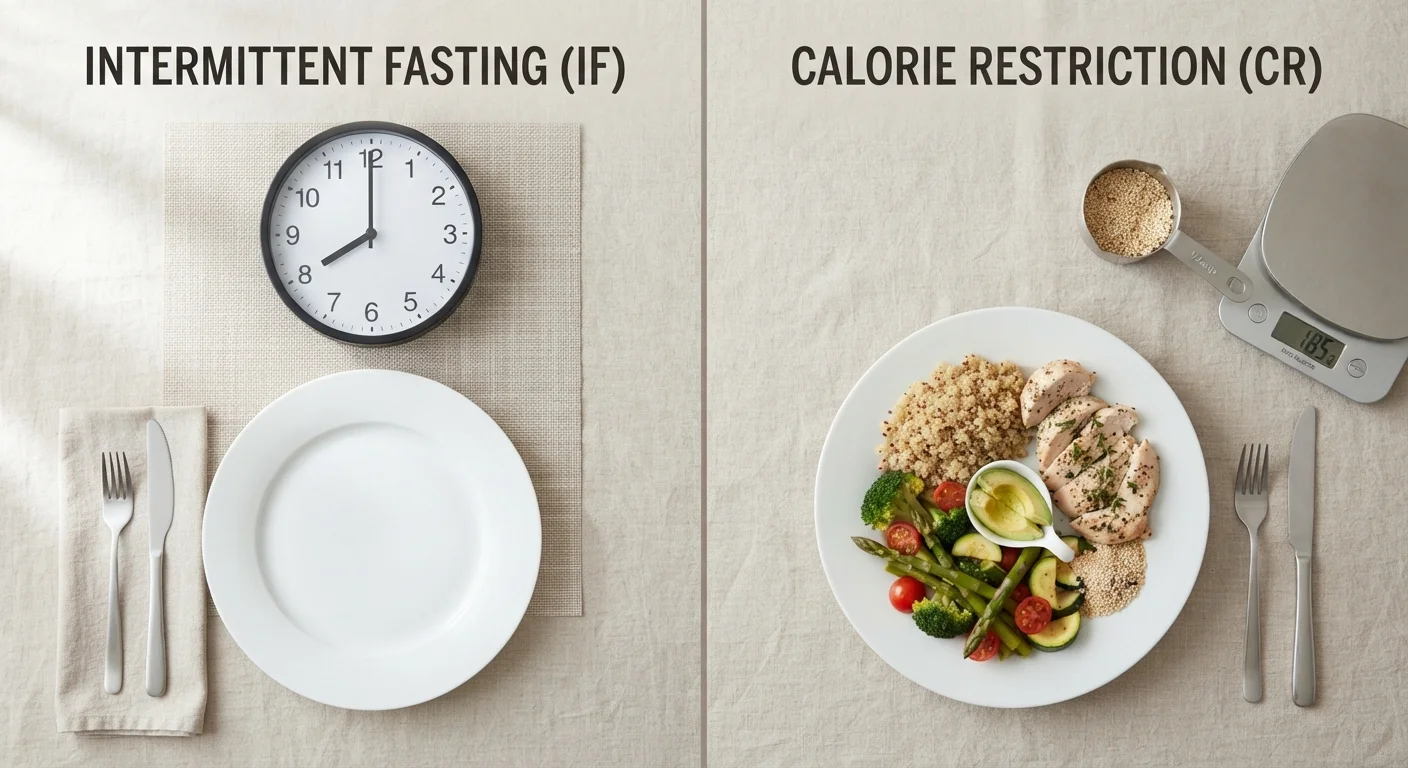
Intermittent Fasting (IF)
The time-structured approach to eating.
Best for: People who prefer flexibility in food choices and find meal timing easier to manage than portion tracking.
Option B
Calorie Restriction (CR)
The established, evidence-backed dietary benchmark.
Best for: People who benefit from consistent daily structure and have the tools or support to monitor food intake reliably.
If you find calorie counting stressful or hard to sustain
Intermittent Fasting (IF)
IF imposes structure through time windows rather than arithmetic, which some people find psychologically easier to maintain long-term.
If you prefer a consistent daily eating pattern with clear nutritional targets
Calorie Restriction (CR)
CR offers a predictable, well-researched framework that integrates straightforwardly with nutrition tracking tools and dietary guidance.
If you have a history of disordered eating or a chronic health condition
Neither — consult a healthcare professional first
Both approaches involve deliberate food limitation and require personalised evaluation from a qualified clinician or registered dietitian.
If metabolic health markers like blood sugar or insulin sensitivity are a priority
Intermittent Fasting (IF)
Some research suggests IF may offer modest improvements to insulin sensitivity, though evidence remains mixed and individual responses vary.
Defining the Two Approaches
Intermittent fasting (IF) and calorie restriction (CR) are two of the most discussed dietary strategies in nutrition research. Understanding what each actually involves — and what the science does and doesn't confirm — helps readers make informed decisions rather than following trends.
Calorie restriction means consistently consuming fewer calories than the body expends, typically spread across regular daily meals. It has been studied for decades and serves as the standard comparison point in most diet research. The focus is on how much you eat over a given day or week.
Intermittent fasting refers to structured patterns of eating and not eating — most commonly the 16:8 method (eating within an 8-hour window, fasting for 16) or the 5:2 protocol (eating normally five days per week, and significantly reducing intake on two non-consecutive days). The emphasis is on when you eat, rather than necessarily counting every calorie.
For more on how dietary patterns interact with broader health outcomes, see our look at what the evidence says about plant-based eating.
What the Research Actually Shows
A key finding across multiple clinical trials is that when total calorie intake is matched, intermittent fasting and continuous calorie restriction tend to produce similar outcomes for weight loss and many metabolic markers. A widely cited 2017 study published in JAMA Internal Medicine found no significant advantage for IF over CR when adherence and caloric intake were controlled.
~Equal
Weight loss outcomes vs. calorie restriction
Multiple controlled trials, including a 2017 JAMA Internal Medicine study, found comparable weight loss when total calories were matched between IF and CR groups.
16:8
Most commonly studied IF protocol
The 16-hour fast / 8-hour eating window is the most widely researched intermittent fasting format in clinical nutrition literature.
~12%
Calorie reduction in the CALERIE trial
The CALERIE trial tested approximately 12% calorie restriction over two years and observed meaningful improvements in cardiometabolic risk factors in healthy adults.
That said, IF research has shown some potentially distinct effects. Fasting periods trigger changes in insulin levels and may stimulate cellular processes like autophagy (the body's internal recycling mechanism), though the clinical significance of these effects in humans is still being actively studied. Researchers caution against overstating these findings as confirmed health benefits.
Calorie restriction's evidence base is considerably deeper. Long-term studies — including research from the CALERIE (Comprehensive Assessment of Long-term Effects of Reducing Intake of Energy) trial — suggest that sustained, moderate CR can improve cardiovascular risk factors, reduce inflammation markers, and support metabolic health without severe side effects when done carefully.
It's also worth noting that severe caloric cuts — well beyond moderate CR — tend to backfire physiologically. Our article on why crash diets tend to backfire explains the metabolic mechanisms in detail.
Practical Differences and Who Each Suits
Beyond the research numbers, everyday usability matters enormously. Adherence — sticking with a dietary approach over time — is one of the strongest predictors of real-world outcomes, regardless of which approach has a theoretical edge.
| Criterion | Intermittent Fasting | Calorie Restriction |
|---|---|---|
| Core mechanism | Restricts eating window (time-based) | Limits daily calorie intake (quantity-based) |
| Ease of tracking | No calorie counting required | Requires consistent calorie monitoring |
| Flexibility in food choice | Generally unrestricted during eating window | Any food allowed within calorie budget |
| Volume of research | Growing but more limited | Extensive, decades of clinical data |
| Social eating compatibility | Can be challenging around fixed windows | More flexible across meal times |
| Potential metabolic effects | Some evidence of insulin sensitivity benefits | Well-documented cardiovascular and metabolic improvements |
Intermittent fasting appeals to people who find meal-timing rules easier to follow than tracking food quantities. However, it can be challenging for those with variable schedules, social eating obligations, or early-morning exercise routines that require fuelling.
Calorie restriction works well for those who prefer consistency and have access to nutrition information — whether through labels, apps, or dietitian support. Its main challenge is sustainability: research consistently shows that people tend to underestimate calorie intake, and the approach can feel tedious over time.
Neither approach is inherently superior for every person, and both require thoughtful implementation. This is particularly important for specific populations — including older adults, adolescents, and those managing chronic illness — who should seek guidance from a qualified healthcare provider or registered dietitian before making significant changes to eating patterns.
This article is for general informational and educational purposes only and is not a substitute for personalised medical or nutritional advice. Always consult a qualified healthcare professional before making significant changes to your diet.