

Key Takeaways
Why Bodyweight Training Is a Sound Starting Point
Bodyweight exercise — movement that uses your own body as resistance — has a strong track record for building foundational strength, improving cardiovascular health, and supporting flexibility. It requires no membership, no commute, and minimal space. For readers who feel intimidated by gym environments or are simply looking for convenience, it is a genuinely effective entry point into regular physical activity.
If you want a broader understanding of how fitness works before diving in, the complete guide to fitness fundamentals covers the core principles of exercise, habit formation, and recovery in accessible terms. For those considering whether a gym is even necessary, alternatives to gym-based exercise outlines a wide range of options worth knowing.
Before starting, review
What you will need
Exercise mat or folded blanket
Provides cushioning for floor-based exercises such as planks, push-ups, and stretches.
Timer or smartphone
Used to track work intervals, rest periods, and total session duration.
Water bottle
Keeps you adequately hydrated throughout your workout session.
Consult a Professional Before Starting
This article provides general fitness information, not personalised medical advice. If you have any existing health conditions, injuries, or have been inactive for an extended period, speak with a qualified healthcare provider before beginning a new exercise routine. This is especially important for older adults, those managing chronic conditions, and individuals who are pregnant.
How to Structure Your Home Workout Routine
A well-designed session follows a reliable three-part structure: a warm-up, a main working block, and a cool-down. Skipping any stage — especially the warm-up and cool-down — increases injury risk and slows recovery. The steps below walk you through each phase in sequence.
Warm up for five to eight minutes
A warm-up gradually raises your heart rate, increases blood flow to muscles, and reduces injury risk. Move through marching in place, arm circles, hip circles, and leg swings for roughly 30 seconds each, repeating the sequence until you feel lightly warm. Avoid static stretching before exercise — save that for the cool-down.
Select a balanced set of movement patterns
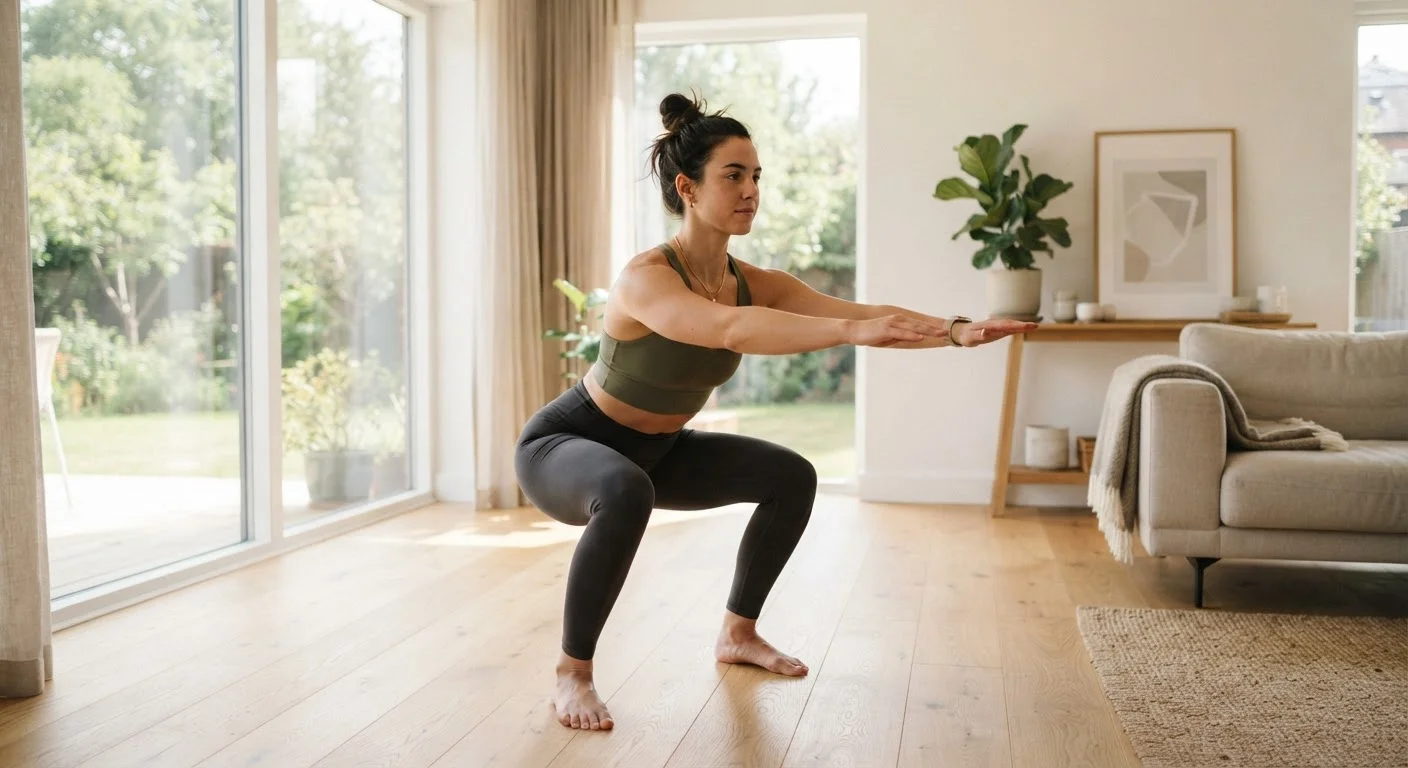
Effective bodyweight routines cover four fundamental movement patterns: pushing (e.g., push-ups), squatting (e.g., bodyweight squats), hinging (e.g., glute bridges), and core bracing (e.g., planks). Choosing one or two exercises per category gives you a well-rounded session that works the whole body without overlap or neglect.
- Push: push-ups, incline push-ups against a wall
- Squat: bodyweight squats, sit-to-stand from a chair
- Hinge: glute bridges, single-leg deadlift (unweighted)
- Core: plank holds, dead bugs, bird dogs
Set realistic sets, reps, and rest periods
For beginners, 2–3 sets of 8–12 repetitions per exercise with 60–90 seconds of rest between sets is a practical starting point. Time-based formats (e.g., 30 seconds of work, 30 seconds of rest) also work well if counting reps feels confusing. Choose an approach that lets you maintain good form throughout — if technique breaks down, stop the set early.
Cool down and stretch for five minutes
After the main workout, gradually lower your heart rate with slow walking in place, then move into static stretches held for 20–30 seconds each. Focus on the muscle groups you worked: hip flexors, hamstrings, chest, and shoulders are common targets after a full-body session. Controlled breathing during the cool-down supports recovery.
Schedule rest and plan progressive overload
Rest days — typically one or two between sessions — allow muscles to repair and adapt. Aim for three sessions per week as a sustainable starting rhythm. Once a routine feels manageable for two consecutive weeks, introduce progressive overload gradually: add one more repetition per set, an extra set, or reduce rest time slightly. This principle of gradual challenge is what drives long-term improvement.
Track Your Workouts Simply
A basic notebook or a free notes app on your phone is enough to log your sessions. Recording which exercises you did, how many repetitions, and how you felt helps you spot progress and stay motivated. You don't need a specialised app to benefit from tracking.
Pain Is Not Progress
Some muscle fatigue during and after exercise is normal, but sharp, stabbing, or joint pain is not. If you experience sudden chest pain, dizziness, or difficulty breathing during a workout, stop immediately and seek medical attention. Never push through pain that feels unusual or severe.
Once your routine is established, fitting exercise into a busy schedule offers practical strategies for staying consistent even when life gets demanding. If you find motivation fading after a few weeks, understanding why routines stall can help you identify and address the cause before the habit breaks entirely.
This article is for general informational and educational purposes only and does not constitute medical advice. Always consult a qualified healthcare professional before beginning any new exercise programme, particularly if you have existing health conditions or concerns.