

Key Takeaways
Why Fearful and Rescue Animals Need a Different Approach
Animals that have experienced neglect, trauma, or inconsistent handling carry those experiences into every new environment they enter. Their nervous systems have often been shaped by unpredictability, meaning even gentle, well-intentioned interactions can trigger a stress response. Understanding this distinction is the starting point for building genuine trust.
Early life experiences have a disproportionate influence on how animals relate to people and their surroundings. A dog or cat that missed positive exposure during its sensitive developmental window may never respond to the world quite as readily as one that had stable early care — but meaningful progress is still possible at any age with the right approach.
The goal is not to rush the animal toward comfort, but to create conditions where comfort becomes possible. That distinction shapes every practice listed below.
~30%
Rescue dogs showing fear-related behavior
Studies on shelter dog populations consistently find that around a quarter to a third of dogs exhibit fear or anxiety-related behaviors upon adoption, according to welfare research published in peer-reviewed veterinary journals.
4–8 weeks
Typical initial adjustment window for rescue pets
Veterinary behaviorists commonly note that fearful rescue animals may take four to eight weeks before showing consistent signs of relaxation in a new home, though individual variation is significant.
Core Practices for Building Trust Gradually
The following evidence-informed practices are grounded in animal behavior science and widely recommended by veterinary and welfare professionals. They apply broadly to dogs, cats, and many other domestic species, though individual animals will always vary.
Let the animal set the pace of every interaction
Forcing contact — even affectionate contact — activates the threat response in a fearful animal and confirms that humans are unpredictable. Allowing the animal to approach, sniff, or retreat at will signals that it has agency, which is a prerequisite for relaxation.
Create and protect a dedicated safe space
Fearful animals regulate stress more effectively when they have a retreat they know will never be entered or disturbed. This space functions as a physiological anchor — a place the nervous system associates with reliable safety.
Use counter-conditioning with high-value food rewards
Counter-conditioning gradually changes the emotional association an animal has with a feared stimulus by pairing it with something positive. Food is a powerful tool because eating requires a degree of physiological calm — an animal that is acutely panicked will not eat.
Keep a predictable daily routine
Predictability lowers baseline anxiety because the animal's brain can anticipate what comes next rather than remaining in a constant state of alert. Consistent feeding times, walk times, and quiet periods are particularly stabilizing.
Avoid flooding — do not expose the animal to its fear all at once
Flooding (prolonged, inescapable exposure to a feared stimulus) can worsen fear responses and damage trust, even though it may superficially appear to work short term. Gradual, controlled exposure — desensitization — is safer and more durable.
Celebrate small progress and reset expectations
Recovery from fear is rarely linear. Expecting steady forward progress leads owners to interpret normal setbacks as failure, which can prompt frustrated reactions that set the animal back further. Recognizing incremental gains keeps the process sustainable.
Recognizing and Responding to Stress Signals
Trust-building fails when owners miss the early signs that an animal is overwhelmed. Stress signals are often subtle — a dog may yawn, look away, or lick its lips; a cat may flatten its ears or flick its tail slowly. These are communication, not random behavior.
Learning to read early stress signals allows you to pause and give the animal space before anxiety escalates. Continuing to approach an animal that is signaling discomfort — even with kind intentions — erodes trust rather than building it.
The 'Three-Second Rule' for Greetings
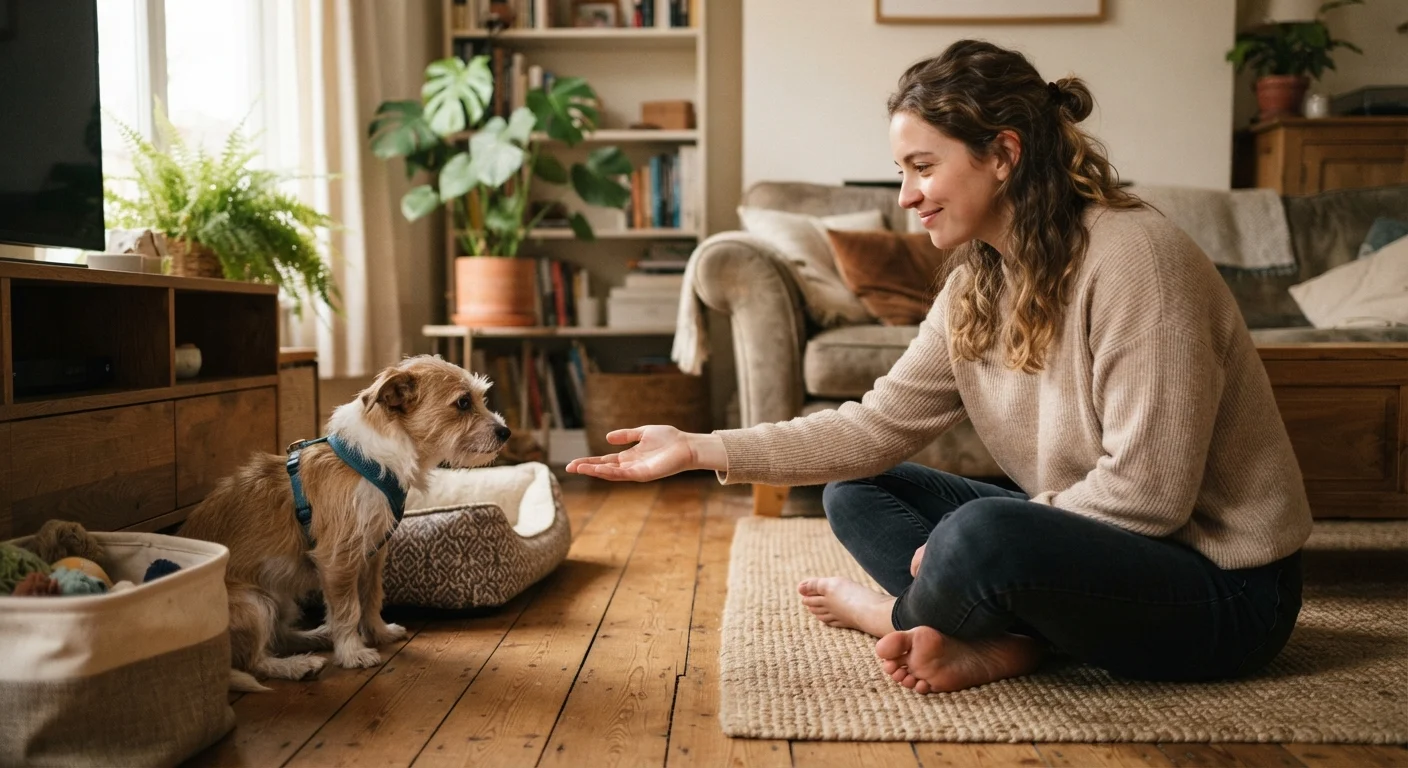
When greeting a fearful animal, offer your hand at their level for no more than three seconds, then withdraw it. If the animal leans in or follows, continue. If they back away, end the interaction there. This micro-interaction pattern respects the animal's pace and avoids overwhelming them with sustained pressure.
When you notice stress signals, the most effective response is usually to stop what you're doing, reduce pressure (turn sideways, avoid eye contact, move away), and let the animal regulate itself. Waiting for the animal to re-engage on its own terms is not passivity — it is the practice.
Quick Wins to Start Today
While long-term trust takes weeks or months to develop, a few immediate changes to your environment and routine can meaningfully reduce a fearful animal's baseline stress from day one. Use these alongside the first-week settling-in framework for the most consistent results.
“The goal is not to eliminate fear, but to build enough of a relationship that the animal feels safe enough to learn. That safety comes from the animal's experience of you — not your intentions.”
— Karen Overall, Veterinary behaviorist and author of clinical animal behavior textbooks
If your animal displays defensive aggression — snapping, lunging, or freezing when cornered — seek guidance from a certified applied animal behaviorist or a veterinary behaviorist. Not all aggression is the same, and identifying the type matters for choosing the right intervention.
This article is for general informational purposes only and is not a substitute for professional veterinary or behavioral guidance. If your animal's fear responses are severe, consult a qualified professional.