

Key Takeaways
Why Your Bank Statement Is Worth Reading Carefully
Most people glance at their account balance through a banking app and move on. But the full monthly statement — whether paper or PDF — contains a level of detail that a balance figure simply cannot provide. It is a complete record of every dollar that entered and left your account during a specific period, organized in a standard format that, once understood, takes only minutes to review.
Regular statement review supports two habits that matter most in personal finance: catching problems early and understanding your actual spending. Unauthorized charges, billing errors, and forgotten subscriptions all show up here. So does the pattern of where your money goes — information that no amount of vague intention can replace.
If you are working on budgeting basics, your bank statement is the most accurate starting point you have. It reflects reality, not estimates.
What you will need
How to Work Through Your Statement Step by Step
The sections below walk you through a reliable reading process. You do not need financial training — just your statement, a few minutes, and a willingness to look at the numbers directly.
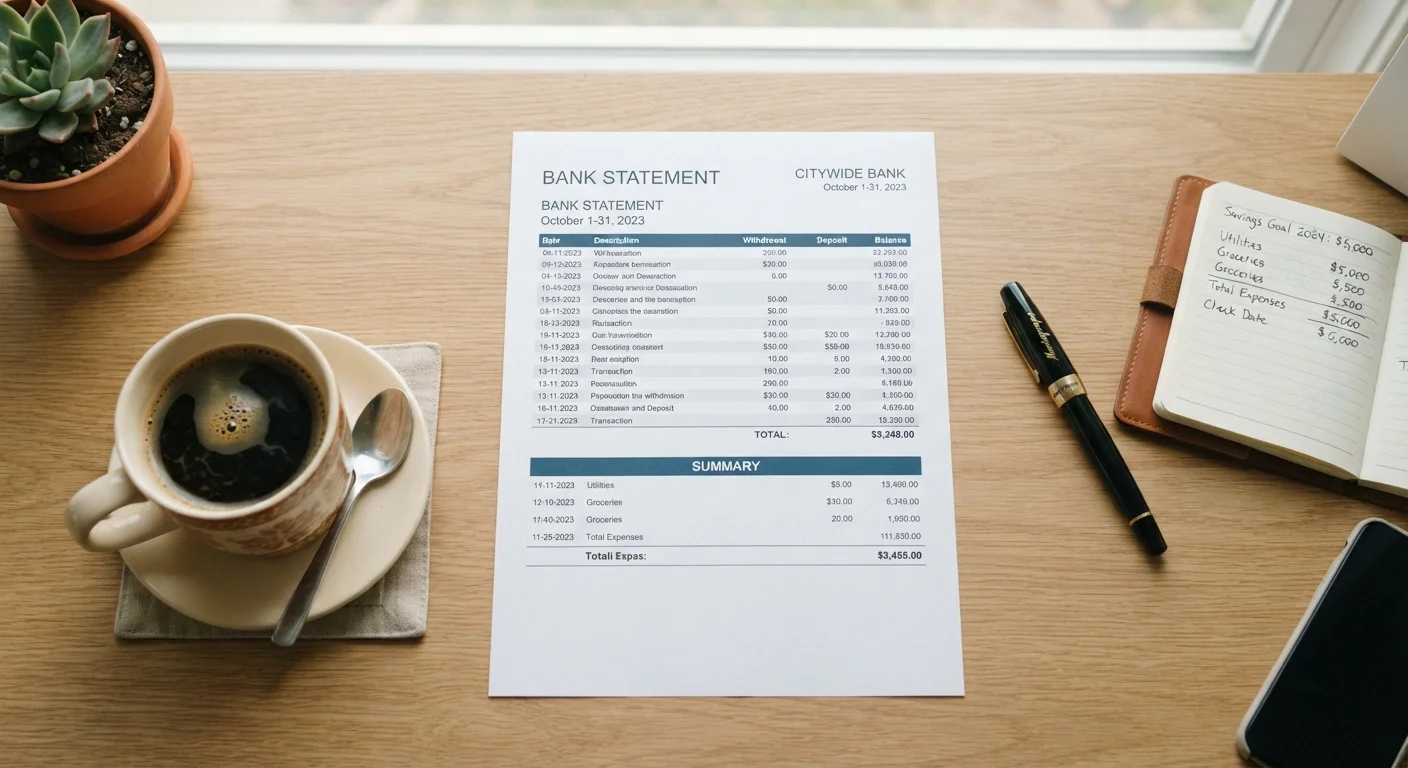
Bank Statement (PDF or Paper)
The primary document you will read and analyze during this process.
Highlighter or Annotation Tool
Mark unfamiliar charges, fees, or transactions you need to investigate further.
Spreadsheet or Budgeting Notebook
Record spending totals by category for use in your monthly budget review.
Locate Your Statement and Verify the Basics
Find your most recent statement — either through your bank's online portal, email, or a paper copy. Before diving into transactions, confirm three things: your name and account number are correct, the statement period (the date range it covers) matches what you expect, and the institution name is your actual bank. These checks take seconds and catch identity or mailing errors early.
Read the Opening and Closing Balances
Near the top of every statement, you will find an opening balance (what was in your account at the start of the period) and a closing balance (what remained at the end). Subtract the opening balance from the closing balance. A positive result means money came in faster than it left. A negative result means the opposite — worth understanding why before next month.
Review All Deposits
Deposits include your paycheck, any transfers in, tax refunds, or other credits. Verify that every expected deposit arrived and that the amounts match what you were paid or transferred. Look for the date posted versus the transaction date — some deposits take one to two business days to clear, which can affect whether a payment posts on time.
Go Through Every Withdrawal and Debit
This is where most of the useful — and sometimes surprising — information lives. Work through each debit, ATM withdrawal, and point-of-sale charge. Ask yourself: Do I recognize this merchant? Does the amount match my receipt or expectation? Is this a one-time or recurring charge?
Flag anything you cannot immediately identify. Some legitimate charges appear under a parent company name rather than the brand you know (for example, a streaming service may bill under a holding company name). A quick internet search of the merchant name usually clarifies it.
Identify Any Fees and Understand What Caused Them
Banks commonly charge fees for overdrafts, falling below a minimum balance, out-of-network ATM use, paper statement delivery, or wire transfers. These appear as separate line items, usually labeled clearly. Once you know what triggered each fee, you can often adjust your behavior — or ask your bank whether any are waivable — to avoid them going forward.
Categorize Spending and Note Your Totals
Once you have verified all transactions, group your spending into broad categories: housing, groceries, transport, subscriptions, dining, personal care, and so on. Add up each category. These totals become the raw material for your monthly budget review. Knowing where the money actually went — not where you assumed it went — is the foundation of any effective spending plan.
See our monthly budget review guide for a structured checklist that puts these totals to work.
Dispute Errors Promptly
Most financial institutions have a limited window — often 60 days from the statement date — for disputing unauthorized transactions or errors. If you spot something suspicious, contact your bank immediately using the number on the back of your card or on the statement itself. Delaying could affect your ability to recover funds.
Watch for Small Recurring Charges
Subscriptions and automatic renewals often appear as small, easy-to-overlook amounts. Over a year, several forgotten $9–$15 monthly charges can add up to hundreds of dollars. Scan your transactions specifically for unfamiliar recurring debits each statement period.
Go Digital for Easier Searching
Online and PDF statements are searchable by keyword or amount, making it faster to find a specific transaction or merchant. Most banks store at least 12 months of statements in your online account at no charge, giving you a useful year-over-year reference.
Once you have completed a statement review, connecting your findings to a broader financial picture becomes straightforward. For context on how saving and debt interact with your monthly cash flow, the saving and debt overview covers the full interplay. And if you want to reduce the manual work of recurring payments, consider reading about automating your finances — though not every transaction benefits from automation, and your statement review will help you decide which ones do.
This article is for general informational and educational purposes only and does not constitute personalised financial advice. Consult a qualified financial professional for guidance specific to your situation.