

Key Takeaways
The 50/30/20 Rule
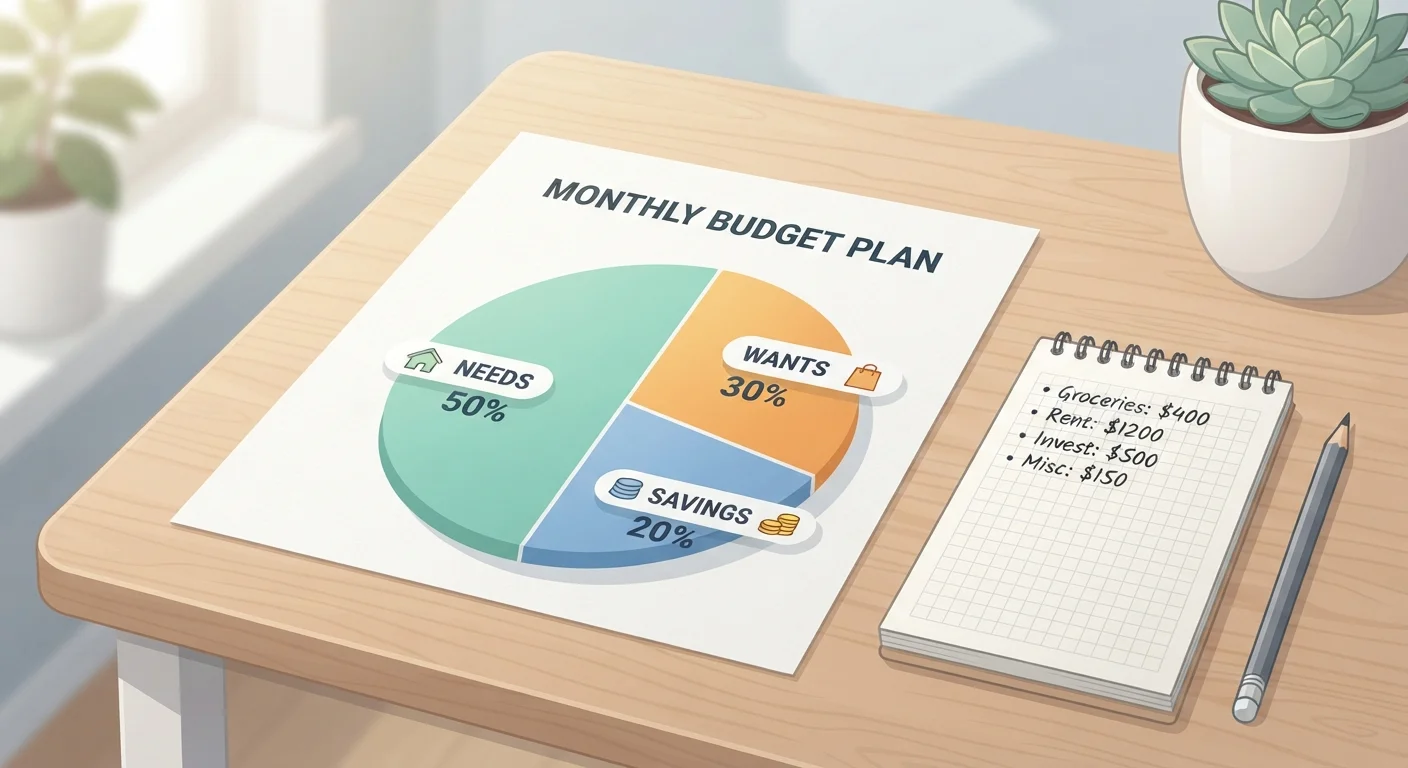
The 50/30/20 rule is a simple budgeting framework that divides your after-tax income into three categories: 50% for needs, 30% for wants, and 20% for savings or debt repayment. It gives you a straightforward percentage-based structure without requiring detailed line-item tracking. The goal is to keep spending balanced while building financial security over time.
The framework is often attributed to U.S. Senator Elizabeth Warren and her daughter Amelia Warren Tyagi, who described it in their 2005 book 'All Your Worth.' It uses after-tax (take-home) income as the baseline, not gross income.
How the Three Categories Work
The 50/30/20 rule organises every dollar of your take-home pay into one of three buckets. Understanding what belongs in each category is the foundation of using this framework effectively.
50% — Needs
Needs are essential expenses you must pay to maintain a basic, functional life. This includes rent or mortgage payments, utilities, groceries, health insurance premiums, transportation costs required for work, and the minimum required payments on any debts. If you stopped paying for it and faced serious consequences — eviction, loss of transportation, loss of coverage — it's likely a need.
30% — Wants
Wants are discretionary spending choices that improve your quality of life but aren't strictly necessary. Dining at restaurants, subscription streaming services, travel, hobbies, new clothing beyond basics, and entertainment all fall here. This category gives you breathing room to enjoy your income without guilt, as long as it stays within proportion.
20% — Savings and Debt Repayment
The final 20% is directed toward your financial future. This includes building an emergency fund, contributing to retirement accounts, and making extra payments above the minimum on debts like student loans or credit cards. For most people, financial advisers generally suggest prioritising an emergency fund before accelerating debt payoff — but consult a qualified financial professional about what order makes sense for your individual circumstances.
For broader guidance on building this financial cushion, explore our resources on saving and debt management.
Start With Your Real Take-Home Pay
Before applying any percentages, confirm your actual monthly after-tax income — not your salary or gross pay. Check your most recent pay stub for the net amount deposited. If your income varies month to month, use a conservative three-month average as your baseline.
Applying the Rule to Your Own Income
Putting the 50/30/20 rule into practice starts with one number: your monthly after-tax income. This is what remains after income taxes, Social Security, and Medicare are withheld from your paycheck.
Once you have that figure, multiply it by 0.50, 0.30, and 0.20 to find your target dollar amounts for each category. For example, if your take-home pay is $4,000 per month:
- Needs: $4,000 × 0.50 = $2,000
- Wants: $4,000 × 0.30 = $1,200
- Savings/Debt: $4,000 × 0.20 = $800
Next, review your last two or three months of bank and credit card statements and categorise your actual spending. Compare those totals to your targets. Most people find at least one category is out of alignment — and that gap is where the work begins.
Tracking doesn't need to be complicated. A simple spreadsheet or a notebook works. What matters is consistency: checking your spending against your targets at least once a month. Our monthly budget review guide walks through exactly what to look for at month's end.
When the 50/30/20 Rule Needs Adjusting
The 50/30/20 rule is a starting point, not a one-size-fits-all prescription. Several real-world circumstances make the standard percentages difficult or unsuitable to follow as written.
High Cost of Living
In cities where housing costs are high, rent alone may consume 40% or more of take-home pay before any other essential is factored in. Forcing the 50% cap in this situation isn't realistic. Instead, consider adjusting to a 60/20/20 or 65/15/20 split while working toward longer-term changes — building income, reducing housing costs, or relocating.
Low or Irregular Income
When income is limited, even needs may be hard to cover within 50%. If you're managing a very tight budget, the percentage framework may be less useful than a priority-based approach. Our article on budgeting when living paycheck to paycheck offers a more grounded starting point for those situations.
Aggressive Debt or Savings Goals
If you're working to pay down high-interest debt quickly or saving for a major near-term goal, you may choose to temporarily redirect part of the 30% wants category into the 20% savings bucket. That's a deliberate trade-off, not a failure of the system.
The framework's real value is in giving you clear proportions to evaluate your spending against — not in demanding rigid adherence. To see how it stacks up against other approaches, see our overview of major budgeting frameworks.
This Is General Financial Education
The 50/30/20 rule is a widely discussed budgeting guideline, not personalised financial advice. Your income, expenses, debts, and goals are unique to your situation. For guidance tailored to your specific circumstances, consider speaking with a licensed financial adviser or a nonprofit credit counsellor.
50%
Recommended share of income for essential needs
The 50/30/20 framework recommends allocating no more than half of after-tax income to housing, utilities, groceries, transportation, and other essentials.
20%
Target savings and debt repayment rate
The framework's savings tier — covering emergency funds, retirement contributions, and extra debt payments — aligns broadly with common personal finance guidance on building long-term financial security.
~37%
Average US household share spent on housing
According to U.S. Bureau of Labor Statistics Consumer Expenditure data, housing typically accounts for the largest single share of household spending, often making the 50% needs cap challenging to maintain.
“The secret to getting ahead is getting started. The secret to getting started is breaking your complex, overwhelming tasks into small, manageable tasks, and then starting on the first one.”
— Mark Twain, American author and humorist