

Key Takeaways
Option A
Engineered Wood Flooring
The moisture-resilient, versatile modern option.
Best for: Homeowners installing over concrete subfloors, in basements, or in humidity-variable spaces such as kitchens.
Option B
Solid Hardwood Flooring
The classic, long-lasting natural wood choice.
Best for: Above-grade living rooms, bedrooms, and formal spaces where multi-decade refinishing potential is a priority.
If you're finishing a basement or installing over a concrete slab
Engineered Wood Flooring
Its cross-ply construction resists the moisture vapor that concrete subfloors release, while solid hardwood would cup or warp under the same conditions.
If long-term refinishing and maximum lifespan are your top priorities
Solid Hardwood Flooring
A thick solid plank — typically ¾ inch — can be sanded and refinished multiple times over decades, renewing its surface well beyond what most engineered veneers allow.
If you want a wood floor in a kitchen or open-plan living area with humidity fluctuations
Engineered Wood Flooring
Engineered planks expand and contract less with seasonal humidity changes, reducing the risk of gapping or buckling in mixed-use spaces.
If you're renovating a historic home and want authentic character
Solid Hardwood Flooring
Solid hardwood matches original construction methods and can be sourced in species and profiles that closely replicate period-appropriate flooring.
How Each Floor Is Built
The most fundamental difference between these two flooring types is their internal structure — and that structure drives nearly every performance characteristic that follows.
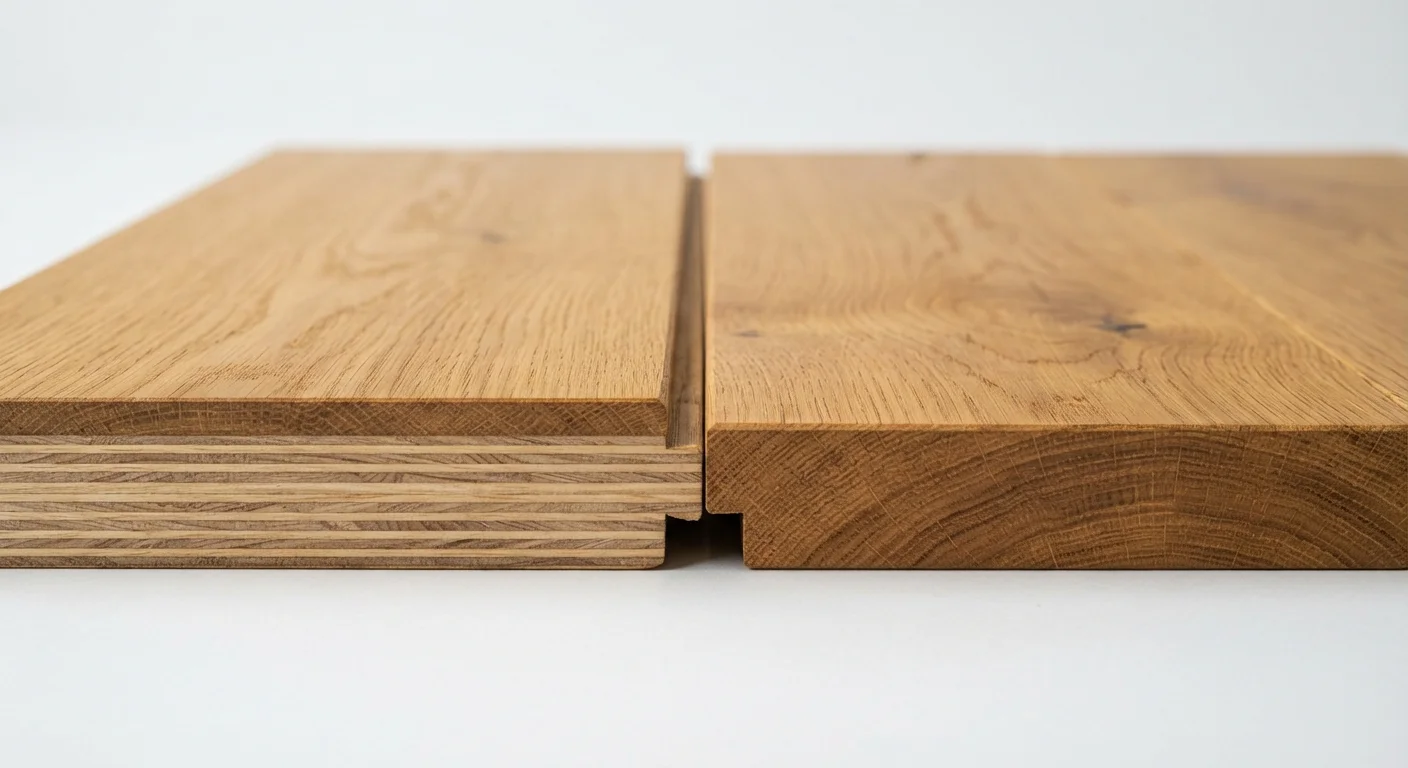
Engineered wood is a manufactured plank composed of a real hardwood veneer — typically 1/12 to 1/6 inch thick — bonded over multiple layers of cross-directional plywood or high-density fiberboard (HDF). Because those inner layers are oriented perpendicular to each other, they counteract the natural tendency of wood to expand and contract with humidity changes. The result is a plank that is dimensionally stable across a wide range of conditions.
Solid hardwood, by contrast, is milled from a single piece of wood, most commonly ¾ inch thick. Every plank is pure wood from top to bottom — no composite core, no adhesive layers. That purity is its strength and its limitation: solid wood breathes and moves with its environment more than engineered alternatives do.
| Criterion | Engineered Wood | Solid Hardwood |
|---|---|---|
| Core construction | Hardwood veneer over plywood/HDF layers | Single solid wood plank |
| Typical thickness | 3/8 – 9/16 inch | 3/4 inch (standard) |
| Moisture tolerance | Moderate — suitable on/below grade | Low — above-grade only |
| Refinishing cycles | 1–3 times (veneer-dependent) | 4–8 times over lifespan |
| Installation methods | Nail, staple, glue, or float | Nail or staple to wood subfloor |
| Dimensional stability | High — resists seasonal movement | Lower — expands and contracts with humidity |
| Expected lifespan | 25–50 years with proper care | 75–100+ years with proper care |
Moisture, Subfloor, and Installation Compatibility
Where you plan to install your flooring may be the single most important factor in this decision. Solid hardwood is generally recommended only for above-grade installations — that is, on the main or upper levels of a home — where subfloor moisture levels are relatively low and stable. Installing solid hardwood directly over a concrete slab or in a basement introduces significant risk of cupping (edges rising), crowning (center rising), or buckling as the wood absorbs ground moisture vapor.
Engineered wood, because of its layered core, is considered suitable for on-grade (ground-level) and below-grade applications, provided subfloor moisture levels fall within the manufacturer's specified range. Always test concrete subfloors for moisture vapor emission using an appropriate test kit before installation — this step applies regardless of which flooring type you select.
Always Acclimate Your Flooring First
Both engineered and solid hardwood should be acclimated in the installation room for 48–72 hours before installation. This allows planks to adjust to the room's temperature and humidity, reducing the risk of post-installation gapping or buckling. Stack planks loosely to allow airflow on all sides, and keep the room at its normal living conditions — not an extreme during a renovation.
Installation methods also differ. Solid hardwood is typically face-nailed or blind-nailed through the tongue to wood subfloors. Engineered wood offers more flexibility: it can be nailed, stapled, glued, or floated depending on the product and subfloor.
Refinishing Potential and Long-Term Durability
One of the most frequently cited advantages of solid hardwood is its refinishing depth. Because the entire plank is wood, a professional can sand away surface scratches, stains, and old finish multiple times over the floor's life — potentially four to eight times depending on plank thickness and how aggressively each refinish removes material. This means a well-maintained solid hardwood floor can last 75 to 100 years or more in the right conditions.
Engineered wood's refinishing potential depends on the veneer layer thickness. Thinner veneers (1/12 inch) may permit only one light sand-and-refinish, while thicker veneers (1/6 inch) can typically support two or three refinishing cycles. For most homeowners, this is sufficient — especially since modern factory finishes are highly durable and may not need refinishing for 15–25 years with normal care.
¾ inch
Standard solid hardwood plank thickness
This depth is what allows multiple sanding and refinishing cycles that extend a floor's usable life by decades.
1/12–1/6 in.
Typical engineered hardwood veneer thickness range
Thicker veneers support more refinishing passes; always confirm veneer depth with the manufacturer before purchasing.
25–50 yrs
Estimated engineered wood floor lifespan
Lifespan varies significantly by veneer thickness, species hardness, finish quality, and maintenance habits over time.
In terms of daily durability, the hardness of the surface species matters more than whether the floor is engineered or solid. A soft species like pine, whether solid or engineered, will dent more easily than a dense species like hickory.