

Key Takeaways
Car Depreciation Rate
Car depreciation is the reduction in a vehicle's market value over time. The depreciation rate measures how quickly that value drops — typically expressed as a percentage of the original purchase price lost over a given period. Most vehicles lose value the moment they're driven off the lot, and continue declining year over year.
Depreciation is calculated as the difference between a vehicle's purchase price and its current market value, divided by the original price. Residual value — the estimated worth at a future point — is a closely related term used in lease agreements and insurance settlements.
Why Depreciation Starts the Moment You Drive Away
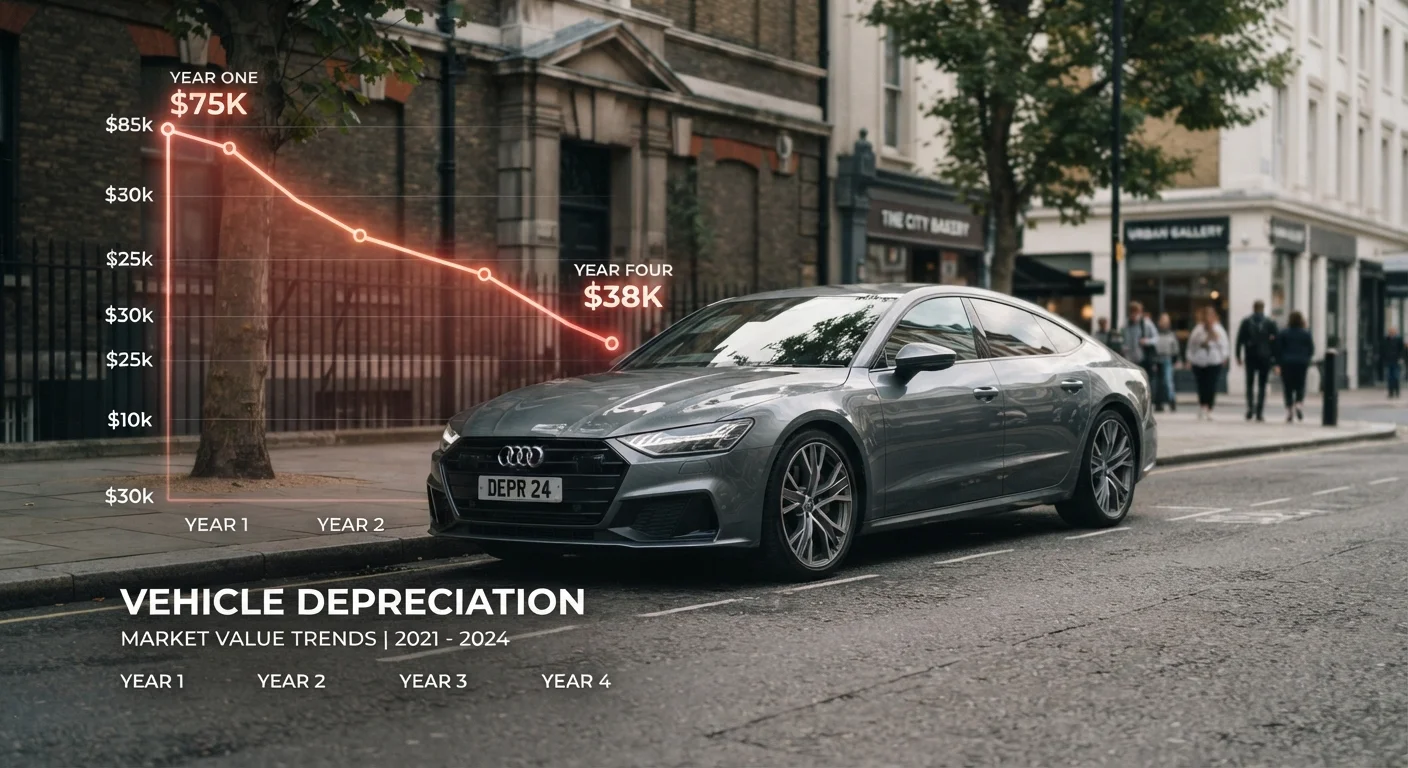
Depreciation isn't abstract — it's the single largest cost most drivers never see on a bill. Unlike a repair invoice or a fuel receipt, value loss happens quietly in the background every month you own a vehicle. Industry data consistently shows that new cars lose a significant portion of their value within the first year, with the sharpest decline occurring in the earliest months of ownership.
The reason for this front-loaded drop is largely perception. A vehicle transitions from 'new' to 'used' the moment it leaves the lot, and the used-car market prices it accordingly. After that initial plunge, depreciation continues — but at a slower, more predictable pace.
Understanding this trajectory is essential context for nearly every major financial decision tied to your vehicle. It's part of the true cost of owning a car that often catches drivers off guard.
~20%
Average first-year new car value loss
Industry estimates consistently place the first-year depreciation rate for new vehicles between 15% and 25%, depending on make, model, and market conditions.
~50%
Value lost within five years
Many vehicles lose roughly half their original value within five years of purchase, though this varies significantly by brand, category, and how well the vehicle is maintained.
~30%
Portion of total ownership cost from depreciation
Automotive financial analysts often cite depreciation as one of the largest individual components of total vehicle ownership cost, frequently exceeding fuel or insurance in the first few years.
What Actually Drives Depreciation
Not all vehicles depreciate at the same rate. Several key factors determine how quickly — or slowly — a car loses its market value:
- Mileage: Higher annual mileage accelerates value loss. Most depreciation estimates assume roughly 12,000 to 15,000 miles per year; exceeding that benchmark typically lowers resale value further.
- Condition: Cosmetic damage, interior wear, and mechanical issues reduce buyer willingness to pay. A well-maintained vehicle signals lower risk to a prospective buyer.
- Brand reliability reputation: Vehicles from manufacturers with strong long-term reliability records tend to hold their value better than those with weaker reputations.
- Fuel economy and powertrain type: As fuel prices shift and consumer demand evolves, vehicles with lower efficiency or less desirable powertrains can see faster depreciation.
- Market demand: Supply, model popularity, and even color choices influence resale prices. Mainstream colors and body styles typically command steadier demand.
Neglecting routine upkeep accelerates depreciation in two ways: it degrades the vehicle's condition and shortens its usable life. The true cost of deferred car maintenance extends well beyond the repair shop.
Preserve Value With a Clean Service Record
Keeping all maintenance receipts and following the manufacturer's recommended service intervals creates a documented history that prospective buyers and dealers recognize. A verifiable record of consistent upkeep typically supports a higher trade-in or private-sale offer. This is one of the most straightforward actions within any owner's control.
How Depreciation Affects Insurance, Loans, and Trade-Ins
Depreciation doesn't just matter when you sell — it shapes several other financial realities during ownership.
Insurance payouts: Standard collision and comprehensive policies pay the vehicle's actual cash value (ACV) at the time of a claim — not what you paid for it. If your car has depreciated substantially, a total-loss settlement may fall well short of your expectations. This is why gap coverage exists: it bridges the difference between the ACV and any remaining loan balance. Understanding this connection is worth reviewing alongside what your car insurance policy actually covers.
Auto loans and negative equity: When a vehicle depreciates faster than you're paying down a loan, you become 'underwater' — owing more than the car is worth. This creates real problems if you want to sell or trade in before the loan is paid off. Shorter loan terms and meaningful down payments reduce this risk.
Lease agreements: Leases are essentially structured around depreciation. The monthly payment covers the anticipated value drop during the lease term. Vehicles with stronger residual values — meaning they depreciate more slowly — typically produce lower monthly lease payments.
Depreciation also plays into factors that influence your auto insurance premium, particularly as older vehicles decline in ACV and coverage decisions evolve accordingly.
Using Depreciation to Make Smarter Ownership Decisions
Knowing how depreciation works gives you a practical edge at several decision points:
Buying used: A vehicle that's two to four years old has typically absorbed its steepest depreciation. You pay a lower price for a car that will continue to decline more gradually — a widely recognized value proposition, though individual outcomes vary by make, model, and market conditions.
Timing a sale: If you're planning to sell privately or trade in, doing so before major depreciation milestones — such as crossing 60,000 or 100,000 miles — can meaningfully affect your offer. Markets vary, so checking current used-car pricing tools for your specific vehicle is always worthwhile.
Holding an older vehicle: Beyond a certain point, a car has depreciated most of what it will lose. At that stage, the financial calculus often favors keeping the vehicle maintained rather than replacing it. Owning an older vehicle involves its own trade-offs, but depreciation pressure is considerably lower.
Depreciation is not a problem to solve — it's a reality to account for. Drivers who factor it into their ownership decisions consistently make more informed choices about when to buy, sell, insure, and maintain their vehicles.
“Depreciation is the cost of using something that wears out — and for most car owners, it's the expense that quietly dominates every year of ownership without appearing on a single bill.”
— Autos & Driving Editorial Team, Vehicle Ownership & Finance Desk